 Economy


Việt Nam sets four priorities for APEC Finance Ministers’ Meeting in 2027
1.
 |
Võ Trí Thành*
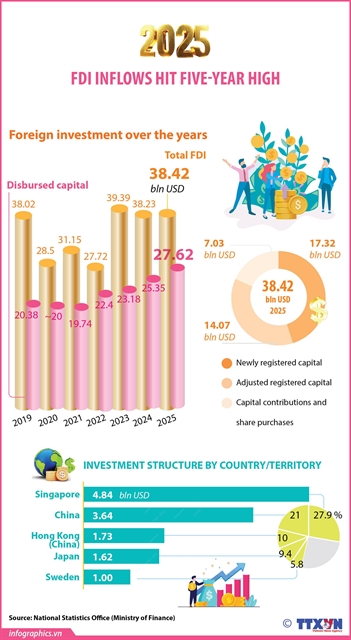
Foreign direct investment (FDI) has long been a central pillar of Việt Nam’s economic rise. In 2024, the FDI sector accounted for roughly 17 per cent of GDP, over 16 per cent of total social investment and as much as 72 per cent of merchandise exports. In 2025, the momentum accelerated further: disbursed FDI capital climbed to US$27.62 billion, the highest level in five years, while total registered capital exceeded $38 billion.
In an era marked by geopolitical fragmentation, supply chain disruptions and intensifying competition for capital, such figures are more than statistical achievements. They signal global investors’ confidence in Việt Nam’s political stability, macroeconomic resilience and strategic location amid shifting supply chains.
Yet numbers alone do not define success. The strategic question confronting Việt Nam today is not how much FDI it can attract, but how effectively it can shape, filter and leverage that investment to serve Việt Nam’s long-term goal of sustainable, inclusive and innovative development.
From passive attraction to strategic selection
For decades, Việt Nam competed primarily on comparative and cost advantages – low labour costs, tax incentives and improving administrative reforms. This model delivered impressive export growth and deep integration into global value chains. However, structural weaknesses have become more visible.
FDI inflows remain heavily concentrated among Northeast and Southeast Asian investors, while capital from the United States and Europe remains modest relative to Việt Nam’s upgraded diplomatic ties and expansive free trade agreement network. Technology spillovers to domestic firms have been limited, with Vietnamese enterprises often occupying peripheral roles in FDI-led supply chains.
At the same time, global geopolitics is reshaping investment flows. The 'China Plus One' strategy presents an opportunity as multinational corporations diversify production bases. But it also brings risks: Việt Nam must avoid being perceived as a mere transhipment hub in an era of tariff tensions and reshoring policies.
In this environment, passive attraction is no longer sufficient. Strategic selection is imperative.
Registered capital reflects expectation; disbursed capital reflects absorption capacity. What Việt Nam now requires is a third metric: transformation capacity. Can FDI catalyse technological upgrading, strengthen domestic firms and deepen national resilience?
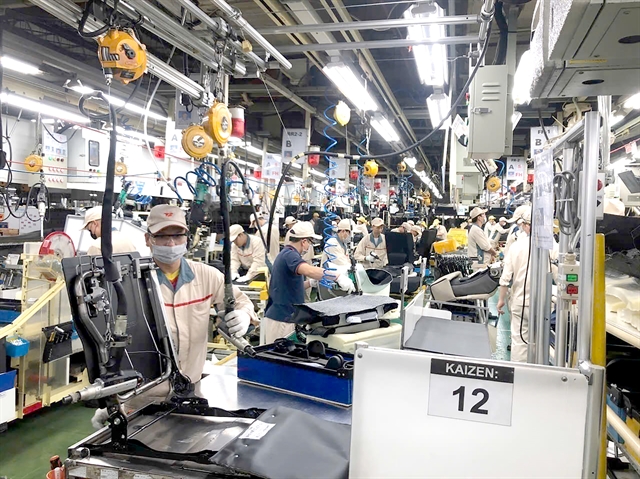 |
| Production at the Toyota Boshoku Hanoi Co. Ltd., a Japanese-invested automotive interior manufacturer. — VNA/VNS Photo Minh Nghĩa |
Avoiding the assembly trap
The risk is not a shortage of capital, but the possibility of locking into low-value-added assembly. Even in high-profile sectors such as electronics, rapid export growth does not automatically translate into technological mastery.
Let's take the automotive industry as an example. After more than three decades of opening its automotive market, Việt Nam still struggles with low localisation rates – a reminder that without a disciplined strategy to exchange market access for technology transfer and skill development, domestic firms remain marginal players.
High-quality FDI must therefore extend beyond export figures. It should encompass the full value chain – from research and development (R&D) and design to advanced manufacturing and after-sales services. It should foster stronger backwards and forward linkages, enabling Vietnamese enterprises to integrate more deeply into global production networks.
In short, FDI should not substitute domestic capability – it should strengthen it.
Competing for technology 'eagles'
In emerging sectors such as semiconductors, artificial intelligence (AI), biotechnology and clean energy, the standards are exacting. Major investors evaluate not only tax incentives but the entire ecosystem: ultra-stable and clean electricity, ultra-pure water, vibration-resistant infrastructure, resilient logistics and regulatory predictability.
Persistent obstacles – complex licensing procedures, high logistics costs, shortages of skilled labour and concerns over policy stability and predictability – continue to weigh on investor decisions.
Human capital is decisive. The ambition to train tens of thousands of semiconductor engineers reflects strong political will, but achieving it requires deep reforms in higher education, vocational training and enterprise–university partnerships. Digital transformation, meanwhile, must move beyond equipment acquisition towards genuine productivity gains.
Energy policy is equally strategic. Without sufficient, stable and green power, advanced technology investment will not be sustainable. Implementing Power Development Plan VIII, expanding renewables and operationalising mechanisms such as direct power purchase agreements are not merely environmental commitments; they are competitive necessities.
In this sense, global technology corporations resemble discerning 'eagles' – or even 'princes' – with multiple options. Việt Nam cannot shape conditions solely on its own terms. It must align domestic standards with global benchmarks.
 |
Beyond infrastructure and skills, governance will determine success.
Administrative complexity, overlapping regulations and inconsistent enforcement have long been cited as obstacles by investors. Addressing these requires not only simplification and digitalisation but also institutional innovation. Regulatory sandboxes, decentralisation and credible protections for proactive officials can enhance responsiveness in a rapidly changing global market.
Equally important is fostering genuine linkages between FDI firms and domestic enterprises. Differences in scale, technology and management culture have constrained cooperation. Targeted incentives for high-tech sectors, structured business-matching programmes and cluster development can help bridge this gap.
FDI should be viewed not as an end in itself, but as a policy instrument to upgrade the broader economy.
From counting dollars to defining direction
International forecasts remain more or less optimistic in the medium term, projecting solid GDP growth with FDI as a key driver. Yet growth at any cost is not the objective. The ultimate measure of success lies in qualitative outcomes: stronger domestic enterprises, enhanced technological self-reliance, greener development pathways and improved living standards.
The $38 billion milestone is a significant starting point. But the finish line is further ahead – in mastering core technologies, building resilient supply networks and ensuring that global integration translates into inclusive prosperity.
Việt Nam is entering a new development phase in which the quality – not merely the quantity – of FDI will shape its long-term competitiveness and strategic autonomy.
The era of celebrating inflows is giving way to the era of strategic attraction.
* Võ Trí Thành is former vice-president of the Central Institute for Economic Management (CIEM) and a member of the National Financial and Monetary Policy Advisory Council. With a doctorate in economics from the Australian National University, he focuses on macroeconomic policy, trade liberalisation and institutional reform.
Economy
 Economy
 Economy
 Economy
 Economy
 Economy
 Economy
 Economy
 Economy
 Economy
 Economy
 Economy
 Economy
 Economy
 Economy