 Economy



Top leader Tô Lâm’s EU visit to focus on trade, investment, energy security: ambassador
1.
 |
| Harvesting shrimps at a farm in Cà Mau. — VNA/VNS Photo |
HÀ NỘI — Riding a strong tide into the new year, Việt Nam’s seafood industry enters 2026 after recording an export turnover of more than US$11 billion in 2025, with positive growth expected to continue and bolster seafood stock performance.
The sector marked a major milestone last year, achieving record production of 9.95 million tonnes and exports of $11.32 billion, excluding around $250 million from fish meal.
This result contributed to the total export value of agricultural, forestry and aquatic products, which reached $70.09 billion, generating a trade surplus of more than $20.7 billion for the entire industry.
The impressive growth was driven by improved production capacity, technological advances and stronger competitiveness, particularly amid a volatile global market.
A standout feature was the industry’s ability to pivot. As uncertainties emerged in the US market, seafood exports quickly shifted towards China while also expanding into Europe and Africa, both of which recorded positive growth in 2025.
This strategic move not only sustained growth but also reduced reliance on traditional markets.
Looking ahead to 2026, the Ministry of Agriculture and Environment continues to steer the seafood sector with a focus on innovation, acceleration and sustainable growth.
Building on the achievements of 2025, the ministry is concentrating on three pillars: digital transformation and technology, a green and circular economy and enhanced added value, with the aim of reaching export turnover of $14–16 billion by 2030.
Deputy Minister Phùng Đức Tiến has stressed that deeper integration will require the seafood industry to rigorously streamline and review its supply chains, noting that the current landscape demands transparency and responsibility towards marine resources and future generations.
From the industry’s perspective, Đỗ Ngọc Tài, chairman of the Vietnam Association of Seafood Exporting and Producing, said 2025 was a crucial test of resilience. Maintaining production, preserving and expanding markets while improving quality and diversifying products has strengthened Việt Nam’s seafood reputation internationally.
That proactive spirit is set to carry into 2026 as seafood companies prepare for the new business year with strategies to expand markets, enhance competitiveness and adapt quickly to increasingly stringent environmental standards, traceability requirements, digital transformation and compliance with international regulations. The shift towards sustainability, transparency and accountability is no longer optional but a mandatory requirement.
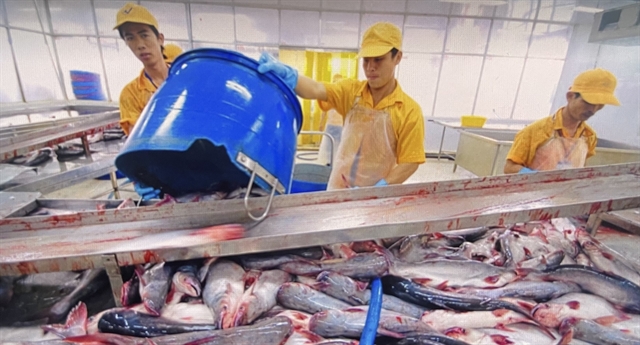 |
| Workers process tra fish at a plant of Vinh Hoan company. — VNA/VNS Photo |
Investment opportunities
The outlook for seafood stocks in 2026 is not expected to be uniform but will depend on the ability of companies to continue proactive farming practices and diversify market reach.
With a favourable export growth forecast, seafood stocks are likely to perform well in 2026, driven by a recovery in global consumption, expansion into new export markets and investment in high-tech aquaculture and deep processing.
In addition, green credit policies and a growing focus on ESG standards will provide a solid foundation for sustainable development over the long term.
However, the investment landscape shows marked disparities.
Many seafood stocks are trading at low valuations compared with historical averages. As of January 30, the price-to-book ratio for Vinh Hoan Corporation (VHC) stood at 1.44 and the price-to-earnings ratio at 9.41; Sao Ta Foods (FMC) recorded a price-to-book ratio of 0.92 and a price-to-earnings ratio of 6.67; Navico (ANV) reported a price-to-book ratio of 2.16 and a price-to-earnings ratio of 7.61; while Bentre Aquaproduct Import And Export JSC (ABT) had a price-to-earnings ratio of 4.63.
Despite risks from exchange rate fluctuations, input costs and technical barriers, seafood stocks remain attractive due to growth prospects closely tied to exports, particularly for leading companies with proactive farming structures, diversified markets and deep processing capabilities.
As a result, 2026 is viewed as a pivotal period for these stocks to establish new pricing levels.
KB Vietnam Securities Company (KBSV) expects seafood exports to continue growing in 2026 but at a moderate pace amid intensifying competition in key markets such as the US and Europe.
Within this context, Vinh Hoan and Sao Ta Foods are highlighted as industry leaders with attractive valuations.
Vinh Hoan’s main product is pangasius, while Sao Ta specialises in shrimp. Both companies are pursuing strategies to diversify markets and reduce reliance on the US, where they face tax-related risks.
KBSV forecasts steady production for both firms, with average selling prices potentially falling by 3–5 per cent due to structural changes in the market.
Nevertheless, Sao Ta’s profit margins are expected to improve through expansion into higher-margin markets, while Vinh Hoan aims to maintain stability with contributions from its collagen, gelatine and rice products.
In terms of financial performance, Sao Ta reported consolidated revenue of $300.53 million in 2025, up 19.80 per cent from 2024, with profits expected to reach VNĐ420 billion ($16.2 million). A clear strategy and effective execution have helped the company navigate adverse market fluctuations.
Meanwhile, Navico is recognised for its competitive advantage, particularly in tilapia.
Bao Viet Securities Company (BVSC) has noted that Navico's tilapia export volume could record double-digit growth in 2026, even as overall growth slows due to rising competition.
BVSC estimates that Việt Nam accounts for around 7 per cent of the US tra fish export market and approximately 87–89 per cent of the tilapia segment.
The company is expected to benefit from a 0 per cent anti-dumping tax in the US, enabling it to expand its tilapia market share and lead the segment in 2026.
However, these opportunities come with challenges. High preliminary anti-dumping duties on shrimp, increased competition among Vietnamese tra fish producers with six additional companies qualifying for 0 per cent tariffs, and the US lowering tariffs on China to match those on Việt Nam at 20 per cent will put pressure on the entire sector.
In 2026, the ability to adapt to volatility will remain a key challenge for seafood companies. Those with strong financial capacity, high-quality products and flexible responses are expected to be well placed to overcome obstacles and capture new growth opportunities. — BIZHUB/VNS
Economy
 Economy
 Economy
 Economy
 Economy
.jpg) Economy
Economy
 Economy
 Economy
 Economy
 Economy
 Economy
 Economy
 Economy
 Economy
 Economy