 Economy



Top leader hails friendship association's role in nurturing Việt Nam–Denmark ties
1.
 |
| Deputy Minister of Construction Nguyễn Văn Sinh speaks at a high-level forum on real estate prospects for 2026 held on Thursday in HCM City. — VNA/VNS Photo |
HCM CITY — A sweeping overhaul of laws governing land, housing and the real estate business is repositioning Việt Nam’s property market for a new growth cycle from 2026, as authorities move decisively to curb speculation, unlock stalled projects and steer development toward real demand and long-term sustainability.
After weathering its sharpest downturn in more than a decade, the real estate sector showed clear signs of stabilisation in 2025, supported by accelerated public investment, easing legal bottlenecks and stronger policy coordination, Government officials and industry leaders said at a high-level forum on real estate prospects held on Thursday in HCM City.
Despite continued global uncertainty, Việt Nam maintained relatively stable economic growth last year, driven by infrastructure spending and the coordinated rollout of transport, urban and logistics projects, said Nguyễn Thị Hồng Nga, editor-in-chief of Xây dựng (Construction) newspaper, which hosted the forum.
Following a prolonged period of market correction and restructuring, the real estate sector is recovering in a more cautious and substantive manner, she said, with transparency, legal compliance and social welfare increasingly defining the next phase of development.
“The market is no longer driven by short-term speculation,” she said. “Instead, institutional reform and social housing are emerging as the core pillars of sustainable growth.”
Unlocking stalled projects and frozen capital
Central to the Government’s strategy is the removal of legal obstacles that have stalled thousands of real estate projects nationwide.
Deputy Minister of Construction Nguyễn Văn Sinh said Việt Nam currently has 2,991 real estate projects facing difficulties, more than 80 per cent of which are affected by legal and procedural issues related to land use rights, project approvals, land valuation and financial obligations.
The total capital tied up in these projects is estimated at VNĐ2.4 quadrillion (US$95 billion), representing a significant pool of idle resources within the economy.
“If these bottlenecks are resolved, the market will gain very large additional supply, helping to ease housing shortages and contribute to economic growth,” Sinh said.
Authorities have so far cleared 926 projects, or about 31 per cent of the total. The remaining projects are being classified according to jurisdiction, with some requiring National Assembly resolutions, and others falling under the authority of the government, ministries or local administrations.
In addition, around 80 build-transfer (BT) projects facing complex legal issues are expected to be addressed under a separate government resolution aimed at restoring investor confidence and restarting implementation.
Legal overhaul reshapes market dynamics
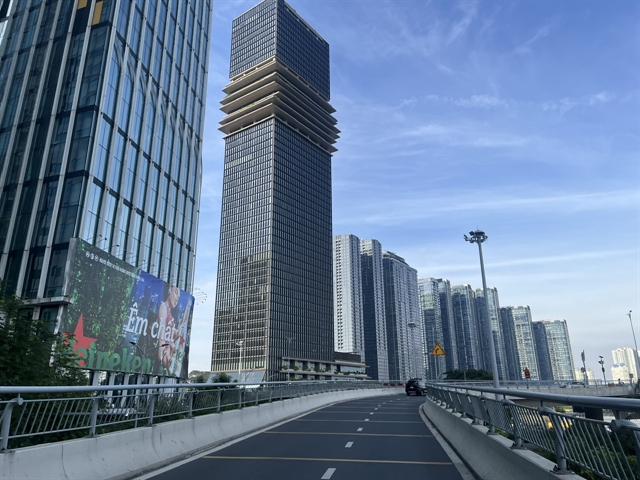 |
| New luxury real estate developments in downtown HCM City. Việt Nam is moving to curb speculation and steer the market toward real, sustainable demand. — VNS Photo Bồ Xuân Hiệp |
The push to unblock projects is being reinforced by a broad overhaul of the legal framework governing the real estate market.
Over the past two years, the National Assembly and Government have revised and introduced key laws, including the Land Law, Housing Law and Law on Real Estate Business, alongside a series of resolutions to address long-standing project bottlenecks, particularly in major urban centres such as HCM City, Đà Nẵng and Khánh Hòa.
More recently, the Government issued a resolution tightening oversight of land-use right auctions, aiming to improve transparency and restore market discipline following disruptions in previous auction rounds.
These changes have helped stabilise prices and improve investor confidence, said Nguyễn Văn Đính, vice chairman of the Việt Nam Real Estate Association.
“In 2025, supply rebounded strongly as many projects were legally cleared and returned to the market,” Đính said. “Transaction volumes recovered and approached pre-2020 levels, with nearly two-thirds of annual transactions recorded in the second half of the year.”
Property prices rose sharply in early 2025 but levelled off by mid-year as regulatory measures took effect, reflecting improved market control, he added.
Credit flows, infrastructure and social housing
The real estate sector has continued to benefit from strong credit flows. Total outstanding bank lending reached a record VNĐ4 quadrillion, with approximately VNĐ1.8 quadrillion directed to real estate-related activities.
Public investment has also played a stabilising role, particularly through large-scale transport and urban infrastructure projects that are reshaping development corridors and supporting new urban models.
According to the Ministry of Construction, Việt Nam currently has more than 1,110 commercial housing and urban projects under development, supplying around 529,000 housing units.
Social housing has emerged as a key policy priority and market stabiliser. In 2025, more than 102,000 social housing units were completed nationwide, exceeding annual targets and bringing the national programme for one million affordable homes to approximately 62 per cent completion. Authorities plan to add another 160,000 units in 2026.
Officials said expanding affordable housing is essential to improving access for low-income households and workers, while also helping balance supply and demand across the market.
Selective, sustainable growth cycle
 |
| Delegates discuss legal reforms and growth drivers at a forum on real estate prospects for 2026 held on Thursday in HCM City. — VNA/VNS Photo |
Construction and real estate together account for around 11 per cent of Việt Nam’s GDP, with real estate contributing roughly 4.5 per cent directly and indirectly, according to government data.
Looking ahead, policymakers and experts expect the next growth cycle to be more selective than previous booms, with greater emphasis on legal compliance, financial discipline and alignment with genuine housing demand.
Urban development models such as higher-density development and transit-oriented development (TOD) are being prioritised, while administrative restructuring, including the consolidation of provinces and cities, is expected to open up new development space and strengthen inter-regional connectivity.
Economist Nguyễn Minh Phong said the legal overhaul is accelerating a broader restructuring of the market.
“As supply is unlocked, the market will undergo clearer selection,” he said. “Projects that lack transparency or financial capacity will be phased out, while large-scale developments linked to infrastructure and long-term planning will take the lead.”
Despite ongoing challenges, including supply skewed toward higher-end housing and a continued reliance on bank credit, officials said 2025 has laid a critical institutional foundation.
“Việt Nam is entering a new real estate growth cycle,” Deputy Minister Sinh said. “This will be a growth cycle built on legal certainty, real demand and long-term sustainability, rather than speculation.” — VNS
Economy
 Economy
 Economy
.jpg) Economy
Economy
 Economy
 Economy
 Economy
 Economy
 Economy
 Economy
 Economy
.jpg) Economy
Economy
 Economy
 Economy
 Economy