 Economy


84 individuals investigated for transnational online frauds
1.
.jpg)
|
| Nguyễn Văn Dũng, vice chairman of the HCM City People’s Committee, speaks at a conference held in HCM City on January 10 to review the performance of the industry and trade sector in 2025 and set tasks for 2026. — Photo courtesy of congthuong.vn |
HCM CITY — HCM City targets to maintain a high and stable growth rate in its industrial and trade–services sectors, with a focus on processing and manufacturing, high-tech industries and supporting industries this year.
According to a report presented at a conference held in HCM City on January 10 to review the performance of the industry and trade sector in 2025 and set tasks for 2026, the sector recorded solid results last year.
The industrial production index (IIP) rose by 8.9 per cent, total retail sales of goods and consumer services increased by 15.8 per cent, and export turnover grew by 7 per cent compared to 2024. Electricity supply also maintained stable growth, ensuring energy security for socio-economic activities.
The sector’s growth was supported by the flexible adaptation and proactive efforts of the business community, together with timely support from State management agencies. Market management, administration and stabilisation measures proved effective, while programmes on regional linkages, digital transformation, consumption stimulus, e-commerce development and administrative reform contributed significantly to overall performance.
For 2026, the sector has set ambitious targets, including IIP growth of 10 per cent, retail sales growth of 12 per cent, and a 10 per cent increase in export turnover.
The sector also aims for 100 per cent of large commercial enterprises and 70 per cent of small and medium-sized enterprises to implement digital transformation in commercial activities. All traditional markets across the city are expected to adopt modern payment methods.
The logistics sector is projected to grow by 14–15 per cent compared to 2025, accounting for 18–20 per cent of the service sector and 8–10 per cent of the city’s GRDP.
To achieve these targets, the HCM City Department of Industry and Trade will implement Resolution No 60/2025/NQ-HĐND, issued by the City People’s Council in December 2025, which sets out specific policies to support trade promotion activities.
The city will roll out programmes and projects to accelerate digital and green transformation, support businesses in applying digital technologies, expanding digital payment platforms and smart logistics, and adopting smart solutions in production and business operations. These measures are intended to help enterprises move deeper into high value-added stages and strengthen industrial value chains.
Expanding industrial space and regional linkages
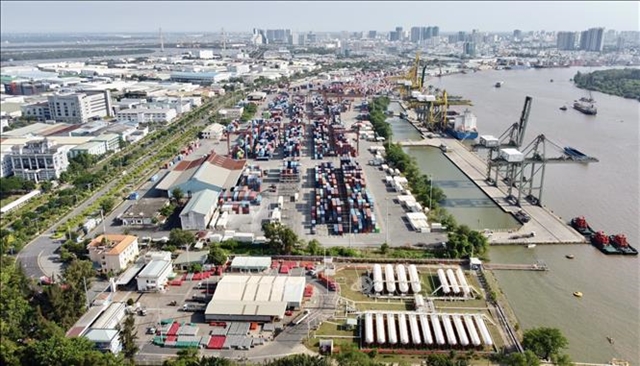
According to Hà Văn Út, the department’s deputy director, the sector this year will focus on attracting investors to develop five to seven new industrial clusters, formulating policies to support enterprises that voluntarily relocate to industrial parks and clusters, and strengthening linkages within the Southeast region in industrial development, logistics, innovation and digital transformation.
|
| HCM City aims to attract investors to develop five to seven industrial clusters this year. — VNA/VNS Photo |
Trade promotion efforts will also be intensified in overseas markets, alongside activities to connect supply and demand and support key industrial and supporting-industry enterprises in increasing localisation rates and expanding market reach, he said.
Speaking at the conference, Nguyễn Văn Dũng, vice chairman of the HCM City People’s Committee, said that despite numerous challenges, the city achieved positive socio-economic results, with GRDP growth reaching 8.03 per cent in 2025, providing a solid foundation for higher growth in the coming period.
He emphasised that the industry and trade sector played a significant role in the city’s overall performance and called for continued efforts to build on existing achievements while addressing remaining shortcomings.
Priority tasks for 2026 include accelerating the implementation of approved programmes and projects, piloting pork trading via an exchange platform in the first quarter of 2026, and effectively rolling out major projects to develop service centres and international exhibition centres.
He also urged the sector to strengthen domestic trade by tapping more effectively into the domestic market through consumption stimulus programmes, concentrated promotion campaigns and supply–demand connection initiatives between HCM City and other provinces and cities nationwide.
At the same time, the sector was encouraged to scale up and innovate trade promotion activities to support enterprises in exploring export markets and participating more deeply in global supply chains, particularly through specialised promotion events such as fairs for Vietnamese export products.
Alongside trade development, the sector is required to prioritise the development of high-tech, supporting and green industries, while strengthening linkages between supporting-industry enterprises, foreign-invested firms and leading companies in the value chain.
The sector also needs to strengthen inter-agency coordination to strictly monitor the market and combat smuggling, trade fraud and counterfeit goods, particularly violations in e-commerce, he added.
At the conference, director of the Department of Industry and Trade Bùi Tá Hoàng Vũ called on associations and enterprises to proactively develop plans and closely coordinate with the department to fully utilise resources allocated by the city.
He stressed the need to strengthen linkages to increase value, ensure energy security for growth, promote comprehensive innovation in technology and governance, develop high-quality human resources, especially in emerging technologies such as artificial intelligence, and make effective use of existing policy mechanisms to support sustainable development in 2026 and beyond. — VNS
Economy
 Economy
 Economy
 Economy
 Economy
 Economy
 Economy
 Economy
 Economy
 Economy
 Economy
 Economy
 Economy
 Economy
 Economy