 Economy


Sơn La applies science and technology to coffee production
1.
|
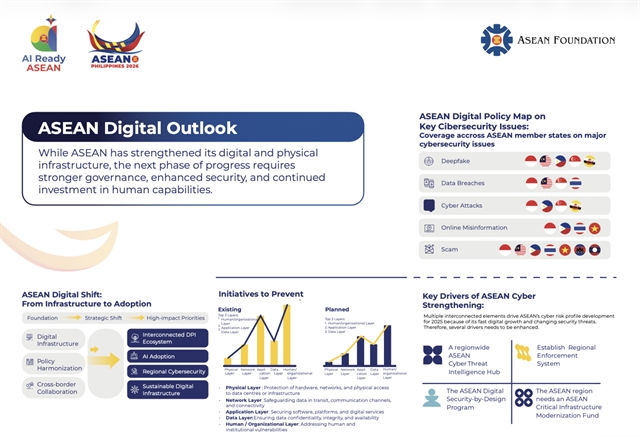
| ASEAN Foundation launches ASEAN Digital Outlook and the first look of AI Readiness Research. — Photo courtesy of the organiser |
HCM CITY — Generative AI usage in Việt Nam is widespread, with 89.3 per cent of students and 81.9 per cent of educators reporting they use such tools, according to the AI Ready ASEAN Research.
However, while nearly two-thirds of educators have completed AI-related courses, only around a quarter of students have received formal training.
Despite high levels of confidence, assessments reveal gaps in foundational AI understanding, suggesting that adoption is outpacing readiness.
The findings were released as part of the AI Ready ASEAN Research and the ASEAN Digital Outlook, officially launched by the ASEAN Foundation with support from Google.org at the AI Ready ASEAN: 3rd Regional Policy Convening in Manila, the Philippines.
The AI Ready ASEAN Research assesses AI readiness across the 10 ASEAN member nations, focusing on education communities and examining students, educators and parents as key actors shaping how AI is adopted, understood and governed.
The findings reveal a consistent gap between high levels of AI usage and actual readiness, particularly in AI literacy, ethical understanding and institutional support.
While students often emerge as early adopters of AI tools, educators and parents face greater barriers related to confidence, guidance and access to structured training.
Developed jointly with the ASEAN Digital Senior Officials’ Meeting, the ASEAN Digital Outlook aligns with region-wide digital governance priorities and offers a perspective on digital maturity, infrastructure development and institutional preparedness.
Together with the AI Ready ASEAN Research, it builds on the progress of the AI Ready ASEAN programme, which has reached more than five million beneficiaries through AI literacy initiatives, enabled over 100,000 learners to complete in-depth AI training, and empowered more than 3,000 master trainers across the region.
These efforts come at a time of rapid change.
Digitalisation and artificial intelligence are reshaping Southeast Asian economies, education systems and public services at unprecedented speed.

|
| Delegates at the AI Ready ASEAN: 3rd Regional Policy Convening conference held in Manila, the Philippines. — Photo courtesy of the organiser |
With a population of more than 660 million people, nearly a third of them under the age of 20, Southeast Asia’s ability to adopt AI responsibly will play a decisive role in shaping future skills development, employment opportunities and social inclusion.
ASEAN’s digital economy is projected to expand from US$300 billion to $1 trillion by 2030, creating immense opportunities alongside increasingly complex risks.
As AI adoption accelerates across sectors, the need for inclusive, responsible and well-governed AI use has become an urgent need and priority for governments, institutions and communities across the region.
“Across ASEAN, we are seeing AI use grow faster than our systems’ ability to guide it,” Dr Piti Srisangnam, executive director of the ASEAN Foundation, said.
“These studies move the conversation beyond whether AI is being used to whether our institutions, educators and communities are truly prepared. Evidence like this is essential to designing policies that protect trust, strengthen skills and ensure AI benefits people, not just economies.”
The ASEAN Digital Outlook provides a broader regional assessment of digital and AI infrastructure, governance and cybersecurity readiness across ASEAN Member States.
While several countries have made progress in strengthening digital infrastructure, the study highlights uneven levels of digital maturity and institutional capacity across the region.
Persistent gaps in digital skills, public trust, cybersecurity preparedness, and responsible use of technology underscore the limitations of fragmented national approaches.
Taken together, the findings show that AI and digital adoption across ASEAN are advancing faster than institutional, ethical and community readiness.
Meanwhile, growing risks, including online scams, deepfake-enabled fraud, misinformation, and data breaches, are undermining trust in digital systems and reinforcing the need for stronger governance frameworks.
“Access to AI tools alone is not enough,” Marija Ralic, head of Google.org Asia-Pacific, said.
“Real readiness requires people to understand how AI works, where its limits lie and how it can be used ethically. These findings reinforce why investments in AI literacy, especially for educators and communities, are critical to ensuring that technological progress translates into inclusive opportunity.”
Through the launch of the two studies, the ASEAN Foundation aims to provide data-driven insights to support informed policy dialogue on digital and AI transformation across the region.
The studies are intended to serve as key references for policymakers, educators and development partners in designing interventions that strengthen digital literacy, institutional readiness and inclusive growth. — VNS
Economy
.jpg) Economy
Economy
 Economy
 Economy
 Economy
 Economy
 Economy
 Economy
 Economy
 Economy
 Economy
 Economy
 Economy
 Economy
 Economy