 Economy


84 individuals investigated for transnational online frauds
1.
|
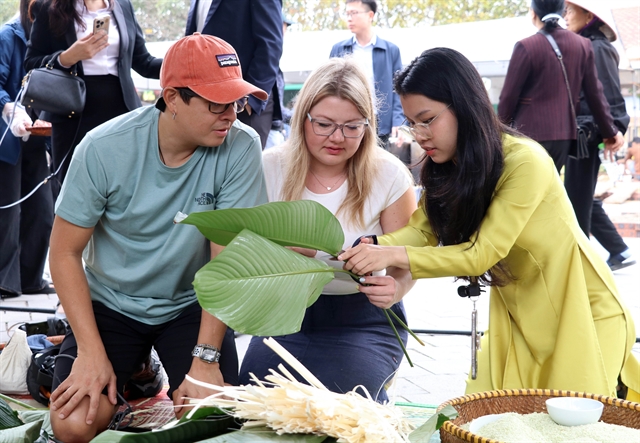
| Local residents and visitors join a bánh chưng (square, glutinous rice cakes)-making activity in Ninh Bình Province on February 6. — VNA/VNS Photos |
HÀ NỘI — From pandemic recovery to regional prominence, Việt Nam’s tourism industry has reached a pivotal moment, with experts warning that only stronger coordination and an end to fragmented, go-it-alone promotion will sustain its rapid growth.
In 2025, despite global economic uncertainty and an uneven rebound in international travel, Việt Nam delivered a clear breakthrough in tourism, both in scale and international standing.
For the first time, the country welcomed more than 21 million international visitors, while total tourism revenue surpassed VNĐ1 quadrillion (US$38.56 billion). Việt Nam overtook Singapore and Indonesia to rank third in ASEAN, behind only Malaysia with 42 million arrivals and Thailand with 33 million.
The results underline Việt Nam’s rising profile on the regional tourism map and signal a shift from post-pandemic recovery to a more sustainable growth phase.
Nguyễn Thị Hoa Mai, Deputy Director of the Vietnam National Authority of Tourism, said the performance was driven in part by renewed approaches to promotion and marketing. Rather than dispersing resources widely, the sector concentrated on priority markets such as the United States, China, South Korea, Russia, France, and Australia.
Promotion methods were also diversified, spanning roadshows, international fairs, cultural tourism festivals, and investment promotion conferences, alongside the rollout of new tourism products tailored to changing visitor demand.
She highlighted Việt Nam’s first Tourism-Cinema Promotion Programme in Hollywood, held under the theme Việt Nam – A new destination for global cinema, as a milestone. The event drew more than 500 guests, including US filmmakers and directors, and opened new prospects for tourism development through cinema.
Alongside this, Việt Nam has intensified its presence at major global tourism fairs such as WTM London and China’s CITM, while expanding digital promotion across online platforms and international media channels, including CNN.

|
| Promoting Hà Nội tourism at an international travel fair held in France in 2025. |
Despite these efforts, experts said State funding for tourism promotion remains limited.
Figures from the Vietnam National Authority of Tourism show that annual spending on destination marketing is only about one twentieth of Singapore’s level and as little as one fortieth to one hundredth of that in some developed countries.
At a recent conference on tourism promotion, the authority's Director Nguyễn Trùng Khánh said many promotional activities lack professionalism and depth, while funding falls short of practical needs.
He also pointed to weak mobilisation of social resources and a continued reliance on State budgets in several localities.
Vũ Thế Bình, Chairman of the Vietnam Tourism Association, said promotion efforts remain fragmented and poorly coordinated, with many localities still operating independently.
“Cooperation often stops at general memoranda and promises, without clear roadmaps, task assignments, or unified implementation,” Bình said.
Strengthening regional linkages
Enhancing the quality and professionalism of tourism promotion is a central objective under Việt Nam’s Tourism Development Strategy and Master Plan through 2030.
Experts said the sector needs a more systematic approach, closely tied to market research and brand development, spanning central and local authorities as well as public and private stakeholders.
Nguyễn Mạnh Thản, Chairman of the Hà Nội Tourism Association, stressed the need for closer coordination between tourism and related sectors such as transport, trade and foreign affairs, alongside clearer inter-agency cooperation mechanisms.
Nguyễn Anh Tuấn, Director of the Institute for Tourism Development Research, added that local promotion strategies must align with the national framework, with each locality building distinctive tourism brands based on careful assessment of regional connectivity.
To ease funding constraints, tourism businesses have called for greater socialisation of promotion budgets.
Nguyễn Công Hoan, General Director of Flamingo Redtours, proposed that travel companies and hotels contribute about $1 per night from international guests to a tourism promotion fund, noting that broad consultation and a clear global marketing plan would be required.
|
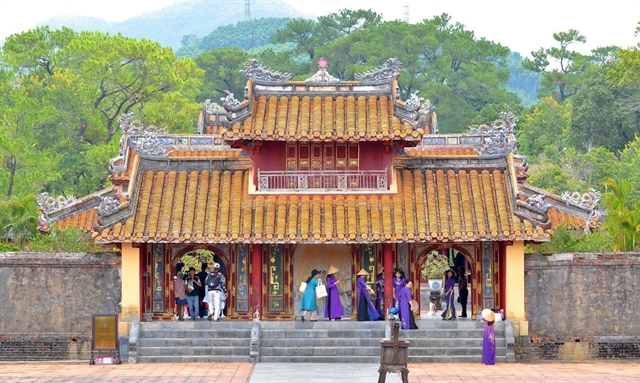
| Visitors explore Huế Imperial City. |
Phạm Hải Quỳnh, Director of the Asia Tourism Development Institute, highlighted the growing role of social media and digital platforms, calling for stronger cooperation among localities, businesses, and State agencies, alongside wider use of technologies such as virtual reality, three-dimensional mapping, and destination digitalisation.
From a management perspective, Hà Văn Siêu, Deputy Director of the Vietnam National Authority of Tourism, said international promotion would be stepped up, with a focus on markets offering visa-free access, strong air connectivity, and high growth potential.
In 2026, Việt Nam plans promotional campaigns in key markets through major tourism fairs, including Travex in the Philippines, ITB in Germany, and WTM London in the United Kingdom. Activities will also be implemented under the National Tourism Year 2026 framework, alongside regular domestic promotion events.
“These programmes are expected to help build a consistent Việt Nam tourism brand internationally, support new visa policies, open air routes, boost service exports, and reshape tourism products in line with global demand,” Siêu said. — VNS
Economy
 Economy
 Economy
 Economy
 Economy
 Economy
 Economy
 Economy
 Economy
 Economy
 Economy
 Economy
 Economy
 Economy
 Economy