 Economy


Top leader urges deeper, higher-value economic ties with EU, Belgium
1.
 |
| Ribbon-cutting ceremony marking the launch of the route on Monday. — Photo courtesy of the Embassy of Israel in Hà Nội |
HÀ NỘI — Israel and Việt Nam on Monday launched their first direct air route, linking Tel Aviv and Hà Nội in a move expected to accelerate tourism, trade and wider bilateral exchanges.
The service, operated by Arkia Airlines, was inaugurated at Nội Bài International Airport, marking the first non-stop passenger connection between the two countries.
Arkia flight IZ595 departed Tel Aviv shortly after midnight local time and landed in Hà Nội at 4.30pm after an 11.5-hour journey. The return flight leaves Hà Nội at 7.40pm, arriving at Ben Gurion Airport at 2.25am the following day.
The route will initially operate once a week using a wide-body aircraft with a capacity of around 290 passengers, the airline said.
Israeli officials said the new route eliminates the need for transit through third countries, shortening travel time between Israel and Việt Nam.
"The direct flight is a strategically significant step in Israel–Việt Nam relations", Israeli Ambassador Yaron Mayer said at the launch ceremony.
"It brings our peoples closer together, opening up new opportunities for cooperation in tourism, trade, investment and innovation."
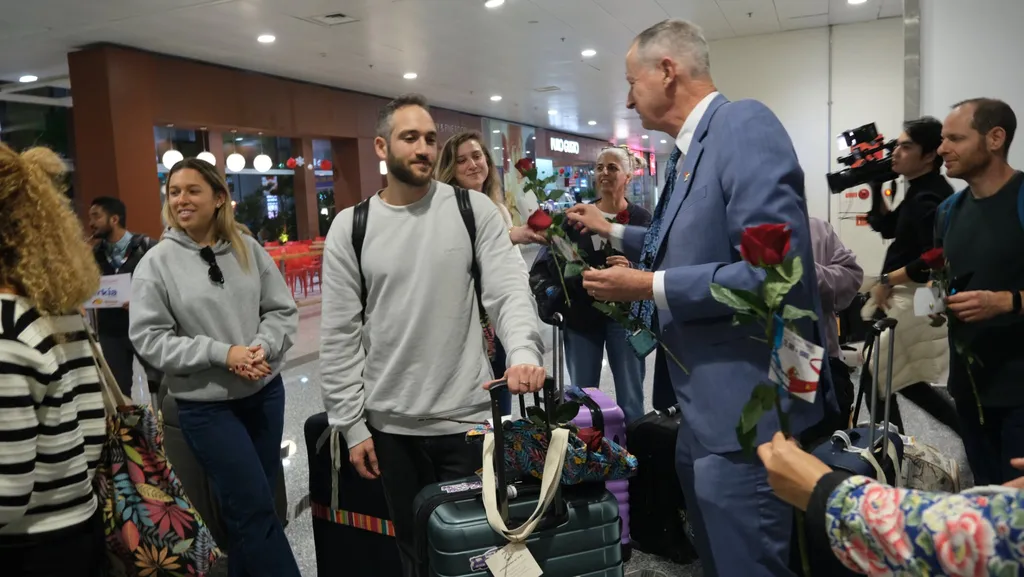 |
| Israeli Ambassador Yaron Mayer presents flowers to Israeli passengers arriving on the inaugural flight. |
The inaugural flight carried a delegation of Israeli tour operators and media representatives exploring opportunities to expand travel products in Việt Nam, particularly customised tours targeting Israeli travellers.
Arkia officials said the route forms part of its broader push to expand in Asia, reflecting growing demand for long-haul travel and the rising profile of Việt Nam as a destination for Israeli tourists and businesses.
Vietnamese travellers are also expected to benefit, with Tel Aviv serving as a gateway to destinations across the Middle East and Europe.
Officials from both sides said improved air connectivity could help push bilateral trade beyond US$4 billion in 2026. — VNS
Economy
 Economy
 Economy
.jpg) Economy
Economy
 Economy
 Economy
 Economy
 Economy
 Economy
 Economy
 Economy
 Economy
 Economy
 Economy