 Economy

Lotte, Phát Đạt combine strengths in Thu Thiem project
1.
.jpg)
|
| The three flights officially marked the inauguration of Long Thành International Airport, often referred to as Việt Nam’s “super airport” due to its scale and long-term capacity. —Photo courtesy of Bamboo Airways |
HÀ NỘI — Việt Nam marked a major leap forward in its aviation ambitions on December 19 as aircraft from Vietnam Airlines, Vietjet Air and Bamboo Airways successfully landed at Long Thành International Airport, officially inaugurating the country’s largest and most modern aviation infrastructure project to date and opening a new chapter for the national aviation industry.
The three inaugural flights highlighted a historic milestone, formally debuting the super airport that is expected to transform regional connectivity and support long-term economic growth.
Vietnam Airlines operated the first ceremonial flight from Nội Bài International Airport in Hà Nội, carrying senior leaders of the Party and State, and touching down at Long Thành at 8.10am on a Boeing 787-9. The aircraft later departed at noon to return to Hà Nội, completing the symbolic round trip the same day.
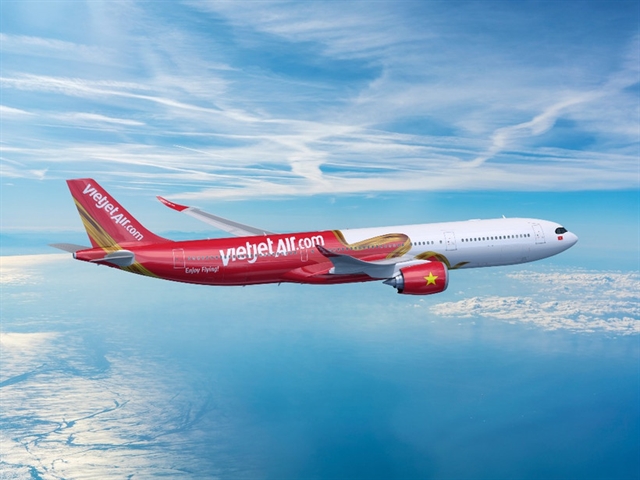
Vietjet Air followed with an Airbus A321neo flight that departed Tân Sơn Nhất International Airport in HCM City at 7.35am and arrived at Long Thành at 8.30am, with a scheduled return departure at 12.20pm for Tân Sơn Nhất.
Bamboo Airways’ inaugural flight, QH18, took off from Tân Sơn Nhất at 7.55am and landed at Long Thành at 8.35am. Operated by an Airbus A321, the aircraft was scheduled to return to HCM City at 12.25pm, with an expected landing time of 1.05pm.
The successful operations officially marked the inauguration of Long Thành International Airport, widely regarded as Việt Nam’s most ambitious aviation project in scale and long-term capacity development.
Following the inaugural event, Long Thành will continue completion works before opening to commercial operations, which are expected to begin from mid-2026. In its first phase, the airport is designed to handle up to 25 million passengers and 1.2 million tonnes of cargo annually.
Under a proposal by the Ministry of Construction, Long Thành will operate all international routes with flight distances of 1,000 kilometres or more, as well as other routes designated by airlines. Domestic flights will be allocated according to carriers’ operational needs, while the airport is expected to serve around 10–12 per cent of passenger volume on the main Hà Nội/Đà Nẵng–HCM City corridor.
Tân Sơn Nhất International Airport will continue to handle international routes under 1,000 kilometres, particularly to neighbouring markets such as Thailand, Cambodia and Laos, accounting for an estimated 15–17 per cent of international arrivals to HCM City. The remaining domestic network will continue to be operated through Tân Sơn Nhất.
With this distribution, Long Thành is expected to manage about 80 per cent of international flights and 10 per cent of domestic services, while Tân Sơn Nhất will handle 20 per cent of international flights and 90 per cent of domestic operations. Authorities will monitor and adjust the allocation based on actual performance over the first five years of operation.
In the initial phase, the Ministry of Construction has encouraged airlines, particularly domestic carriers, to shift long-haul international routes to Europe, the Americas and Oceania to Long Thành. New international services, non-scheduled flights and charter operations will also be prioritised at the new airport.
Covering more than 5,000 hectares in Long Thành District, Đồng Nai Province, the airport has a total estimated investment of over US$16 billion across three phases, with Phase 1 requiring more than $5.4 billion. When fully completed, it will feature three passenger terminals and four runways, with the main terminal topped by an 82-metre-high glass roof inspired by the lotus flower.
Once fully operational, Long Thành International Airport is expected to handle up to 100 million passengers a year, placing it among the world’s largest and most significant aviation hubs. — VNS
Economy
 Economy
 Economy
 Economy
 Economy
 Economy
 Economy
 Economy
 Economy
 Economy
 Economy
 Economy
 Economy
 Economy
 Economy