 World
World

Ministry eyes data architecture as quality becomes key to deeper digital transformation
1.
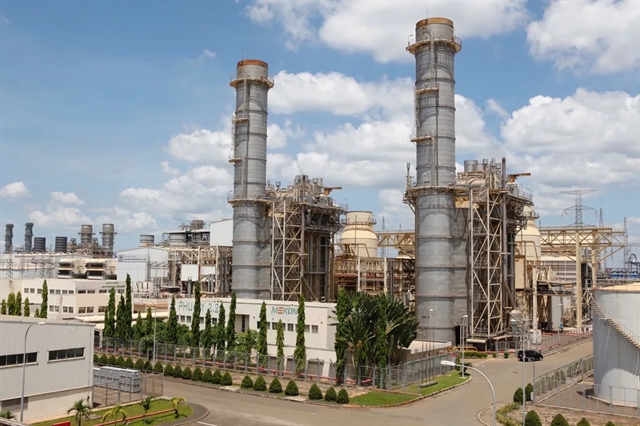 |
| The Phú Mỹ 2.2 Power Plant is located in the Phú Mỹ Thermal Power Plant Complex in HCM City. — Photo Courtesy of Mekong Energy |
By Ly Ly Cao
HÀ NỘI — As Southeast Asia faces surging energy demand alongside mounting climate pressures, Japan is stepping up as a key partner to help the region pursue decarbonisation without compromising economic growth or energy security.
Japanese policymakers and businesses increasingly see ASEAN, and Việt Nam in particular, as central to demonstrating that economic expansion and emissions reduction can advance together.
Speaking on the challenges facing the region, Ando Shigemi, director of the Regional Policy Division in the Asia and Oceanian Affairs Bureau under the Japanese Ministry of Foreign Affairs, highlighted ASEAN's unique position.
"ASEAN has a lot of potential for economic growth and decarbonisation," he said, stressing that the region could "show economic growth and decarbonisation compatibility" and emerge as a successful model worldwide.
Unlike developed economies such as Japan, which have already built mature energy systems, Southeast Asian countries face the dual task of expanding electricity supply while simultaneously decarbonising it.
"What you are doing is together expanding the energy system and replacing some portion of the energy system with decarbonisation," Ando said, adding that this makes the region's challenge "more difficult than that faced by developed countries like Japan and European countries."
It is precisely because of this complexity, he said, that Japan is "very happy to support your efforts," with the expectation that ASEAN's experience could guide other developing regions.
A core pillar of Japan's regional engagement is the Asia Zero Emission Community (AZEC) initiative, proposed by the Japanese government in January 2022.
According to a report by Keidanren, Japan's powerful business federation, AZEC was designed to counter 'a one-size-fits-all approach to decarbonisation' by promoting 'various pathways tailored to the circumstances of the respective countries,' while pursuing what Japan calls a triple breakthrough – decarbonisation, economic growth and energy security.
AZEC has gained momentum rapidly. Its first ministerial meeting was held in March 2023 with nine Southeast Asian nations and Australia, all of which endorsed the initiative.
In mid-November, the Ministry of Industry and Trade of Việt Nam (MoIT) and the Japanese Embassy in Việt Nam convened a meeting to advance the AZEC Initiative and the Project Acceleration Platform.
The focus was on fostering the energy transition towards Việt Nam's 2050 carbon neutrality goal, establishing working groups, and expediting project activities. A total of 15 cooperative projects were identified, with ongoing discussions about nine specific projects in the second meeting.
Speaking to Việt Nam News and Law, a representative of Sumitomo Corporation, one of the investors in the Phú Mỹ 2.2 Combined Cycle Gas Project, said the company will continue to expand its gas-fired power plant projects in Việt Nam, supporting the country in its clean energy transition.
Similarly, Tokyo Gas is developing LNG terminal projects and gas power plants in Quảng Ninh and Hưng Yên Provinces. The company said gas-fired power plants are a better choice for countries in ASEAN due to their weather and infrastructure conditions.
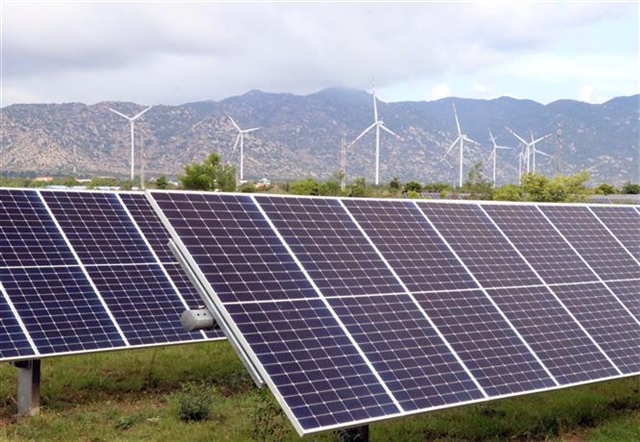 |
| A solar and wind power farm in Khánh Hòa Province. VNA/VNS Photo |
Japan’s approach also reflects its own evolving energy strategy.
Yamada Ryota, deputy director of the International Affairs Division at the Agency for Natural Resources and Energy under the Japan Ministry of Economy, Trade and Industry, explained that while renewable energy remains Japan's top priority, nuclear power continues to be viewed as one of the key solutions to achieve decarbonisation and also energy security.
For Southeast Asia, Japan emphasises the importance of innovation driven by the private sector.
"Government itself cannot create innovation," Ando said, adding that Japan's role is to support environments where innovation can occur by connecting Japanese companies with Southeast Asian partners.
This philosophy underpins efforts to expose more Japanese private-sector players to decarbonisation opportunities across the region.
Việt Nam features prominently within AZEC's project portfolio. Keidanren highlighted several decarbonisation initiatives, including the development of an ecosystem for refrigerant recovery, recycling and reuse in commercial air-conditioning systems.
While Việt Nam has already mandated refrigerant recovery for large-capacity air conditioners, the report noted that 'tangible development of the ecosystem' remains inadequate, with low awareness of cost burdens slowing implementation.
Another project focuses on energy efficiency in buildings through advanced ventilation and air-conditioning systems, which have demonstrated potential energy efficiency gains of around 40 per cent.
However, Keidanren observed difficulties in moving from demonstration to commercial deployment, calling for Việt Nam to establish a roadmap towards Net Zero Energy Buildings and stricter construction standards.
In renewable energy, rooftop solar power purchase agreements (PPAs) are identified as a key area for reform.
Despite the introduction of a Direct Power Purchase Agreement decree, inconsistencies in implementation and resistance from industrial park electricity providers have created barriers, particularly for Japanese-affiliated firms seeking to deploy renewable energy systems.
Through AZEC, Japan’s government and business community aim to address such bottlenecks by advancing policy coordination while accelerating individual projects.
Keidanren stressed that building a track record of individual projects is essential to sustaining momentum and deepening understanding of the initiative among both public and private stakeholders. — BIZHUB/VNS
World
 World
World
 World
World
 World
World
 World
World
 World
World
 World
World
 World
World
 World
World
 World
World
 World
World
 World
World
 World
World
 World
World
 World
World