 World
World

PM, NA President meet with female lawmakers, marking Việt Nam Women's Day
1.
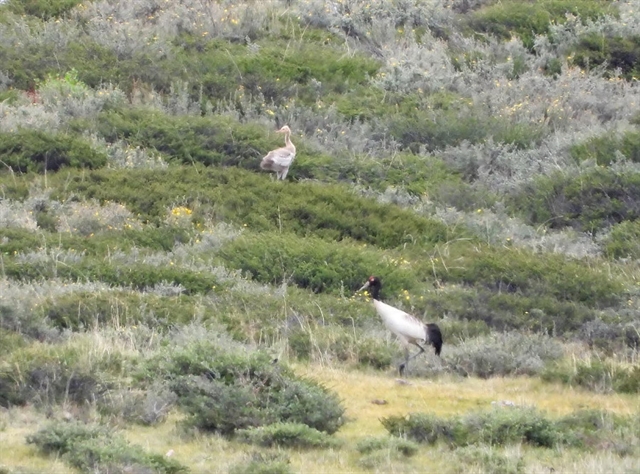 |
| A black-necked crane with its chick pictured near Sakya Khola in Namkha Rural Municipality in Humla, a few weeks ago. — Photo courtesy of Ankit Bilas Joshi |
KATHMANDU — Nepal has recorded the first confirmed breeding of the black-necked crane (Grus nigricollis), locally called Kalikantha Saras, in the high-altitude Limi valley of Humla district.
The black-necked crane is a globally rare and near-threatened bird species in the International Union for Conservation of Nature (IUCN) Red List. The milestone observation was made along the Sakya stream plain in Namkha Rural Municipality, Humla, where a pair was seen tending a chick.
The discovery was made recently by a field team from Bird Conservation Nepal (BCN), led by vulture conservation officer Ankit Bilas Joshi and senior research officer Kiran Gosai. The team spent about three weeks in a remote area, camping at elevations of roughly 4,500 metres, while surveying the Ning stream, Dhyau stream and Sakya stream basins.
BCN researchers explained that the cranes had selected a flat, open wetland near the stream, a typical breeding habitat for the species across the Tibetan plateau. The black-necked crane usually lays one to two eggs, with both parents sharing incubation duties for around 30 to 32 days. The chick is cared for until it can fly at around 100 days.
The research team observed the chick for two consecutive days, carefully documenting behaviour and habitat conditions without disturbing the birds. Joshi confirmed that a follow-up research expedition is planned for April, 2026 to further study nesting success and seasonal movements.
According to ornithologist Krishna Prasad Bhusal, Nepal is home to four crane species—the sarus crane (Saras), black-necked (Kalikantha Saras), demoiselle (Karyangkurung) and common crane (Laxman Saras). Previously, only the sarus crane had a confirmed breeding record in Nepal, primarily in the Tarai.
“With the black-necked crane now confirmed as breeding here, Nepal becomes a breeding ground for two crane species—a remarkable development for a small country with diverse ecological zones,” said Bhusal. Sarus cranes remain resident in the lowlands, while the black-necked crane uses high-altitude regions seasonally.
Despite the confirmed breeding, conservationists warn that the black-necked crane faces mounting threats. Habitat degradation, disturbance from infrastructure projects, overgrazing and climate change are gradually shrinking suitable breeding grounds across its range. The IUCN classifies it as a near threatened bird species.
Globally, there are 15 crane species – India records five and Nepal now officially hosts four with increasing ecological importance.
However, bird conservation has many challenges across the nation. Loss of habitat, mainly due to human encroachment, haphazard extraction of riverbed materials, shortage of food and excessive fishing threaten the survival of birds in the country. Bird hunting, chemical poisoning, land fragmentation, climate change and lack of awareness among the locals are other major threats to bird conservation efforts. — THE KATHMANDU POST/ANN
World
 World
World
 World
World
 World
World
 World
World
 World
World
 World
World
 World
World
 World
World
 World
World
 World
World
 World
World
 World
World
 World
World
 World
World