 Society
Uruguayan parliament highlights Việt Nam’s role, bilateral cooperation prospects
1.
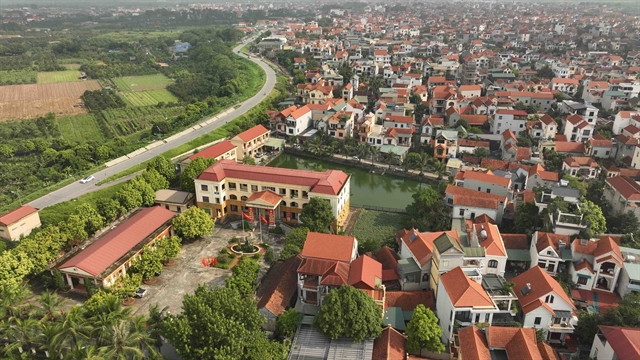 |
| A new-style rural area in Hà Nội. — Photo courtesy of the Hà Nội Office for Coordination of National Target Programmes |
HÀ NỘI — From centuries-old craft villages and heritage sites to clean farming models and experiential tourism, rural Hà Nội is opening up new development opportunities by combining traditional values with contemporary creativity.
Beyond improving infrastructure and living standards, these efforts help preserve cultural identity, enhance the appeal of rural communities and present the image of a dynamic Việt Nam deeply rooted in tradition to international friends.
With its wealth of ancient villages, craft villages, historical sites, festivals and folk knowledge, Hà Nội enjoys distinctive advantages in promoting rural development through culture and creativity.
Values preserved across generations are being brought to life through new approaches that connect production, the arts, tourism and education, creating fresh momentum for local economies.
In Phù Đổng Commune, Green Park eco-tourism site is gradually developing into a space where contemporary art meets the landscape, culture and heritage.
In Đào Thục traditional craft village, visitors can experience tuồng classical drama, chèo folk opera, ca trù ceremonial singing, traditional folk performances, water puppet painting and hand-printing, offering more engaging ways to connect with cultural heritage.
In Bát Tràng, pottery-making experiences and tours of communal houses and pagodas are helping bring traditional craftsmanship closer to visitors.
In Đường Lâm Ancient Village, lacquerware artisan Nguyễn Tấn Phát creates products inspired by traditional motifs, while the Đoài Creative space organises interactive activities and heritage experiences.
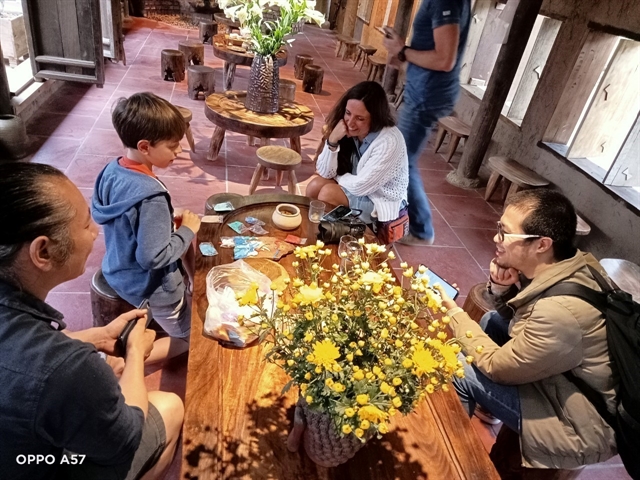 |
| International visitors take part in creative activities at Đoài Creative in Đường Lâm Ancient Village, Hà Nội. |
These models demonstrate that culture is not merely an asset to be preserved; it can also serve as a driver of economic development.
When connected with design, art, education and tourism, heritage remains relevant to contemporary life, generating higher-value products and distinctive attractions.
This approach holds considerable potential for Hà Nội, home to more than 1,350 craft villages and villages with traditional trades.
Rather than simply supplying products, rural communities can create additional value by sharing their cultural stories, offering on-site experiences and fostering exchanges between local people and visitors.
A handicraft can become an educational experience; a production workshop can turn into a cultural destination; and a village can introduce international visitors to Việt Nam’s history, customs and way of life.
Creative development, however, should not mean transforming rural communities through uniform urbanisation.
Upgrading roads, services and digital infrastructure must go hand in hand with preserving traditional architecture, landscapes and communal spaces.
It is this combination of modern amenities and traditional identity that gives Hà Nội’s countryside its distinctive character.
Alongside the promotion of cultural assets, improving people’s livelihoods remains fundamental to rural renewal.
In Thanh Trì Commune, local residents have donated 3,874sq.m of land, contributed more than VNĐ200.217 billion (US$7.75 million) and provided tens of thousands of workdays for public and welfare projects.
Residents of Tự Khoát Village donated 300 square metres of land, while those in Vạn Phúc 1 Village contributed 176sq.m for road construction.
More than 310 households voluntarily dismantled structures and relocated material storage areas to clear the site for a road running alongside the Tô Lịch River.
In agriculture, Thanh Trì is encouraging hydroponic and organic vegetable cultivation, citrus and other fruit growing, ornamental plants, and livestock farming that follows VietGAP standards and biosecurity practices.
By adopting new approaches and applying technological advances, the value of agricultural production rose from VNĐ190 million ($7,350) per ha in 2020 to VNĐ280 million ($10,830) per ha in 2025.
Meanwhile, initiatives such as farmers’ flower-lined roads, model gardens, clean houses and beautiful gardens, model residential areas, clean fields and waste sorting at source are helping improve the living environment.
According to Lã Văn Huy, Chairman of the Thanh Trì Commune People’s Committee, the commune currently has no poor or near-poor households.
These changes show that new-style rural development is measured not only by better roads and more efficient production, but also by the ability to create greener living environments, preserve cultural traditions and empower local residents.
These values are essential to sustainable development and help shape an image of Vietnamese rural communities that are modern yet rich in cultural identity.
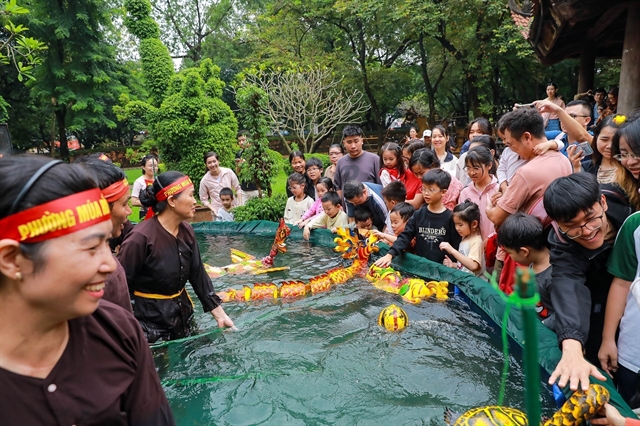 |
| Artists from Đào Thục Village’s water puppet troupe in Hà Nội perform water puppetry, delighting local residents and visitors from Việt Nam and abroad. |
Towards modern countryside
For the 2026-30 period, Hà Nội aims for 80 per cent of its communes to meet new-style rural development standards and 20 per cent to qualify as modern new-style rural communes.
In 2026 alone, the city expects three communes to meet its own set of new-style rural development criteria.
To achieve these targets, local authorities are reviewing conditions on the ground, identifying outstanding criteria and developing appropriate implementation roadmaps.
In Kiều Phú Commune, responsibilities have been assigned to individual departments, officials and civil servants.
Hát Môn Commune, meanwhile, had met 31 of the 47 indicators under the national criteria for new-style rural development for 2026-30 as of June 2026, providing a basis for prioritising resources to address the remaining gaps.
According to Nguyễn Đình Hoa, Deputy Director of the Hà Nội Department of Agriculture and Environment, the city has identified 36 communes in Group 1 and 39 in Group 2 for the implementation of the national criteria.
This classification enables localities to assess their actual conditions more accurately, select suitable development pathways and make more effective use of available resources.
Notably, Hà Nội’s vision of modern rural development places emphasis on science and technology, innovation, digital transformation, better-quality services and improved living standards.
These priorities create opportunities for rural communities to develop in a greener and more civilised manner, strengthen their economic vitality and expand connections with markets and international exchanges.
For a capital city as rich in heritage as Hà Nội, rural development also offers an opportunity to showcase the depth of Vietnamese culture through authentic living spaces.
Craft villages, traditional architecture, handicrafts, farming practices and community life can all serve as bridges helping international visitors gain a deeper understanding of Việt Nam’s people, culture and ongoing transformation.
Achieving this vision requires each locality to build on its own strengths while bringing together clean agriculture, traditional crafts, environmental protection and experiential tourism.
Economic development must go hand in hand with landscape conservation, heritage preservation and better living standards, ensuring that local people remain both the driving force behind creativity and the direct beneficiaries of change in their communities.
Unleashing creativity in the countryside is therefore not only a way to improve the effectiveness of new-style rural development, but also a fresh approach to harnessing cultural resources and promoting Việt Nam’s image abroad.
When tradition is carried forward through creative thinking, Hà Nội’s rural communities can become places their residents are proud to call home, while emerging as attractive destinations that introduce international audiences to a modern, welcoming Việt Nam with a rich cultural identity.
* This article was produced in collaboration with the Hà Nội Office for Coordination of National Target Programmes.
Society
 Society
 Society
 Society
 Society
 Society
 Society
 Society
 Society
 Society
 Society
 Society
 Society
 Society
 Society