 Society

ZOOD Real Estate launches Élevée, a $667 million project in north Riyadh
1.
|
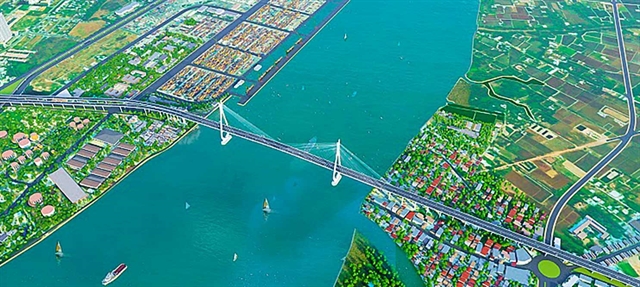
| A perspective view of the under-construction Cát Lái Bridge spanning the Đồng Nai River, a major transport link connecting HCM City and Đồng Nai City. HCM City is accelerating backbone infrastructure projects to strengthen inter-regional linkages. — Photo Courtesy of Advisory Unit. |
HCM CITY — Developing synchronised and modern infrastructure is a top strategic breakthrough for HCM City to maintain high economic growth and expand its urban space, Deputy Minister of Construction Nguyễn Tường Văn told a recent conference.
Speaking at the seminar "Investing in Synchronised Infrastructure Development: Economic Growth Driver and Expansion of HCM City’s Development Space", organised by the HCM City Department of Construction and Tiền Phong (Vanguard) newspaper on October 16, Văn said infrastructure is not only a vital transport link but also the key to reorganising the metropolis under a multi-polar model.
“An upgraded network will help relieve pressure on the historic inner city, boost regional competitiveness, promote logistics and maritime economics, and improve residents' quality of life,” Văn said.
He said administrative adjustments and new policy mechanisms under the Law on Urban Development 2026 provide a historic opportunity for the city to restructure its growth model.
The newly expanded space seamlessly connects the city's financial, commercial, and service hubs with surrounding industrial centres, innovation zones, seaport systems, and maritime economic areas across the Southeast region.
He asked experts and policymakers to focus on unlocking these spatial advantages to generate maximum value for both businesses and residents.
Trần Quang Lâm, director of the city's Department of Construction, outlined HCM City's action plan under Resolution No 09-NQ/TW, which aims to transform the city into a leading Southeast Asian metropolis by 2030.
Lâm said the immediate priority is tackling major bottlenecks, including traffic congestion, severe flooding, and environmental pollution.
“All tasks must be implemented on the basis of comprehensive planning,” Lâm said, adding that the city is inheriting and integrating previous master plans from the former HCM City, Bình Dương, and Bà Rịa-Vũng Tàu provinces to ensure seamless spatial coordination.
To achieve this, the city is accelerating key backbone projects, including Ring Road Nos. 2, 3 and 4, expressways, gateway routes, and port connections, with the goal of fundamentally completing the core network by 2030.
For urban transit, the city targets developing around 255km of metro lines by 2030.
It is also leveraging the Law on Urban Development 2026 to apply flexible investment procedures, streamline project approvals, and mobilise private capital through Public-Private Partnerships (PPP), EPC (Engineering, Procurement, and Construction), and BT (Build-Transfer) contracts.
|
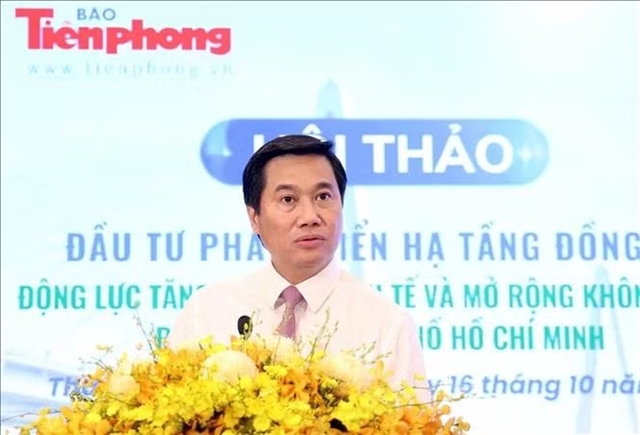
| Deputy Minister of Construction Nguyễn Tường Văn delivers his keynote address at the seminar on October 16, emphasising infrastructure as a strategic breakthrough for urban expansion. — VNA/VNS Photo Tiến Lực |
A multi-polar economic engine
At the seminar, experts agreed that sustaining double-digit growth over the long term requires proactive planning and synchronised execution across the region.
Vũ Đình Ánh, former deputy director of the Market and Price Research Institute under the Ministry of Finance, said infrastructure must serve as a long-term growth catalyst. He called for precise financial planning, as public budgets can cover only a fraction of the total investment required.
Addressing maritime potential, Nguyễn Xuân Phương, rector of the HCM City University of Transport, highlighted the need to build an integrated ecosystem combining seaports, logistics, industry, and maritime services.
A unified administrative area for major port clusters like Cát Lái-Hiệp Phước, Cái Mép-Thị Vải, and Cần Giờ makes integrated planning essential.
“We must avoid a scenario where ports are built first, but access roads come later,” Phương said, adding that roads, railways, navigation channels, barge berths, and logistics centres must be developed concurrently with port infrastructure.
Architect Ngô Viết Nam Sơn outlined a multi-polar urban model driven by three main economic engines: the central city as the financial and administrative core, Bình Dương area as the industrial hub, and Bà Rịa-Vũng Tàu area as the maritime and logistics gateway.
Echoing this view, Assoc. Prof. Dr. Trần Đình Thiên, former director of the Vietnam Institute of Economics, said the city must leverage its five strategic development spaces, including sea, sky, underground, digital, and cultural, to serve as Southeast Asia's strategic gateway.
Experts concluded that unlocking this vast potential will rely heavily on key regional anchor projects, such as Long Thành International Airport, Ring Roads 4 and 5, and high-speed rail lines. — VNS
Society
 Society
 Society
 Society
 Society
 Society
 Society
 Society
 Society
 Society
 Society
 Society
 Society
 Society
 Society