 Society
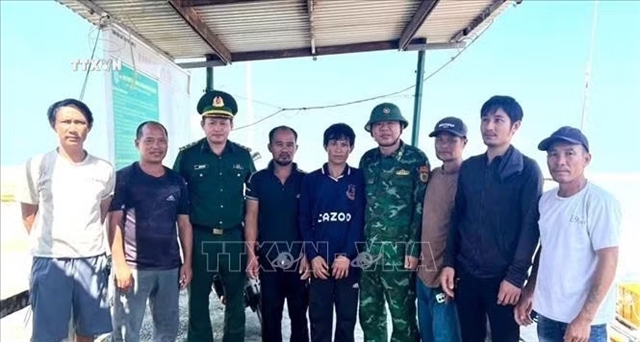
Five fishermen rescued after boat catches fire in Quảng Trị
1.
|
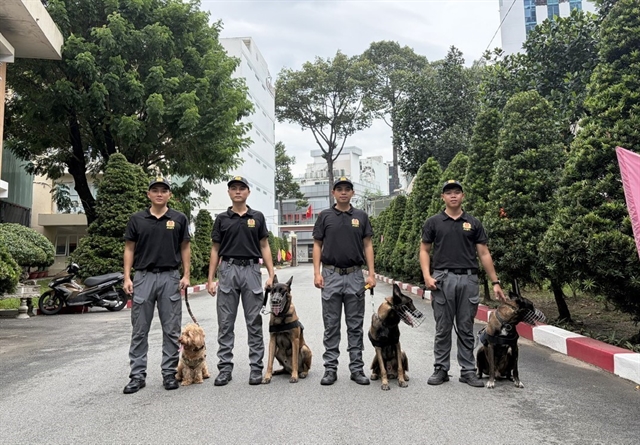
| Officers of the Southern Security Guard Division with their police dogs. — VNA/VNS Photo |
HCM CITY — Rarely seen in public, the police dogs of the Southern Security Guard Division (Security Guard High Command) are considered “security shields” for major national events.
At the unit, they undergo daily care and training under a rigorous regimen, remaining ready to carry out security checks at key locations and major events.
Behind their ability to detect explosives, weapons and signs of danger lies a process of persistent training. The trainers and their special four-legged partners share a deep bond.
Every day, the trainers start their jobs by checking health of the dogs, cleaning kennels, caring and preparing lessons.
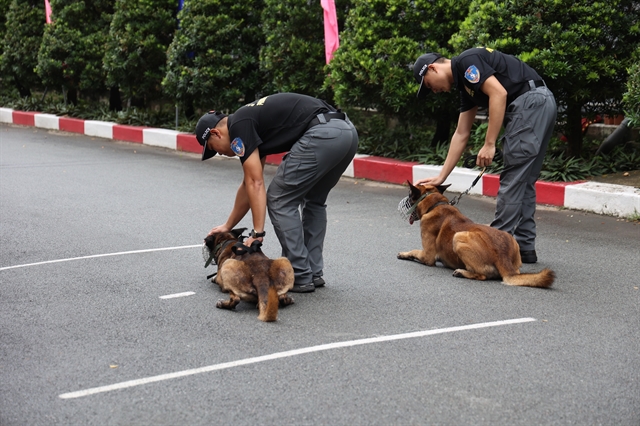
Basic movements such as standing, sitting and crawling are practised regularly, alongside specialised exercises for detecting explosives in vehicles, suitcases and various other locations.
Second Lieutenant Lê Tấn Thông, said: “I was assigned to train a dog named Rich when he was 11 months old. It took about a week to get acquainted – understanding his personality and building a bond – before training began.”
“Rich is quite gentle, though a bit energetic, so the settling-in process went relatively smoothly. Once a trainer understands a dog's personality and habits, the training process becomes much easier,” Thông said.
Lieutenant Colonel Trần Ngọc Trường, head of the Technical Protection Team, said that the police dogs are trained by a common curriculum from the Ministry of Public Security.
After being transferred to the Southern Security Guard Division, every dog receives extra training as per mission requirements.
“Along with abilities of detecting explosive and incendiary materials, some are specially trained to detect firearms, depending on their aptitude and ability to meet the requirements of each specific task,” Trường said.
The unit uses Belgian Malinois dogs, which are agile and responsive, making them well-suited to operational training.
According to the lieutenant colonel, sniffer dogs have an advantage thanks to their keen sense of smell and ability to search areas that are difficult to access.
Combined with technical equipment, the dogs assist the authorities in security inspections, detecting explosives, drugs and other dangerous objects.
The unit also uses cocker spaniels, which have compact bodies that make them useful for security checks. Their size allows them to access low and confined spaces where conventional inspection methods may be less effective.
The unit currently has four police dogs, all of which participate in training.
“Each dog undergoes seven sessions of basic skills training and 19 specialist training sessions every month,” Trường said.
“Advanced training focuses on searching for and detecting explosives in complex terrain and under varying environmental and weather conditions, as well as honing the dogs' ability to detect concealed firearms at protected locations,” he said.
The training programme is tailored to each dog's abilities, helping the animals adapt to real-world environments and respond correctly to commands.
Regular care, health checks and cleaning of their kennels are also maintained to ensure the dogs remain physically fit and capable of carrying out their duties.
|
| Dogs are being trained. — VNA/VNS Photo |
Close bond
Lieutenant Nguyễn Công Danh, a trainer of the dog named Oscar, said that training a dog typically takes about six months, depending on its learning ability and adaptability.
Trainers must thoroughly understand the characteristics and strengths of each dog to select the appropriate training method, said Danh.
“Dogs that follow commands correctly are praised, allowed to play or rewarded with food. If a dog fails to respond correctly, the handler must adopt a firm attitude so that the animal understands and changes its behaviour,” Danh said.
“To ensure the dog understands and follows commands, we must be patient and maintain discipline, while also providing care and encouragement to build a bond of trust,” said the lieutenant.
The dogs tend to cooperate best with their primary handlers, but they must also become familiar with other officers in the team.
Handlers are responsible for monitoring the dogs’ health, controlling their behaviour and maintaining their concentration in different environmental conditions.
For second Lieutenant Lê Tấn Thông, the 50th anniversary of the Liberation of the South and National Reunification in April 2025 was an unforgettable experience.
He and his dog – Rich – worked continuously for several days, sometimes setting out as early as one or two in the morning, with little time for rest. Despite the demanding schedule, he had to remain alert and coordinate closely with Rich to fulfil their duties.
When searching rooms or routes that protected individuals are expected to travel along, handlers work with their dogs to inspect every assigned area, paying particular attention to elevated positions, spaces beneath tables and chairs, and places where dangerous objects might be concealed.
If a dog detects anything suspicious, its handler reports the findings to the commander for action in accordance with regulations.
According to Lieutenant Colonel Trường, the Southern Protection Department operates across an area stretching from Khánh Hòa to Cà Mau provinces.
The deployment of police dogs depends on local conditions and the nature and scale of each event.
During the 50th anniversary of the Liberation of the South and National Reunification, the unit deployed police dogs to inspect vehicles, grandstands, ceremonial platforms and areas designated for delegates.
The requirements for maintaining security and safety demand a high degree of accuracy and meticulousness at every stage of preparation and inspection.
The Southern Protection Department has pledged to continue improving the management, care and training of working animals, intensifying specialised training and deploying teams in line with practical requirements, Trường said.
These efforts contribute to safeguarding senior leaders, international guests and important national events.
The friendly appearance of the police dogs reflects rigorous training and the dedication of their handlers.
The close coordination developed through daily practice helps protection officers fulfil their duties and ensure the highest standards of security and safety. — VNS
Society
 Society
 Society
 Society
 Society
 Society
 Society
 Society
 Society
 Society
 Society
 Society
 Society
 Society
 Society