 Society
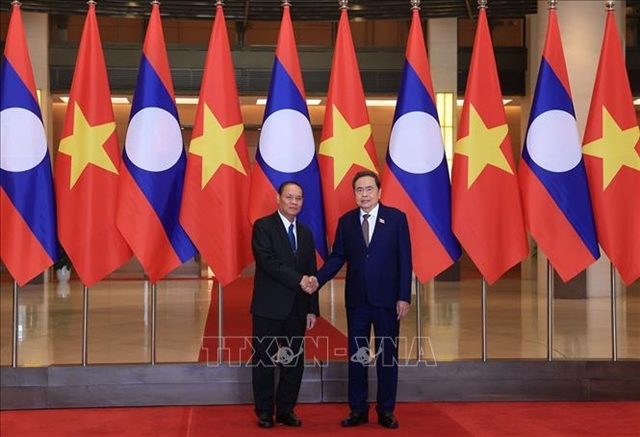
Việt Nam’s top legislator welcomes Permanent Member of LPRP Secretariat
1.
 |
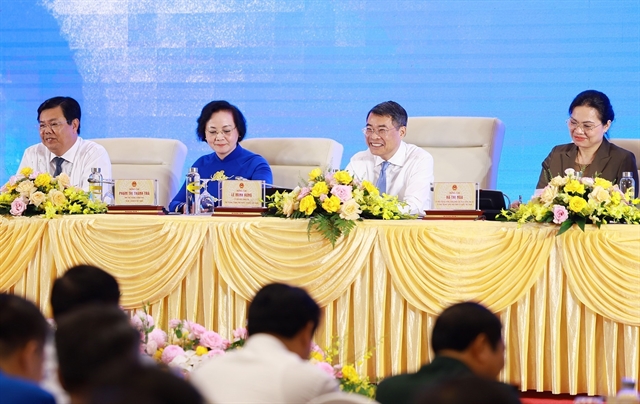
| Prime Minister Lê Minh Hưng with delegates attending the 2026 youth dialogue on Thursday. — VNA/VNS Photo Dương Giang |
HÀ NỘI — The Ministry of Home Affairs and the Government Office, in coordination with the Hồ Chí Minh Communist Youth Union Central Committee, held a dialogue between the Prime Minister and Vietnamese youth on Thursday, focusing on promoting youth entrepreneurship and innovation to boost growth and create jobs.
The event was attended by Prime Minister Lê Minh Hưng; Deputy Prime Minister Phạm Thị Thanh Trà; Hà Thị Nga, Vice President and Secretary-General of the Việt Nam Fatherland Front Central Committee; Bùi Quang Huy, Vice President of the Việt Nam Fatherland Front Central Committee and First Secretary of the Hồ Chí Minh Communist Youth Union Central Committee; and 300 young people representing more than 21 million Vietnamese youths.
At the dialogue, ministry representatives answered questions on scientific research, entrepreneurship, technology, innovation and the pioneering role of young people in national development.
Nguyễn Thị Như Quỳnh, an engineer at Vindynamics, a humanoid robotics research and development company, asked about measures to create jobs for young people as artificial intelligence (AI), automation and digital transformation reshape the labour market. Traditional jobs are changing or disappearing, while new positions require higher skills. About 1.6 million young people remain without jobs.
Minister of Home Affairs Nguyễn Tiến Hải said the youth unemployment rate among people aged 15-24 reached 9.07 per cent in the third quarter of 2026, more than four times the national rate of 2.22 per cent, according to the National Statistics Office.
About 1.6 million young people, or 11.2 per cent of the youth population, were not in employment, education or training. However, the rate remained below the global average of more than 20 per cent and Southeast Asia's rate of over 16 per cent.
He attributed the situation to limitations in training quality and a mismatch between education and labour market demand. Young people, particularly those in remote and ethnic minority areas, also face limited access to education and employment information. Some lack experience and skills or are insufficiently proactive in seeking work, while others rely on family support and do not seek employment.
The Government will raise awareness of the importance of education, training and employment, promote sustainable economic growth and expand vocational and information technology training in line with labour market needs, he stated.
The Ministry of Home Affairs is implementing labour and employment policies, improving labour market analysis and forecasting, and developing a worker database linked to national databases and the national employment exchange to better match job seekers with employers, he said.
It is also working to improve the quality of young Vietnamese workers sent overseas under labour contracts and strengthen career counselling and job placement through public employment services, educational institutions, businesses and local authorities, he added.
Giving young scientists major challenges
Đặng Thị Lệ Hằng, a doctoral researcher at the Vietnam Academy of Science and Technology's Institute of Advanced Technology, asked how young scientists could receive research assignments, funding and product evaluations that would enable them to contribute to national development.
Minister of Science and Technology Vũ Hải Quân said his first policy after taking office as minister was to provide outstanding doctoral researchers with support of up to VNĐ1 billion (US$38,000) a year for three years.
Applications to the basic research programme increased from 31 per cent in 2024 to 46 per cent in 2025 and 67 per cent in 2026, he said, reflecting growing interest in basic research, particularly among young scientists.
The ministry also plans to invite 50 young Vietnamese scientists to Russia for an international congress of young scientists. In addition, a programme supporting AI adoption by businesses, particularly small and medium-sized enterprises, offers funding of up to VNĐ3 billion to help young AI talent develop ideas with businesses to improve productivity and quality. Successful initiatives could receive long-term investment.
Quân urged young people to begin tackling major national challenges by solving smaller research problems thoroughly. He outlined five priorities: developing a long-term vision, maintaining an open mindset and confidence, committing to sustained effort, building professional networks and drawing up concrete action plans to contribute to the country.
Expanding funding
Responding to Nguyễn Thùy Chi, a person with cerebral palsy and co-founder and deputy director of Chạm Vào Xanh Co. Ltd., Deputy Finance Minister Tạ Anh Tuấn praised young people's entrepreneurial ambitions and commitment to the community.
He said the Government needs to improve the business environment, reduce costs and unlock resources to help young people establish and grow businesses.
Under Politburo Resolution 68 on private economic sector development, the Ministry of Finance has advised the Government on financial and tax policies to support small and medium-sized enterprises. These include raising the annual revenue threshold for household businesses exempt from tax to VNĐ1 billion and cutting personal and corporate income taxes by 30 per cent for eligible entities with annual revenue below VNĐ10 billion.
The ministry has also submitted a draft Law on Small- and Medium-sized Enterprise Development to the National Assembly for consideration at its October session. The draft aims to connect startups with investors and business support networks, strengthen links between smaller and larger domestic and foreign companies, simplify procedures, reduce compliance costs and improve access to capital.
Tuấn said the ministry will continue to refine policies, cut administrative procedures and costs, and implement support measures to facilitate youth entrepreneurship.
He said the ministry hopes young people will build not only successful businesses but also competitive, large-scale enterprises that create jobs, contribute to national development and expand into regional and global markets. — VNA/VNS
Society
 Society
 Society
 Society
 Society
 Society
 Society
 Society
 Society
 Society
 Society
 Society
 Society
 Society
 Society