 Society

Swiss President to visit Việt Nam on October 17–18
1.
|
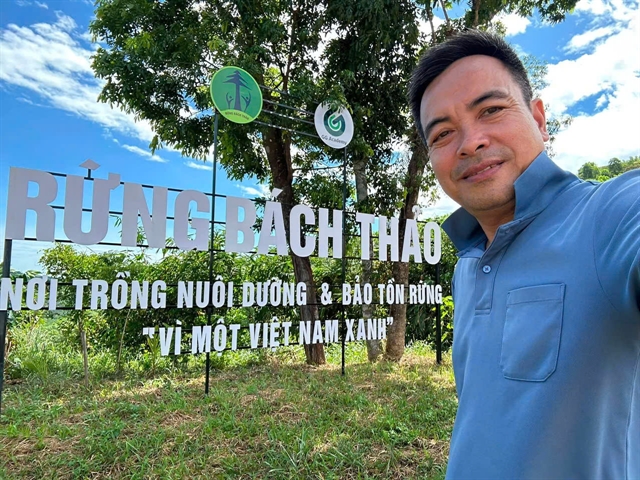
| Nguyễn Văn Bình introduces his jungle-structured garden in central Việt Nam. He has transformed a 20ha acacia log farm into sustainable agro-forestry project in trends of global 'green' farming growth. Photo courtesy of Rừng Bách Thảo Co-operative |
By Công Thành
CENTRAL REGION – In transforming 20ha of acacia farm in Cẩm Lãnh village, 70km south of Đà Nẵng City, Nguyễn Văn Bình, 49, spent three years redesigning the low-value log farm into an eco-forest garden for long exploitation and native terrain conservation.
A multi tree-layer jungle structure was set up in a garden-size lay-out, including a protected wall fence with bamboo, indigenous timber and canopy-grown herbs and high-value fruits in the middle-land terrain farm.
The garden could create immediate revenue by collecting extracted oil from short-term cinnamon, lemongrass, ginger and turmeric, while betel, durian and mangosteen are expected for a relaxed harvest.
|
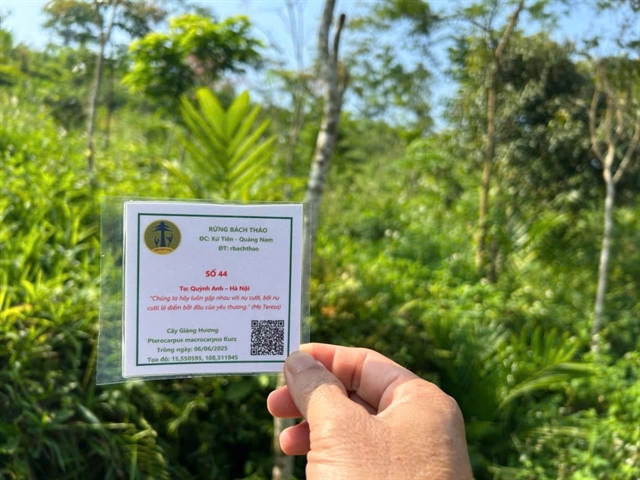
| QR Code is marked on larger timber trees at the Botanical Garden Co-operative in central Việt Nam. Digital transformation and IT applications have been adapted in boosting nature-based 'green' farming in central Việt Nam. Photo courtesy of Nguyễn Văn Bình |
Valuable tropical hardwood species native – Rosewood, green ironwood, Agarwood and black locust – listed among the most threatened plants in Việt Nam, were all grown in the garden, Bình said.
“I have been seeking long-term targets from the garden in terms of economic value, climate-resilient circular agriculture mode and practical education for young generations. Larger timber species will be reserved for the next few decades, but it creates a ‘green’ shadow for herbs, fruits and ginseng roots,” Bình explained.
“I assigned 50 per cent of middle and long-term herbs for annual revenue, while larger timber accounts for 40 per cent and bamboo is the remaining share. The garden regularly produces income for farmers and covers the reinvestment fund,” he said.
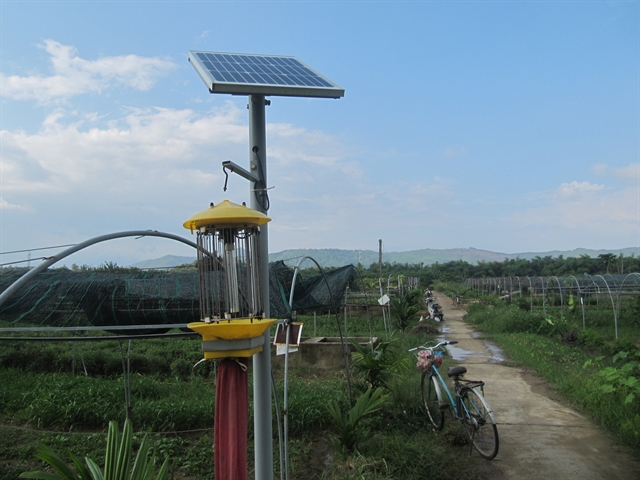
|
| Solar power panel installed at a farm in central region. Many farms have been boosting non-chemical and recycling production for long-term sustainable growth target. VNS Photo Công Thành |
Bình estimates that each hectare of the garden would earn VNĐ1.5 billion (US$60,000) – much higher than an acacia farm, while conserving the ‘evergreen’ environment and land protection from erosion.
He established his own Botanical Garden Cooperative to introduce the first sustainable model of a jungle-structured high-value garden in the main log farm-based midland region.
Bình has been building digital applications in product traceability for exportable standard and environmental protection qualifications.

|
| A shrimp farm in central Việt Nam being applied non-chemical aquaculture for global export and value chain. The solution has become a choice for local farmers going 'green' with world market reach. VNS Photo Công Thành |
Low carbon
Diệp Thị Kim Hoàn, from Hải Phòng-based DEEP C Industrial Zones, a Belgian industrial park developer, said the business has been pioneering an innovative and sustainable approach to industrial development in Việt Nam.
She said a series of ‘low carbon’ solutions were used at five industrial parks in Hải Phòng and Quảng Ninh, including power efficiency, wind and solar power system development and nature-based infrastructure.
“Energy efficiency adoption has helped the company save 5.76 million kilowatts per hour each year, while reducing consumption by 88,000 cubic metres and cutting 10,000 tonnes of carbon emissions,” Hoàn shared.
“’Green’ designs – bushes and shadow canopy trees – and a 14ha lake, or ‘wetland’ zone were built at the IZ to cool down the temperature and absorb carbon emissions.”
“An amount of one tonne of plastic waste was used as material for building a 200 metres inner road at the IZ, and nearly 250,000 plastic bags were either reused or recycled. Kitchen waste was also composted for a farm to supplying one tonne of fresh vegetables to poor labourers,” she said, adding that old labour clothes were designed as shopping bags or reusable labour fashion for the other workers.
Trần Trung Mỹ, from TH Milk Group, said ‘circular’ adapted solutions were built as a sustainable production chain in linkage with the farmers' community at dairy farms.
“We completely consume the farm produce of the local farmers' community to feed cows, while 25,000 tonnes of cattle waste is composted for dairy farms. The solution helped reduce 50 percent of greenhouse gas (GIG) emissions in 2019-25,” Mỹ reported.
He said rooftop solar power system also saved 10 percent of power use as well as energy use from biogas at farms.
Tech-based aquaculture
Non-antibiotic aquaculture was thoroughly applied to 250 shrimp farms by Việt Úc Seafood Group in Phù Mỹ commune of Bình Định Province (Gia Lai Province now).
Microbes were adapted as a dual-purpose solution in transforming an Aquaculture farm model into an Aquaculture Technology Group (Aquatech), said Đào Tấn Học, an engineer at the farm.
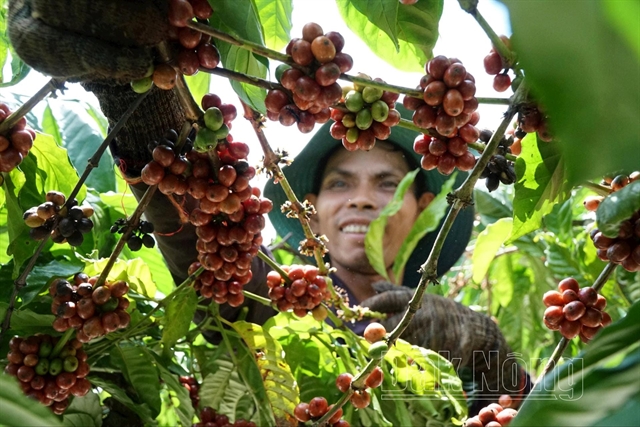
|
| A farmer collects coffee beans at his farm in the Central Highlands of Đắk Nông. Farmers have been aware of sustainable farming in approaching long-term production. Photo courtesy of ĐắK Nông Portal |
He shared that the bio-based control had reduced the 300 cubic metres of water that used to discharge all feed.
“Our farms currently do not have any chemical-based water treatment or antibiotics, but probiotic adaption was used instead of previous aquaculture practices. Our shrimp product is no longer tested with over antibiotic residue now,” Học explained.
He said the farm achieved a healthy quality of 30 shrimps per kilo in the company’s export turnover of 1 million tonnes per year.
Vương Văn Quý, from Agribank, blamed that a series of barriers have limited ‘green’ transformed farming projects' access to the bank’s loans, including a legal framework for risk control, database, transparent cash flow, ESG performance and emission measurement.
He said Agribank has offered ‘green’ credit programmes in supporting projects in hi-tech farming, One-Commune-One-Product (OCOP) and conservation-protected agroforestry projects in the region.
The European Union (EU) and Visible Impact (a German non-profit organisation), the Centre for Social Research and Development (CSRD) has jointly partnered with the GreenViet Biodiversity Conservation Centre in funding initiatives for green and circular economy applications in central Việt Nam.
The central and Central Highlands region of Việt Nam – one of the richest biodiversity sites in Việt Nam – has been building as a key economic power of the country in terms of a fully transformed ‘circular and green’ economy by 2050. VNS
Society
 Society
 Society
 Society
 Society
 Society
 Society
 Society
 Society
 Society
 Society
 Society
 Society
 Society
 Society