 Society
Vietnam Hardware & Hand Tools Expo 2026 to return to HCM City
1.
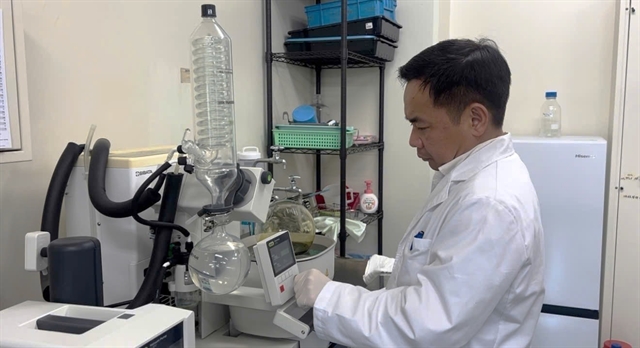 |
| Trần Đăng Xuân at work in his laboratory. — VNA/VNS Photo |
HÀ NỘI — In a set of early trials in Việt Nam and Japan, rice plants given only half their usual fertiliser produced as much grain as others given the full dose. The difference was bacteria.
The microbes in question are photosynthetic bacteria, known as PSB, which, like plants, draw their energy from light. Applied to rice, they have produced striking results in early tests.
Yields rose by more than a fifth, and under certain trial conditions, PSB combined with half the standard mix of nitrogen, phosphorus and potassium fertiliser matched the harvest from the full amount.
The findings are preliminary, but the appeal is obvious. A farmer who can halve fertiliser use without losing any of the crop spends less and earns more, and less of the surplus washes into rivers and canals.
It is the kind of gain, says Trần Đăng Xuân, that points towards a genuinely sustainable agriculture.
Xuân, a specialist in agriculture and biotechnology at Hiroshima University’s IDEC Institute, was recently ranked first at the university in plant science and agronomy by Research.com.
He has spent many years researching and teaching in Japan. Throughout that time, he says that his aim has stayed the same: to see his findings put to use in Việt Nam.
The bacteria are one part of a wider argument about what Vietnamese farming should become. In Xuân’s view, the sector has long been guided by a single instinct: produce as much as possible.
He wants that to change to farming smarter by putting quality first and drawing more economic value from the same plot of land. That, he argues, is how farmers’ incomes will rise and how Vietnamese produce will compete.
His research follows three main lines towards that goal. The first deals with the climate. Rice is increasingly exposed to extreme heat, drought and seawater creeping into farmland. His team is developing ways to help crops withstand all three.
The second looks inside the rice plant itself. Rice produces compounds called momilactones. His team is particularly interested in two of them, momilactone A and momilactone B.
He sees them as the raw material for high-value products. He also sees a more practical use. These compounds give rice a natural ability to suppress weeds, and if that ability can be harnessed, farmers can depend less on chemical sprays.
The third line explores natural compounds that could protect crops safely without harming the environment. His team is preparing to test one taken from a plant common in rural and mountainous Việt Nam.
Researchers in Taiwan have previously studied the compound as a possible lung cancer treatment, and it has shown signs of repelling nematodes, the tiny worms that damage crops. If the trials succeed, Xuân believes it could become a valuable biological tool for farmers.
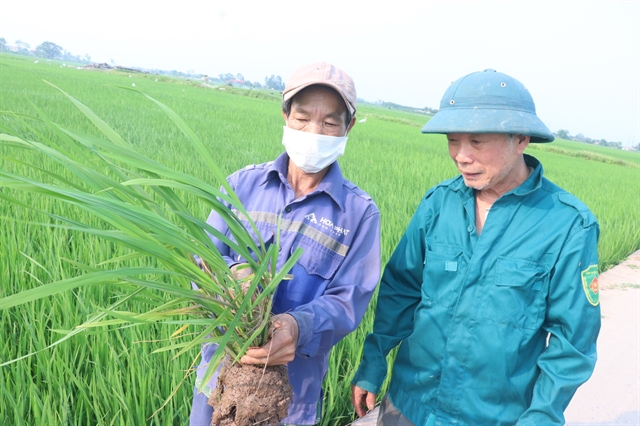 |
| Two farmers in the northern province of Hưng Yên check a bunch of rice plants for pests and disease. — VNA/VNS Photo |
Farming smarter requires training, which he places particular weight on. By his own account, he has been principal supervisor to more than 70 masters' students and 26 doctoral candidates at Hiroshima, many of them Vietnamese.
He is also trying to build something more lasting than a list of graduates. Under a "satellite campus" model, Hiroshima University runs doctoral training in partnership with Vietnamese universities.
The first partnership, with Thái Nguyên University of Agriculture and Forestry in northern Việt Nam, covers agriculture and biotechnology. It enrolled its first students in October 2024.
He has also been comparing notes with Vietnamese professors and lecturers at other Japanese universities, hoping to share what methods work and see similar partnerships spread.
Good science and well-trained people are not enough, however, if the system around them does not work. Việt Nam, he says, has adopted a long list of progressive policies on science, technology and innovation. The challenge is promoting awareness of those policies and ensuring that they're properly applied.
Xuân gave the example of a Vietnamese company which recruited a team of foreign experts to develop a biological product in Việt Nam.
Besides paying them well, it promised them 5 per cent of after-tax profits once the product was commercialised. Both sides were satisfied.
Xuân then told them about the Law on Science, Technology and Innovation, passed by the National Assembly on June 27, 2025. Its rules on sharing the proceeds of State-funded research, he says, could entitle the researchers to many times more than what they were promised.
Neither the company nor the experts had heard of those rules.
The lesson he draws is that publicising and implementing existing policy needs a stronger push, so that incentives designed to reward innovation actually reach the businesses and scientists they were written for.
Việt Nam must also keep improving how the State, companies and researchers work together, he argues, especially regarding intellectual property, how rewards are divided and how research reaches the market.
Get that right, and the country will find it far easier to attract talent inside and outside Việt Nam, and make science and technology real engines of economic growth.
Some of that talent is already abroad, and Xuân sees it as one of Việt Nam’s underused assets. In Japan alone there is the Việt Nam–Japan Society of Experts (VJS), the Vietnamese Academic Network in Japan (VANJ), several associations of Vietnamese intellectuals and a range of community groups.
Each has its own strengths, he says. Each organisation and each member can help build Việt Nam’s science and technology base, particularly in strategic technologies; in doing so they can contribute to growth and national competitiveness.
Japan itself is part of that picture. Việt Nam can draw on Japan’s scientific and technological strength, he says, as well as the goodwill its government and people have shown towards Việt Nam’s development.
Given the warm relations between the two countries, he believes the Vietnamese scholars and experts living in Japan can act as a catalyst, deepening trust and drawing the two sides into closer cooperation.
No single scientist can carry a country’s agriculture forward, and Xuân is clear about that. One person’s contribution, however large, will always have limits, he says.
But when thousands, even tens of thousands, share the same ambition, their combined strength can move a nation. — VNS
Society
 Society
 Society
 Society
 Society
 Society
 Society
 Society
 Society
 Society
 Society
 Society
 Society
 Society
 Society