 Society
Eximbank shareholders approve board expansion, changes to foreign ownership rules
1.
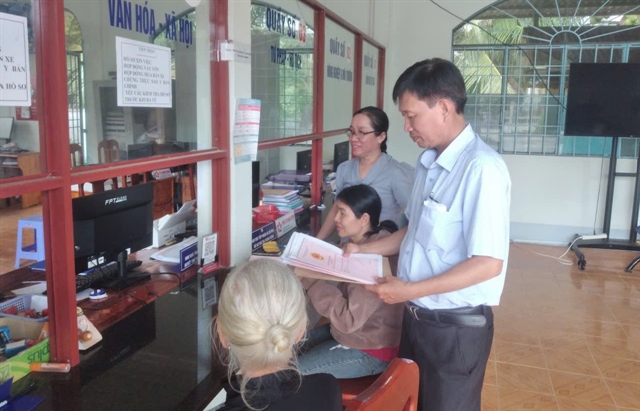 |
| Residents visit the public administration service centre in Trung Hiệp Commune, Vĩnh Long Province to handle paperwork. — Photo baochinhphu.vn |
Lê Sơn
VĨNH LONG — On any given day, Võ Thị Lệ Hiền might start with a pile of forms for a national rural development programme, pause to deal with neighbours complaining about the stench from a nearby livestock farm and spend the afternoon coaching a local food producer through the fine print on labelling.
A year ago, she covered one area of policy. Now she has five, none of which she had handled before.
Hiền is a civil servant in Trung Hiệp, a rural commune in the Mekong Delta province of Vĩnh Long. Even the work closest to her degree in rural development turned out to be a maze of targets, templates and paperwork. Many of her colleagues now juggle three or more policy areas, and weekends in the office have become routine, she said.
What changed her job was a decision taken far away. Last year, as part of the Communist Party's drive to streamline the apparatus, Việt Nam scrapped its entire district tier of government, merged its 63 provinces and cities into 34 and folded roughly 10,000 communes into about 3,300 larger ones.
The district tier disappeared. The work did not.
In the Mekong Delta province of An Giang, officials have counted nearly 1,600 tasks passed down to communes since the districts disappeared. Some of the new wards are cities in all but name: Rạch Giá now has more than 260,000 people under a single ward office.
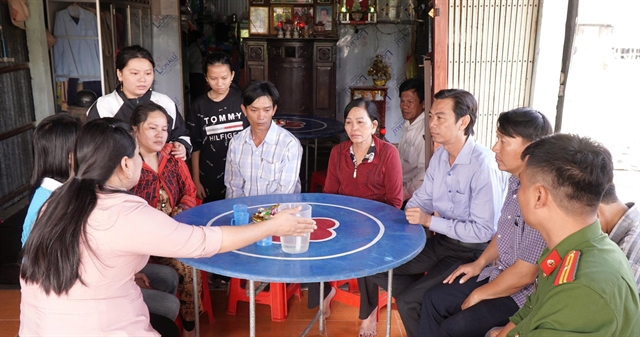 |
| The chairman of a commune People's Committee in Cà Mau visits a family in difficult circumstances. — Photo baochinhphu.vn |
According to the province's own assessment, some officials are struggling to cope with the bigger territory and wider powers.
The neighbouring city of Cần Thơ has adopted the slogan 'one person, many jobs' and handed communes new powers over paperwork, budgets and small investment projects.
The trade-off is plain enough: when the commune holds the pen, it also takes the blame. A land case that stalls or a permit that never arrives can no longer be quietly passed up the chain. It sits on the commune's desk, in full view of the people waiting for it.
Yet early figures from some places are reassuring.
In Nguyễn Phích, a commune in Cà Mau, almost 99 per cent of the 4,325 applications received in 2025 were dealt with on time, according to a local survey that also shows residents' satisfaction at about 96 per cent. Nobody pretends the upheaval is over, but there, at least, the ordinary machinery of government has kept turning.
Up to the task
The harder question is whether the people now running the communes are up to the task. On paper, most are. The trouble is that a certificate says very little about what someone will do when a problem walks through the door that doesn't fit any form.
In Tân Hồng, a commune in the border province of Đồng Tháp, local party secretary Nguyễn Minh Ngọc said many cases refuse to stay in their lane. Knowing the regulations is the easy part – the skill lies in judging when to handle something yourself, when to bring in other agencies and when to pass it upwards.
In Vĩnh Long, the complications are cultural. About one in nine people in the province belong to an ethnic minority, many of them Khmer, and a third follow a religion.
Kim Ngọc Thái, a senior provincial official, argues that some land quarrels and neighbourhood feuds will never be settled by procedure alone. An official has to hear the story behind each complaint.
Trust comes from unglamorous things: knowing which families are struggling, turning up when you're needed and treating people with respect even when you have to tell them no.
The officials villagers like best, he said, are those who "talk less, do more and do what they say".
Region IV Political Academy researcher Nguyễn Yến Nhi said such skills don't mean going easy on the rules. Knowing when to explain, when to negotiate and when simply to enforce is what makes the rules stick.
Then there is the screen. More of a commune's work now runs through online portals and shared databases, and officials are expected to help residents who can't figure them out.
Vũ Thị Bích, another researcher at the academy, warns that this takes more than knowing which buttons to press. An official who understands the system but not the villagers risks turning digital government into one more layer of red tape. At the same time, one who knows every family but can't keep up with the software is just as stuck.
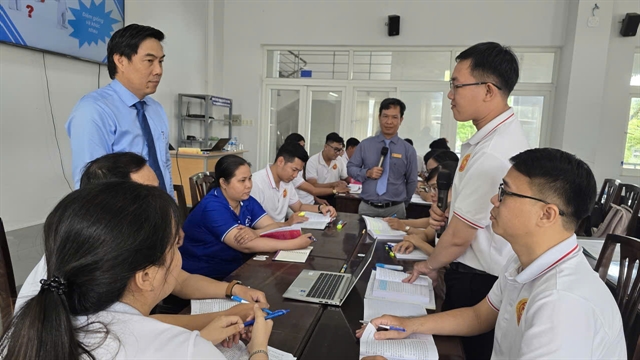 |
| Trainees and lecturers at a political school in Cần Thơ discuss situations commune officials may face on the job. — Photo baochinhphu.vn |
Provincial political schools
Closing this gap falls largely to provincial political schools, which train local officials in party doctrine and public administration. Dương Quốc Hoàng, deputy director of the Phạm Hùng Political School in Vĩnh Long, is blunt about where they fall short.
"The biggest gap isn't in theory. It's in authority," he said.
Commune officials now wield powers that used to belong to the districts, but the courses were built for the old system. Trainees go home understanding the policy, then trip over procedures, deadlines and the question of who is legally on the hook.
The training, as he puts it, is strong on 'why' and weak on 'how', and who answers for it.
His school has started bringing real cases into the classroom. In one, two families are feuding over a boundary along the old line between two communes that have since merged.
The land records disagree on plot sizes because the plots were surveyed at different times; the families want it settled now, and the land officer, new to the job, doesn't know the history.
Trainees have to work out what the commune is allowed to do, how to run the mediation and how to explain the outcome so that neither family takes the fight over the commune's head. There is nothing to memorise.
Other schools are moving the same way. In Đồng Tháp, staff want to build a library of real local disputes, so that one commune's hard-won solution becomes another's precedent.
Given a typical five-day course to redesign, Hoàng from the Phạm Hùng Political School would drop lectures that recite documents people can read for themselves and spend most of the week on real files, real software, mediation and working with specialists from the province.
The political theory wouldn't disappear, he said. Instead, it would be built into the cases.
Hoàng suggests comparing figures communes already keep, such as how many applications run late or how many disputes end in agreement, in the months before and after a course.
He would also swap part of the written exam for a practical assignment: each trainee drafts a plan to fix a current problem in their own commune. If the plan is good, it gets used.
Done properly, a course wouldn't end with a certificate on the wall. It would become a loop: find where communes are struggling, teach to that gap, send people back, see what changes, adjust.
What matters in the end isn't how many courses an official has sat through. It's whether the people who walk into the commune office walk out with their problem solved. For Hiền and her pile of work in Trung Hiệp, that exam comes round every morning. — VNS
Society
 Society
 Society
 Society
 Society
 Society
 Society
 Society
 Society
 Society
 Society
 Society
 Society
 Society
 Society