 Society

Digital transformation opens new prospects for sports medicine in HCM City
1.
 |
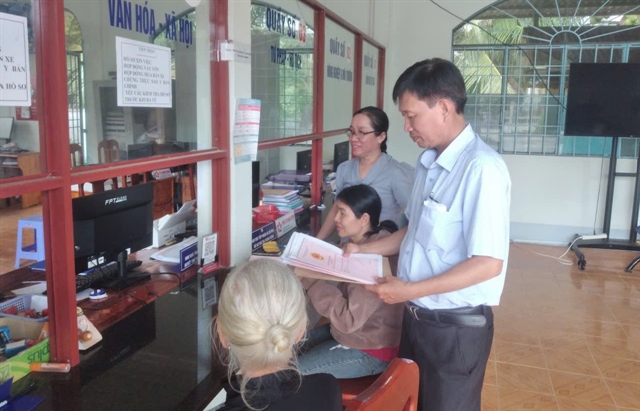
| Staff at the personnel department use information technology and modern software to manage officials and employees. VNA/VNS Photo Quý Trung |
HÀ NỘI — More than a year after the Politburo issued Resolution 57-NQ/TW on breakthroughs in science, technology, innovation and national digital transformation, many localities are seeing notable socio-economic changes and developing approaches tailored to their own conditions.
Administrative reform and digital infrastructure
In Lai Châu Province, a mountainous area still grappling with limited infrastructure and human resources, Resolution 57 is creating opportunities to narrow the development gap.
Shortly after the resolution was issued, the Lai Châu Provincial Party Committee moved swiftly to put it into action, adopting its own Resolution 10-NQ/TU on developing science, technology, innovation and digital transformation through 2030.
The province has set out a clear development approach: prioritising practical application over research, putting people and businesses at the centre, and choosing technologies that suit local needs rather than spreading resources thinly or chasing expensive solutions.
As of March 31, 2026, the province had carried out 240 tasks under the resolution. Of these, 137 had been completed, 23 were on schedule and 80 were being carried out on an ongoing basis. Local agencies and authorities have also put forward 121 initiatives and breakthrough models.
In administrative reform, 93.87 per cent of applications were submitted online, well above the 80 per cent target, while 94.06 per cent of records have been digitised, exceeding the target of more than 90 per cent. A dedicated data transmission network now links all provincial departments and agencies.
Lai Châu ranked fourth among 58 ministries, sectors and localities for electronic document processing, and seventh among 38 provincial and municipal Party committees for progress in standardising Party member data.
The province is also investing in digital infrastructure and skills. It aims to provide basic digital skills training to all officials, civil servants and public employees, assign at least one dedicated digital transformation official to every commune, and ensure at least half of its IT staff obtain basic data management certificates.
Campaigns such as “Youth Pioneering Digital Transformation”, “Women Doing Business Online”, “Farmers Applying Smart Agriculture” and, in particular, “Digital Literacy for All” have been widely rolled out. Community digital technology teams in villages and hamlets are helping residents get to grips with technology, an approach well suited to mountainous areas.
On infrastructure, the province aims to extend 4G coverage to every village and hamlet by mid-2026 and install 5G base stations in commune and ward centres, eliminating signal dead zones so that residents can access digital services.
Laying the groundwork for long-term growth
In Cà Mau Province, Resolution 57 is seen as a key driver of development, especially as the province pursues double-digit economic growth while ensuring sustainability.
From the outset, provincial Party and government leaders turned the resolution into practical programmes and plans, clearly assigning responsibilities, tasks, outputs and deadlines.
Cà Mau has consistently prioritised science and technology, digital transformation and innovation alongside the green transition. The province sees this as the foundation for higher-quality growth, closely tied to cultural and social development, social welfare and better living standards.
According to its review for the first quarter of 2026, Cà Mau was assigned 243 tasks under the resolution, of which 133, or 54.73 per cent, had been completed, 30 were on schedule and 80 were being carried out on an ongoing basis.
The province has also committed adequate resources, with spending on science, technology, innovation and digital transformation accounting for 3.2 per cent of the local budget, in line with the resolution’s requirements.
A key priority for Cà Mau is building digital government alongside administrative reform, with public satisfaction as the measure of success. The province has expanded online public services and is gradually shifting to a governance model based on real-time data to improve decision-making and management.
It is also developing data infrastructure to ensure information is “accurate, complete, clean, up-to-date, consistent and shared”, and connecting it with the National Population Database. This is regarded as an essential foundation for the digital economy, digital society and digital government.
Cà Mau is also fostering science, technology and innovation through partnerships between the State, schools and businesses, with the aim of building an innovation ecosystem. Businesses are expected to lead the way in applying and transferring technology, while also helping train the province’s digital workforce.
However, challenges remain. Technical infrastructure at the grassroots level is uneven, special policies are not yet strong enough to attract and retain highly skilled workers and scientists, and database development still depends on central guidance and timelines.
To tackle these issues, Cà Mau plans to introduce a scheme on science, technology, innovation and digital transformation for 2026–2030, along with a scheme on applying high technology in selected sectors. These will focus on special policies to attract talent and support innovative start-ups, while developing digital infrastructure in tandem with transport, power, lighting and other technical infrastructure.
The experiences of Lai Châu and Cà Mau show that Resolution 57 is gradually taking root through concrete measures tailored to local conditions. Digital transformation is being applied in practical areas such as administrative reform, agricultural production and governance, delivering initial results.
To achieve stronger change, however, mechanisms and policies need further improvement, particularly in digital infrastructure, data development and sharing, and attracting and nurturing high-quality human resources.
Maintaining a clear assignment of responsibilities, tasks, timelines and outputs, combined with local initiative and creativity, will be key to ensuring the resolution continues to deliver results and supports rapid and sustainable development. — VNS
Society
 Society
 Society
 Society
 Society
 Society
 Society
 Society
 Society
 Society
 Society
 Society
 Society
 Society
 Society