 Sci-Tech

Luxury train linking Hà Nội and Ninh Bình to be launched
1.
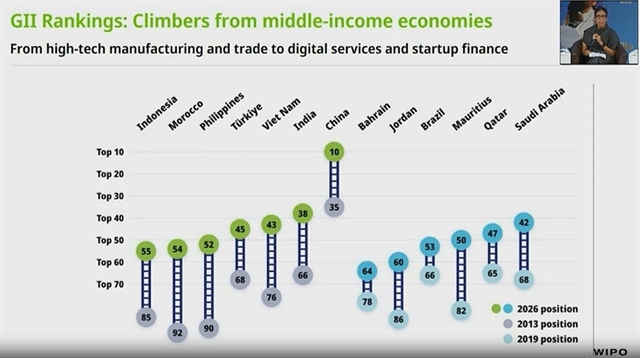 |
| Việt Nam climbed from 76th place in 2013 to 43rd in 2026 in WIPO's Global Innovation Index. — Photo from WIPO |
HÀ NỘI — Việt Nam ranks 43rd among the 139 economies covered by the Global Innovation Index (GII) 2026, moving up one place from 2025, according to a report released by the World Intellectual Property Organization (WIPO) on Tuesday.
The ranking marks a significant improvement in Việt Nam’s standing over the past decade, from 59th place in 2016 to 44th in 2024 and 2025 and 43rd in 2026.
The report places Việt Nam second among the 36 lower-middle-income economies, while the country ranks 35th for innovation outputs, up two places from 37th last year.
WIPO recognises Việt Nam as one of seven middle-income economies that have improved their rankings the fastest since 2013, alongside China, India, Türkiye, the Philippines, Morocco and Indonesia.
Việt Nam is also one of three economies whose innovation performance exceeds expectations for their level of development, together with China and India, according to the report.
The GII ranks economies worldwide based on their innovation capabilities. Comprising roughly 80 indicators grouped into innovation inputs and outputs, the index aims to capture the multidimensional nature of innovation.
Minister of Science and Technology Vũ Hải Quân said Việt Nam’s two-place improvement in the innovation output ranking was a noteworthy achievement, attributing the result to strong efforts over the past year to implement Resolution No. 57 on breakthroughs in science and technology, innovation and national digital transformation.
He said investment in science and technology, innovation and digital transformation had increased significantly.
The participation of stakeholders, from the State and businesses to research institutes and universities, had also helped lay the foundations for an innovation ecosystem in Việt Nam, he said, adding that these efforts were reflected in the country’s innovation performance.
To achieve the goal of placing Việt Nam among the top 40 economies in the GII by 2030 and the top 30 by 2045, the minister said there was still a great deal of work to be done.
“We need to continue improving the quality of human resources, especially postgraduate talent,” he said.
He also stressed the need to promote international scientific publications and increase the number of patents, which he described as outputs directly linked to innovation capacity.
The minister highlighted greater business participation in innovation and research and development as particularly important.
Vietnamese businesses need to step up investment in both funding and human resources, while gradually applying technology and advancing digital transformation in their production and business operations to improve product quality, increase added value and boost labour productivity, he said.
“Only when businesses truly get involved, I believe, can we achieve the innovation targets set for 2030 and 2045,” he said. — VNS
Sci-Tech
 Sci-Tech
 Sci-Tech
 Sci-Tech
 Sci-Tech
 Sci-Tech
 Sci-Tech
 Sci-Tech
 Sci-Tech
 Sci-Tech
 Sci-Tech
 Sci-Tech
 Sci-Tech
 Sci-Tech
 Sci-Tech