 Society
Israeli agricultural know-how takes root in Việt Nam
1.
|
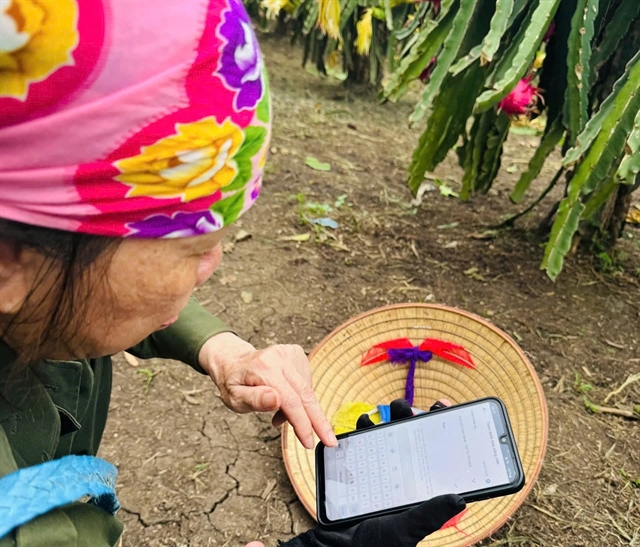
| A female dragon fruit farmer in Sơn La uses an electronic farming log connecting with domestic and international markets. — VNS Photo Thế Cường |
HÀ NỘI — Việt Nam is entering a new phase of digital transformation, with 'smart villages' now included in the national criteria for rural areas in the 2026-30 period.
The move marks a shift from improving digital connectivity and developing individual digital transformation models towards using technology more systematically to improve livelihoods, public services and quality of life.
Under Decision No 51/2025/QĐ-TTg, the national criteria for new-style rural areas for 2026-30 include requirements on science, technology and digital transformation. Telecommunications infrastructure must ensure Internet coverage and connectivity for all rural residential areas and production zones. Smart villages are also included among the criteria in this area.
For Việt Nam, the change is significant. Smart village development is no longer only a matter of local initiatives or pilot models, but has been incorporated into the national framework for new-style rural development.
More than a connected village
A smart village is a rural community that uses digital technology while making use of its local strengths and opportunities to support sustainable development.
The aim is not simply to provide residents with Internet access or digital applications, but to create a better place to live, with stronger connections and easier access to public services and social amenities.
Technology can also help rural communities develop new economic activities, including agriculture, e-commerce, eco-tourism, wellness tourism, experiential tourism and research-based tourism.
According to Trần Thế Cường from the Faculty of Economics and Management under the Việt Nam National University of Agriculture, a smart village should help residents improve their livelihoods and gain better access to public services, education, healthcare and markets.
This distinguishes a smart village from a digital village.
A digital village mainly focuses on connectivity, data and digital platforms. A smart village goes further by enabling the community to use these tools to address local problems, create products and services and generate new value.
Technology needs people
Digital technology can help rural areas overcome challenges such as limited services, fewer business opportunities and a lack of jobs, which can contribute to migration and population ageing.
But infrastructure alone cannot make a village smart.
If residents lack digital skills or are not involved in the process, older people, poor households and others with limited access to technology can be left behind.
The experience of Cornwall in the UK shows why infrastructure and digital skills need to develop together.
The US$179 million Superfast Cornwall project aimed to bring fibre-optic Internet to more than 95 per cent of households and businesses. Alongside the infrastructure, digital skills training was provided at 57 locations between 2010 and 2018.
The approach helped residents access e-healthcare, remote medical consultations, online education and digital training.
Bùi Văn Quang from the Faculty of Economics and Management under the Việt Nam National University of Agriculture said investment in digital infrastructure must go hand in hand with investment in people.
Even modern infrastructure would have limited impact if residents lacked the skills and opportunities to use it, he said.
Việt Nam’s first major steps towards smart rural development were made through the national programme on digital transformation in building new-style rural areas towards smart rural areas for 2021-25, approved under Decision No 924/QĐ-TTg dated August 2, 2022.
The programme produced several results. More than 40 per cent of communes provided level-3 and level-4 online public services, while more than 2,500 digital transformation models were implemented in agriculture.
Many OCOP products were introduced on e-commerce platforms, and initial digital village models were developed in different localities.
These initiatives have provided a foundation for the next stage, but challenges remain, including uneven digital infrastructure, limited digital skills, high investment costs and information security risks.
The 2026-30 criteria seek to move beyond these initial models.
However, experts say smart villages should not be developed according to a single formula.
Cường said the criteria should be flexible and introduced in stages because natural conditions, population characteristics, development levels and local needs differ from one community to another.
A farming village may need digital tools for production and market access, while a tourism village may focus more on visitor services and digital promotion.
Let communities decide
Nguyễn Doãn Lâm from the Hà Nội University of Industry and Trade said smart village development should not depend solely on the State budget.
Public-private partnerships should be encouraged to attract technology companies to develop agricultural databases, user-friendly applications and digital services that can be maintained over the long term, he said.
Residents should also be involved from identifying their needs and selecting solutions to monitoring implementation.
This approach is consistent with Resolution No 57-NQ/TW on breakthroughs in science, technology, innovation and national digital transformation, which places people and businesses at the centre of the process.
For Việt Nam, the next step is therefore not simply to connect more villages or install more technology. It is to help communities identify their own needs, develop the skills to use digital tools and decide how technology can best serve local development.
A smart village may be built on digital infrastructure, but its success ultimately depends on the people who use it. — VNS
Society
 Society
 Society
 Society
 Society
 Society
 Society
 Society
 Society
 Society
 Society
 Society
 Society
 Society
 Society