 Society
Israeli agricultural know-how takes root in Việt Nam
1.
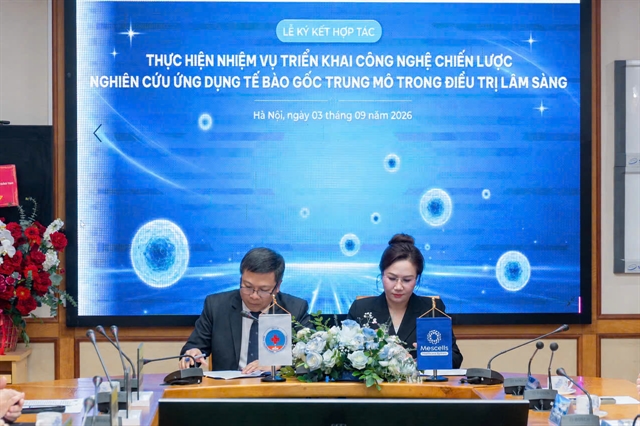 |
| Associate Professor Dr Nguyễn Thế Anh, Friendship Hospital Director, and Mescells Chairwoman Nguyễn Thị Thu Hiền sign the cooperation agreement. — Photos courtesy of the organiser |
HÀ NỘI — Hữu Nghị (Friendship) Hospital and Mescells Medical System have signed a comprehensive cooperation agreement to research and apply mesenchymal stem cells in clinical treatment.
The agreement aims to help develop a key national technology group, in accordance with the Prime Minister's Decision 1131/QĐ-TTg dated June 12, 2025, while simultaneously promoting a public-private partnership model to gradually integrate regenerative medicine advancements into routine healthcare and patient treatment.
The partnership marks a pioneering collaborative model in the field of mesenchymal stem cell research and clinical application in Việt Nam.
Speaking at the signing ceremony, Associate Professor Dr Nguyễn Thế Anh, Friendship Hospital Director, said that the development of regenerative medicine plays a crucial role given Việt Nam's ageing population and the resulting rise in degenerative diseases, particularly musculoskeletal disorders.
“Many elderly individuals remain mentally sharp, yet their mobility and ability to care for themselves are compromised by degenerative conditions. Consequently, the goal of elderly healthcare is not merely to extend lifespan but to prolong the period of life lived with good quality,” Dr Anh said.
In light of this, Friendship Hospital is focusing on the field of regenerative medicine, specifically research into the use of stem cells to improve organ function, with a particular emphasis on degenerative joint diseases.
Dr Anh added that the partnership would create opportunities to use cell technology, a cutting-edge technique in Việt Nam, providing additional treatment options for patients with chronic diseases.
At the ceremony, Mescells Chairwoman Nguyễn Thị Thu Hiền committed to dedicating the group's resources, technology and the highest level of responsibility to the partnership with Friendship Hospital.
“All collaborative activities will adhere to core principles — scientific rigour, safety, transparency and law compliance — while keeping patient interests at the heart of everything we do. Our goal is to ensure patients can access hi-tech medical care right here in the country, sparing them the hardship and expense of travelling abroad for treatment,” Hiền said.
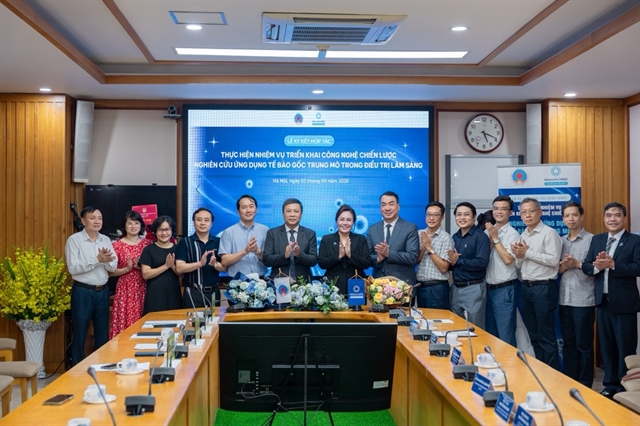 |
| Delegates attend the agreement signing ceremony. — Photos courtesy of the organiser |
Under the framework of the agreement, the two parties will collaborate on scientific research programmes and projects, as well as innovative solutions. They will also intensify research in fields such as regenerative medicine, cell technology, cell-based products, biomedical materials and biomedical solutions, all in strict compliance with legal regulations.
Beyond their core professional activities, both parties are committed to organising training sessions, conferences and scientific forums, while also facilitating the exchange of experts, researchers and technicians.
The two entities will also research, and propose the practical application of, new technical procedures and professional models and will collaborate on scientific publications, intellectual property registration and the transfer and application of research findings.
Mescells and Friendship Hospital also plan to foster cooperation with domestic and international research institutes, universities, hospitals and science organisations in areas of mutual interest.
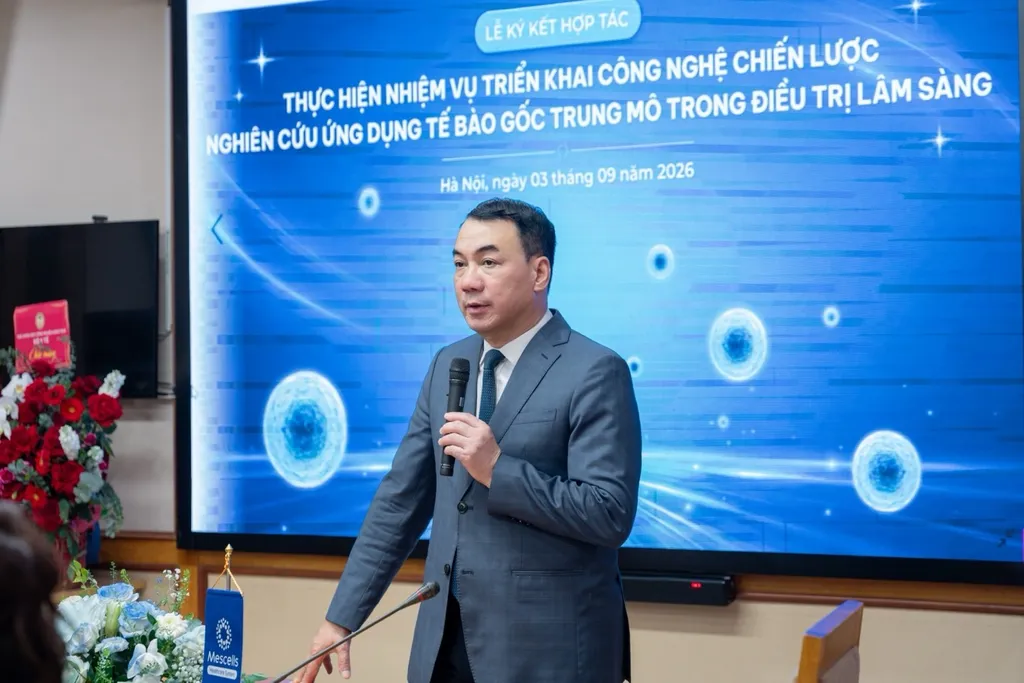 |
| Dr Nguyễn Ngô Quang, Director of the Department of Science, Technology and Training at the Ministry of Health, speaks at the event. — Photos courtesy of the organiser |
Dr Nguyễn Ngô Quang, Director of the Department of Science, Technology and Training at the Ministry of Health, said that the health sector is currently focusing on developing three strategic technology groups: next-generation vaccines, cell technologies (including stem cells and immune cells) and 3D printing technology.
As for umbilical cord-derived mesenchymal stem cells, extensive research has been conducted globally, and several countries have authorised their use for specific medical indications. In Việt Nam, areas of research and application attracting interest include the treatment of musculoskeletal disorders, support for functional recovery following spinal cord injuries and the management of endocrine conditions such as diabetes.
Dr Quang suggested that the two entities develop a roadmap and specific tasks to bring mesenchymal stem cell research and application into practice in a rigorous scientific manner, prioritising safety and therapeutic efficacy above all else.
“Close coordination among regulatory bodies, hospitals and technology developers will be a key factor in gradually introducing stem cell technology into clinical practice through a systematic, scientifically grounded and legally compliant roadmap,” Dr Quang said.
Mescells is a medical system specialising in regenerative medicine and cell therapy in Việt Nam, featuring a closed-loop ecosystem that encompasses research, training, manufacturing and clinical application.
Mescells’ ecosystem includes the Mescells Institute for Applied Cell Technology; the Mescells Tissue Bank; the MSC Clinic System; and the Mescells Training Centre. — VNS
Society
 Society
 Society
 Society
 Society
 Society
 Society
 Society
 Society
 Society
 Society
 Society
 Society
 Society
 Society