 Society
Việt Nam, Switzerland to turn education, sci-tech, innovation into cooperation focus
1.
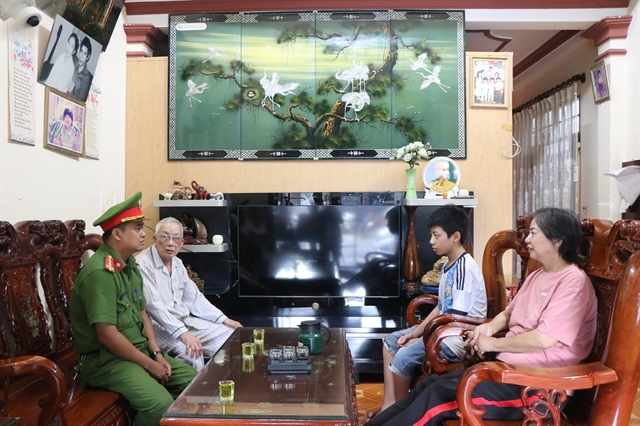 |
| Đỗ Thiện Long, from Buôn Ma Thuột Ward, Đắk Lắk Province, has been admitted to People's Public Security Cultural School 2. — VNA/VNS Photo Nguyên Dung |
Thùy Dung
ĐẮK LẮK — At the age of 14, Đỗ Thiện Long has already experienced the loss of both parents.
His mother died of a brain tumour when he was just one year old. Over a year ago, his father passed away from lung cancer. Since then, Long has been raised by his paternal grandparents, both in their 70s, in Buôn Ma Thuột Ward, Đắk Lắk Province.
This year, as Long prepares to enter Grade 9, a new chapter is about to begin.
Long has been admitted to the newly established People's Public Security Cultural School 2, a boarding school designed in part to provide educational opportunities for children from disadvantaged families, poor and near-poor ethnic households and children eligible for social protection assistance.
For Long and his grandparents, the admission is more than a place at a new school. It is a chance for the teenager to study in a stable environment, receive care and training and gradually build a path towards adulthood.
“We are very relieved knowing that our grandson will study in an environment run by the People's Public Security force,” said Nguyễn Thị Sánh, Long's grandmother.
“We hope he can complete high school, receive proper training and grow up in better conditions.”
For elderly grandparents who have struggled to raise a child on their own, the school offers something that is difficult to provide at home: a full education, along with accommodation, meals, supervision and a structured environment in which a child can learn and grow.
School built around different stories
Long is not alone in carrying a difficult story into the school's first academic year.
H’Hoan Êban, 14, is an Ê Đê ethnic student from Ea Bông Hamlet, Buôn Ma Thuột Ward. Her mother died when she was young, while her father has been serving a prison sentence since H’Hoan was only two.
H’Hoan and her two older brothers have since lived with their maternal grandmother and aunt.
When she learned that she had been admitted to the People's Public Security Cultural School 2, H’Hoan was filled with happiness.
She said she would work hard in her studies and training to repay the care and support she received from the adults around her.
Behind each student arriving at the school is a different family story. Some have lost parents. Some come from families struggling to make ends meet. Others belong to ethnic communities in difficult circumstances or are children of families who have made sacrifices for the country.
The school aims to give these students something that can be easily disrupted by hardship: continuity.
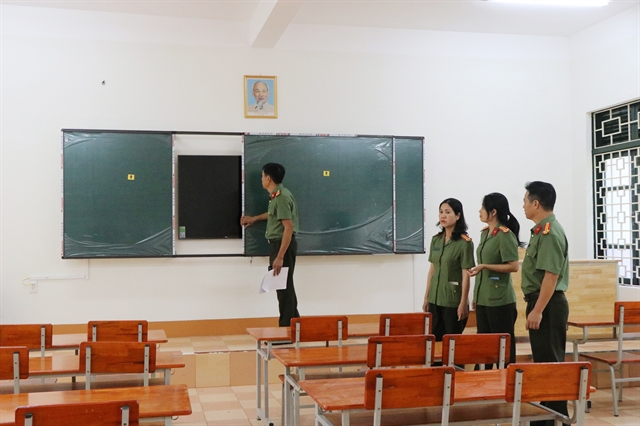 |
| School leaders inspect classrooms before the beginning of the new academic year. — VNA/VNS Photo Nguyên Dung |
Under its boarding school model, students will study, live and participate in activities together. Beyond classroom lessons, they will receive support in their daily lives, take part in skills training and experiential activities, and learn to become more independent in a collective environment.
For children whose circumstances have made their early years more difficult than those of their peers, such stability can be an important first step towards confidence and self-reliance.
Building a school from the ground up
The 2026-27 academic year will be the first for People's Public Security Cultural School 2.
A public non-business unit within the national general education system, it is a specialised boarding school providing education from primary through upper-secondary level.
Its target students include children of wounded and fallen People's Public Security officers; children from policy families facing financial difficulties; ethnic children from poor and near-poor households; children eligible for social protection assistance; and students participating in certain international cooperation programmes of the Ministry of Public Security.
For its first academic year, the school will recruit students from four provinces, Đắk Lắk, Gia Lai, Lâm Đồng and Quảng Ngãi, with 34 classes and a total of 1,020 students.
That scale has made getting ready for the new school year a race against time.
Principal Colonel Mai Hữu Vạn said the school is rushing to complete its preparations, from academic programmes and infrastructure to teachers, staff and admissions.
Its facilities are built on the foundation of the former People's Public Security Cultural School 3, which had around 700 students. With the Ministry of Public Security assigning the new school a quota of 1,020 students for the 2026-27 academic year, additional facilities are needed to accommodate them.
The school is urging relevant units to accelerate construction and renovation work, hoping to complete the necessary facilities before the opening ceremony.
It is also recruiting 25 additional teachers and around 60 contract workers for student care and support services, including catering, electrical and water systems, landscaping and cooking.
The school currently has 103 officials, teachers and staff members. Recruitment procedures are being completed, including the verification of the political backgrounds of officials, teachers and staff, with more than 1,000 verification forms being processed.
Meanwhile, admissions are being carried out under Ministry of Public Security regulations. Local police units conduct preliminary screening, while the school has received applications, established its admissions council and is reviewing and completing the remaining procedures.
Students have been arriving since August 28, and the opening ceremony is scheduled for September 5, Vạn said.
More than lessons
For the teachers, the first academic year is also a new beginning.
Lieutenant Colonel Cao Văn Lâm, deputy head of the Social Sciences Division, said teachers and officials had come from different units and professional environments to take on educational responsibilities.
“It is a great honour, but it also requires every teacher to continuously study, train and improve their professional capacity,” Lâm said.
At this school, he added, teaching cannot stop at textbooks and classroom lessons.
Teachers must be patient and approachable, encouraging students who may have grown up with difficult experiences and helping them regain confidence and gradually develop the skills needed for the curriculum and for life.
“We recognise that every student has a different background, so our educational approach must also be tailored to each individual,” Lâm said.
“Our ultimate goal is to provide the best possible learning conditions, help students develop comprehensively and give them greater opportunities to move forward in life.”
That philosophy will extend beyond the classroom.
The school plans to organise experiential activities, field trips, skills training and collective programmes. Administrators and teachers will eat, live and participate in daily activities with students, allowing them to understand the children's personalities, aspirations and circumstances more closely.
For a school whose students arrive carrying stories of loss, hardship and disadvantage, knowing a child's circumstances may be just as important as knowing their academic record.
For students like Long and H’Hoan, it could be something more: a second chance, a place to grow and a door opening towards a future that once seemed difficult to imagine. — VNS
Society
 Society
 Society
 Society
 Society
 Society
 Society
 Society
 Society
 Society
 Society
 Society
 Society
 Society
 Society