 Economy

Vietnamese businesses shift from manufacturing to brand building
1.

|
| Larry Hu, head of Amazon Global Selling for Southeast Asia, speaks at the event. — Photo baoxaydung.vn |
HÀ NỘI — More Vietnamese businesses are moving beyond contract manufacturing to build their own brands and reach international consumers directly, marking a shift in the country's role in global supply chains.
The trend is becoming increasingly evident on Amazon's global selling platform, according to Larry Hu, head of Amazon Global Selling for Southeast Asia, speaking at the annual Amazon Seller Conference in Hà Nội on November 5.
While Việt Nam has established itself as a major manufacturing hub, many domestic producers still rely on foreign companies for branding, pricing and access to end consumers. Building their own brands would allow Vietnamese businesses to capture more value from their manufacturing capabilities, Hu said.
Held under the theme “National Brands, Shining Globally”, the conference brought together more than 1,000 sellers, businesses and partners from Việt Nam and the region, along with representatives from the Vietnam Trade Promotion Agency under the Ministry of Industry and Trade.
Hu said Amazon Global Selling Việt Nam had identified three priorities for 2027: helping businesses select products that meet global market demand, integrating artificial intelligence (AI) into business operations and supporting manufacturers in building their own brands.
The platform aims to support the launch of 30 Vietnamese brands and help 300 manufacturers in sectors such as furniture, food and apparel begin selling internationally by 2027.
The shift from manufacturing to brand ownership is also reflected in the experiences of domestic businesses.
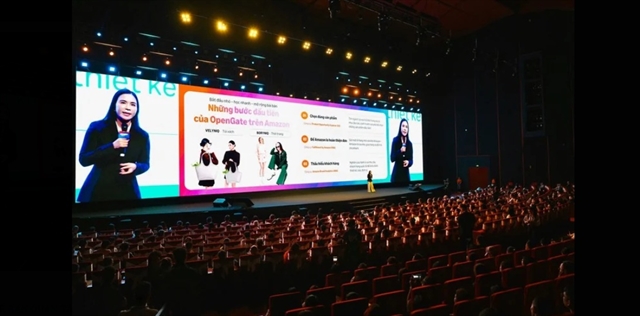
Lưu Nga, chairwoman of OpenGate and founder of the fashion brand Elise, said her ambition to build a Vietnamese brand had taken shape nearly 20 years ago while she was living in the United States.
At the time, she frequently saw products labelled “Made in Vietnam” in major shopping centres, but most carried foreign brand names. This made her realise that although Vietnamese manufacturers could meet demanding international production standards, they captured only a portion of the value generated by their products.
|
|
| Lưu Nga, chairwoman of OpenGate and founder of fashion brand Elise, shares her story during the event. |
Drawing on 15 years of experience building Elise, Nga said the company had prioritised investment in production capacity, technology and modern technical standards, including those used by the Republic of Korea's fashion industry.
It had also researched consumers' body shapes, shopping habits and purchasing power to develop products suited to its target market.
For Nga, a brand's long-term value lies not simply in growing sales or expanding its retail network, but in consumer trust and a distinctive identity built over time.
She is now seeking to develop a platform connecting technology, data, production and e-commerce resources to help other Vietnamese businesses expand. The model would allow companies with quality products but limited resources to share management expertise and operational infrastructure, reducing costs and shortening the time needed to bring products to market while retaining their own brand identities.
Việt Nam's textile and garment exports are projected to reach about US$48 billion in 2026, reflecting the sector's strong manufacturing capacity. However, moving beyond contract manufacturing to build their own brands and gain greater control over pricing remains a challenge for domestic businesses.
Nga said selling products on international e-commerce platforms was only the first step. Businesses also needed to maintain consistent quality, meet technical standards, control costs and ensure timely delivery to build sustainable brands.
She expressed hope that support from Amazon and regulatory authorities would help Vietnamese businesses compete internationally on their own merits, so that consumers in fashion capitals such as New York, Tokyo and Paris would choose their products for their design, quality and brand value, rather than simply because they were made affordably in Việt Nam.
The conference also saw Amazon Global Selling Vietnam and the Vietnam Trade Promotion Agency launch a cooperation programme titled “From National Brands to Global Brands”.
In 2027, the programme aims to equip 30 businesses whose products are certified under the National Brand Programme with the skills needed to export through e-commerce. Jointly selected by the two partners, the businesses will receive tailored training and support at every stage, from brand registration to reaching international customers.
Hoàng Minh Chiến, deputy director of the Vietnam Trade Promotion Agency, said the agency would continue working with businesses and international partners to strengthen export capacity and promote Vietnamese brands, with support tailored to businesses' needs. — BIZHUB/VNS
Economy
 Economy
 Economy
 Economy
 Economy
 Economy
 Economy
 Economy
 Economy
 Economy
 Economy
.jpg) Economy
 Economy
.jpg) Economy
 Economy