 Society
Vietnamese scientist wins ASEAN-US Science Prize for Women
1.
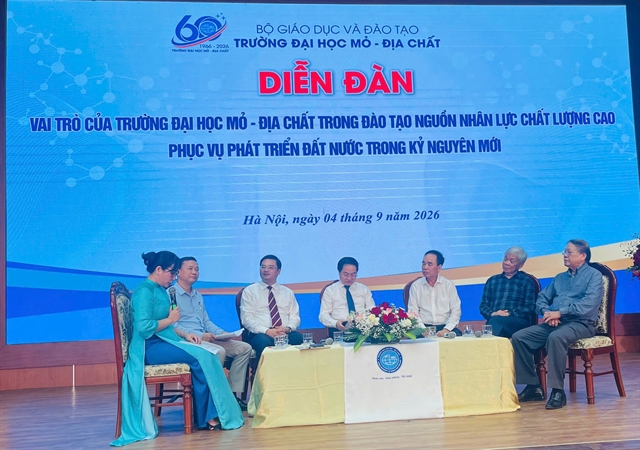 |
| Delegates during a discussion session at the forum. — VNS Photo Thu Trang |
HÀ NỘI — At a forum on the role of Hà Nội University of Mining and Geology (HUMG) in training skilled workers held on Friday, participants discussed how Việt Nam should help its workforce master strategic technologies in the new era.
The event marked the 60th anniversary of the university’s establishment. At the forum, training was considered not only in terms of immediate recruitment needs, but also in connection with major changes in science, technology, energy and national infrastructure.
HUMG rector and Associate Professor Trần Xuân Trường said that over nearly 60 years of development, the university remains steadfast in its mission to train scientific and technical workers in geology, minerals, mining, oil and gas, geodesy and cartography, environment, energy and other key engineering and technology sectors.
As it enters a new development era, the country has set high standards for mastering science and technology, training skilled workers, ensuring energy security, managing resources effectively, building the green and digital economy and achieving sustainable growth, Trường said.
According to the rector, the university must not just train personnel to meet current needs, but should also conduct research, forecast trends, renew training curricula, promote innovation and provide scientific and technological solutions to serve national strategic tasks.
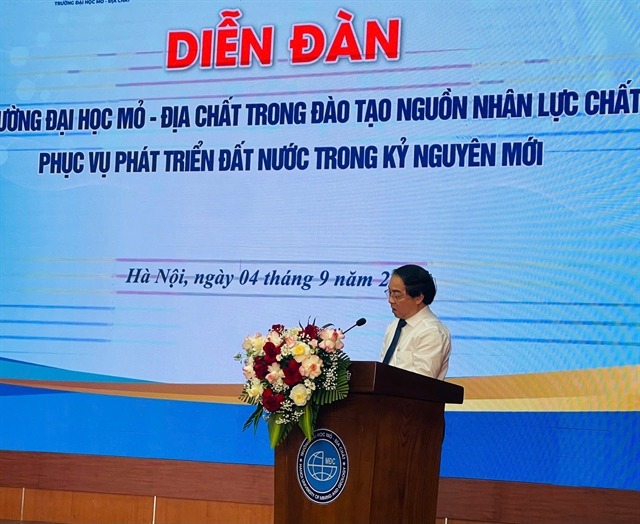 |
| Associate Professor Trần Xuân Trường, rector of the Hà Nội University of Mining and Geology, confirms that the country is setting high requirements for mastering science and technology. — VNS Photo Thu Trang |
Under its orientation towards 2030, the university is establishing three research centres.
The Excellence Research Centre for Strategic Minerals and Underground Technology will focus on rare earths, strategic minerals, survey and exploration, mining, beneficiation, deep processing, underground technology and deep‑sea resources.
Meanwhile, the Excellence Research Centre for Digital Geospatial, AI and Digital Twins involves developing geospatial data, domain‑specific AI, Digital Twin, remote sensing and big‑data analytics platforms.
Finally, the Excellence Research Centre for Underground Works, Metro and High‑Speed Rail, will focus on survey, design, construction, operation and management of underground space and strategic transport infrastructure.
“The three centres are oriented to become the core of the research and innovation ecosystem, carrying out core technology research and development, high‑level training, intellectual property development, commercialisation of research results and participation in solving key national science and technology problems,” Trường said.
Speaking at the event, Chairman of the Việt Nam Petroleum Association Nguyễn Quốc Thập suggested seven priority actions to help skilled workers master technology.
The priorities are to strategically reposition the university’s development; expand the pool of lecturers and experts; focus on five to six training and research clusters; develop reskilling and lifelong learning; establish a university–enterprise cooperation centre; use employment quality as a key performance metric; and design interdisciplinary curricula.
“Priority number one should be to select the right fields on which to concentrate and create distinctiveness,” Thập said.
Associate Professor Phùng Mạnh Đắc, deputy chairman and general secretary of the Việt Nam Mining Science and Technology Association, confirmed that in the new era, Việt Nam’s minerals industry must shift decisively from traditional development models to a modern, smart, green, safe, efficient and internationally integrated model.
“To achieve this, decisive factors are not just resources, investment capital or technological equipment, but also people,” Đắc said.
“Skilled workers are the key link enabling the mining sector to master science and technology, undergo digital transformation, drive innovation, raise productivity, ensure safety, protect the environment and achieve sustainable development,” he noted.
For this task, HUMG will play a key role thanks to its 60‑year training record, comprehensive disciplinary system, experienced expert pool, training and research infrastructure and extensive links with enterprises, alumni, professional associations and international partners.
Đắc suggested that in the new era, the university should continue upholding its mission through four pillars: training skilled workers; reskilling and updating knowledge for the workforce already employed in the sector; focusing on research, innovation, digital transformation and technology transfer; and shaping new development thinking and a new professional culture for Việt Nam’s mining industry.
“To develop Việt Nam’s minerals industry in a smart, green, safe, efficient and sustainable direction, we must start with workforce development; and to get skilled workers, we must build a strong training ecosystem,” he said.
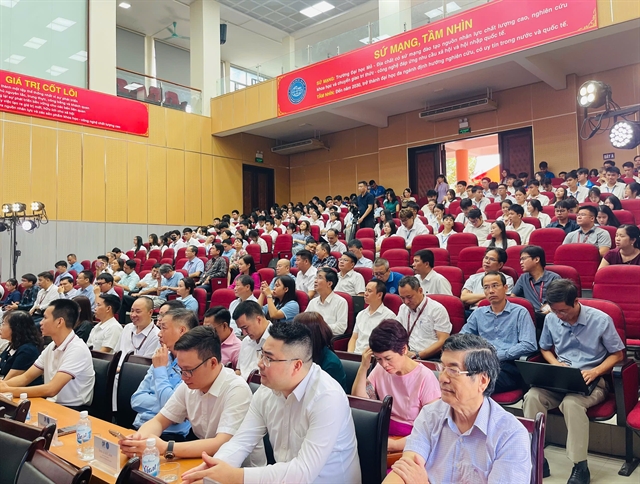 |
| Scientists and students attend the forum. — VNS Photo Thu Trang |
Participating in the discussion session were representatives of the Ministry of Education and Training, the Ministry of Science and Technology, the Việt Nam Petroleum Association, the Việt Nam Mining Science and Technology Association and the Việt Nam Geodesy, Cartography and Remote Sensing Association, along with other professional associations and enterprises.
Key topics included training workers in strategic technology fields; developing science and technology in geology, minerals, energy and the environment; renewing curricula and teaching methods; enhancing learners’ digital literacy, foreign language proficiency, practical skills and occupational adaptability; and strengthening links among the State, universities, research institutes and enterprises in training, research and technology transfer. — VNS
Society
 Society
 Society
 Society
 Society
 Society
 Society
 Society
 Society
 Society
 Society
 Society
 Society
 Society
 Society