 Society
Vietnamese, Danish FMs discuss ways to deepen bilateral ties
1.
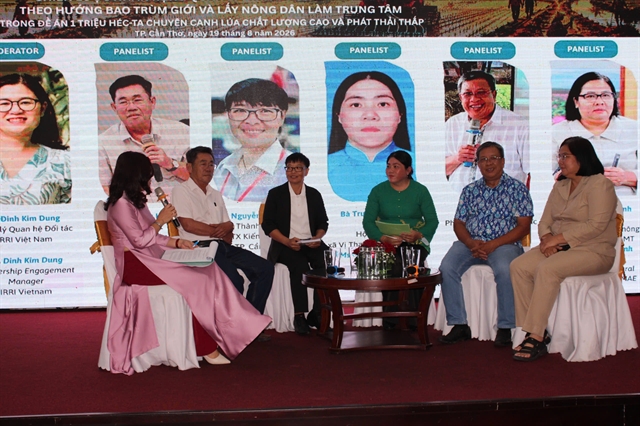 |
| Panel discussions on scaling up Precision Nutrient Management (PNM) in rice production. — Photo from the International Rice Research Institute |
CẦN THƠ — Putting farmers at the centre, ensuring gender inclusiveness and strengthening the participation of stakeholders across the value chain are key to scaling up Precision Nutrient Management (PNM) in rice production, contributing to the implementation of the Mekong Delta’s one-million-hectare sustainable high-quality, low-emission rice scheme.
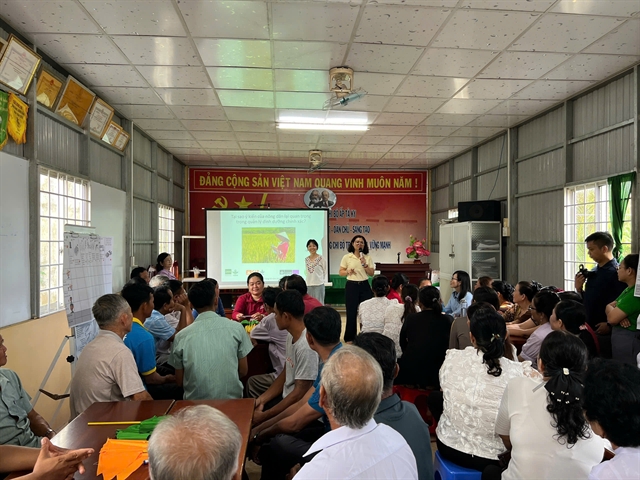
The direction was highlighted at a workshop held on Wednesday on strategies to scale up gender-inclusive, farmer-centred PNM under the scheme, jointly organised by the International Rice Research Institute (IRRI), the International Potato Center (CIP) and the Cần Thơ Department of Agriculture and Environment.
About 70 representatives from management agencies, research institutes, agricultural extension services, businesses, the Farmers’ Union, the Women’s Union, cooperatives, farming households and other stakeholders attended the event.
The workshop focused on opportunities, challenges and orientations for scaling up PNM under the project on developing one million hectares of high-quality, low-emission rice cultivation associated with green growth in the Mekong Delta by 2030.
Participants stressed that expanding PNM depends not only on the effectiveness of the technical solution itself, but also on its compatibility with farmers’ needs and production conditions.
Differences in resources, labour, roles, decision-making power and access to information and advisory services must be taken into account to ensure that different groups of farmers have equal opportunities to participate in and benefit from PNM.
The August 19 workshop followed a training and consultation session with farmers at Kiến Thành Cooperative on August 18, expanding dialogue on production realities, farmers’ needs and appropriate approaches to transferring technical solutions.
Farmer-centred approach
Nozomi Kawarazuka, a gender specialist at CIP, said that scaling up PNM requires looking beyond the technical effectiveness of a solution and asking who benefits from it and which groups are actually reached.
“Listening to farmers, particularly women, who often make decisions on agricultural investment within Vietnamese households, will help us design scaling-up strategies that are more convincing to farmers,” she said.
According to the specialist, the scaling-up process involves agricultural extension services, provincial management agencies, agricultural cooperatives, the private sector and Women’s Unions. These stakeholders therefore need to work together to develop and implement more inclusive approaches.
A key focus of the workshop was identifying which groups of farmers are currently accessing and benefiting from nutrient management services, information and solutions, while identifying those who remain underserved and the reasons behind these gaps.
Participants examined target farmer groups from different perspectives, including farm size, production objectives and gender, identifying barriers related to resources, information, advisory services, decision-making capacity and opportunities for participation.
Nguyễn Thị Giang, Deputy Director of the Cần Thơ Department of Agriculture and Environment, said technical solutions such as PNM could only be widely adopted in production with coordinated efforts across the entire system.
“Management agencies create a supportive policy environment; agricultural extension services bring solutions to producers; while businesses and relevant organisations provide services, products and resources. Most importantly, all these efforts need to stem from farmers’ actual needs and conditions,” she said.
From the grassroots perspective, Trương Hữu Trí, Director of Gò Gòn Cooperative in the southern province of Tây Ninh, said farmers do not have equal conditions for receiving and applying new technologies.
“Therefore, if PNM is to be scaled up, extension workers need to better understand the different groups of farmers they serve and be more flexible in how technical solutions are transferred. When farmers see that a solution is suited to their own conditions, they are much more likely to adopt it,” he said.
Bridging the gender and access gaps
The workshop also reviewed policies and strategies related to gender equality and inclusion, while identifying the roles of businesses, farmer associations and groups, agricultural extension workers, management agencies and Women’s Unions in supporting the scaling up of PNM.
Issues raised by farmers – ranging from the roles of women and men in rice production and fertiliser use to appropriate training methods – were incorporated into discussions aimed at designing PNM activities that are more responsive to realities on the ground.
Nguyễn Thị Huệ, a member of Kiến Thành Cooperative, said farmers need instructions that are easy to understand and suited to their daily work.
“Women also take part in many rice production activities, but sometimes have fewer opportunities to attend training sessions or technical discussions. If the organisation and timing are more suitable, we can fully participate and apply new techniques,” she said.
Huỳnh Kim Đinh, Deputy Director of the National Agricultural Extension Centre under the Ministry of Agriculture and Environment, said the centre would continue integrating farmer-centred and gender-inclusive approaches into agricultural extension programmes, models and activities.
“The focus is on identifying the needs and barriers faced by different groups of farmers, particularly women and underserved groups; strengthening guidance, demonstration and advisory approaches suited to actual conditions; and encouraging farmers’ participation and voices in selecting, applying and scaling up solutions,” Đinh said.
Through this approach, she said, technical advances, including PNM, would not only be disseminated more widely but would also have greater potential to be adopted effectively and sustainably by farmers.
The co-design of strategies tailored to the needs and conditions of different farmer groups is expected to provide a foundation for further refining and scaling up PNM, contributing to the effective implementation of the one-million-hectare sustainable high-quality, low-emission rice scheme associated with green growth in the Mekong Delta by 2030. — VNS
Society
 Society
 Society
 Society
 Society
 Society
 Society
 Society
 Society
 Society
 Society
 Society
 Society
 Society
 Society