 Society
42 people hospitalised over suspected gas leak in Hà Nội
1.
|
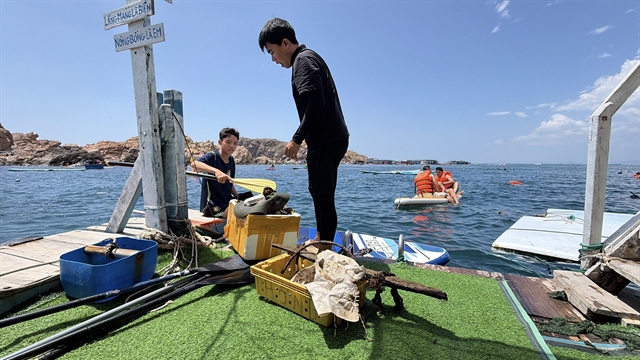
| Members of the Nhơn Hải community fisheries protection team head out to collect rubbish from the coral reef at Hòn Khô island, Quy Nhơn Đông Ward, Gia Lai Province. — VNA/VNS Photos Quang Thái |
GIA LAI — Almost every day, after ferrying the last tourists back to shore, Nguyễn Tôn Xuân Sáng straps on an air tank, pulls on his mask and drops back into the sea with an empty sack.
For years, Sáng and the other members of the Nhơn Hải community fisheries protection team have been diving to clear rubbish from the coral, guard the reefs and rescue sea turtles in the waters off Gia Lai Province.
Their unpaid work is helping revive a marine ecosystem that was badly damaged a decade ago and with it, the fish stocks and the tourist trade that keep the village alive.
"The landscape is beautiful, the air is fresh and the water is very clear. The local people are friendly, so I'm very happy with the trip," said Nguyễn Thị Thùy Trang, a tourist from HCM City, told Vietnamplus online newspaper on her first visit to Hòn Khô, an island in Quy Nhơn Đông Ward.
Hòn Khô's colourful coral reefs, visible through the clear blue water, draw more visitors each year – an asset Nhơn Hải residents have spent years protecting.
Bottle by bottle, the divers haul up what the sea has caught: plastic, nylon bags, straws, fishing line, torn nets tangled in the coral.
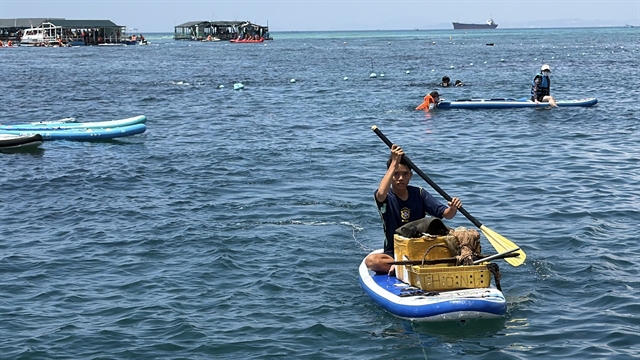
There is no salary, no fixed payment. For people who have spent most of their lives on the water, the clean-ups have simply become part of the working day.
"Some rubbish can damage the coral if it stays there too long. So when we see rubbish, we go down and collect it," Sáng said.
More than 10 years ago, much of the reef around Hòn Khô was scarred by destructive fishing and other human activity, he said.
Since the community was given a role in managing the resource, members have marked out protected zones, monitored the reefs and pushed neighbours towards gentler fishing methods.
"When the coral is healthy, the fish, the shrimp and the turtles come back. A rich ecosystem also brings tourists. Tourism has to go hand in hand with conservation," Sáng said.
A village effort
Phạm Minh Bảy, a resident of the Hải Bắc area, joins the reef clean-ups most weeks.
"Sometimes it's plastic bottles, nylon bags or straws swept in by the waves and caught in the coral," he said.
"Every time we bring a sack ashore, the sea is a little cleaner. When the coral is protected, more fish and shrimp come back, and tourism can grow."
Conservation work supported by international marine groups has been under way since 2018 in the waters off Nhơn Châu, Quy Nhơn Nam and Quy Nhơn Đông, according to the Gia Lai fisheries sub-department.
|
| For people who have spent most of their lives on the water, the clean-ups have simply become part of the working day. |
Community groups in Quy Nhơn Đông now directly manage more than 20 hectares of coral reef.
Since the protected zones were created, coral cover at Bãi Dứa has risen from 62 per cent to 75.6 per cent, and at Hòn Khô from 36 per cent to 44.3 per cent, the sub-department said.
Success brings its own problems.
More visitors mean more waste and heavier pressure on the shoreline, including the beaches where turtles come ashore to lay their eggs.
Trần Việt Quang, chairman of the People's Committee of Quy Nhơn Đông Ward, said authorities are running awareness campaigns for residents and tourists, stepping up inspections and cracking down on activity that threatens nesting grounds.
The community-based approach to protecting the sea is showing results. Protecting the sea means protecting its resources, its landscape and the livelihoods that depend on it.
Local residents said they hope they can go on making a living from the sea without harming its future. — VNS
Society
 Society
 Society
 Society
 Society
 Society
 Society
 Society
 Society
 Society
 Society
 Society
 Society
 Society
 Society