 Society

AITO Looks Ahead to Europe, Building a Thriving Automotive Ecosystem
1.
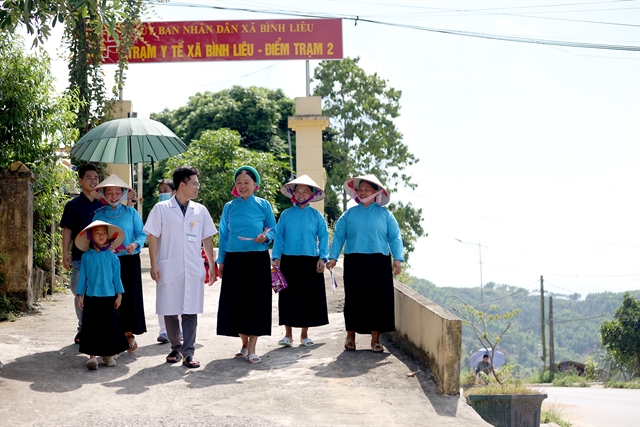 |
| Doctor Vi Văn Tiến and his colleagues at Bình Liêu Commune Health Centre's Post 2 discuss immunisations with ethnic Sán Chỉ people in Khe Ngàn Village. — VNA/VNS Photo Trịnh Bộ |
QUẢNG NINH — Gone are the days of stretchers being borne over mountains, delivering disabled patients to emergency care in the border district of Bình Liêu.
Gone are the dusty stacks of worn paper medical records for the ethnic Sán Chỉ residents.
Gone are the frantic boat trips from Cô Tô Special Zone rushing patients to the mainland, and even the haunting ambulance sirens carrying patients to central-level facilities have gradually diminished.
Quảng Ninh Province’s health sector is realising the Politburo's Resolution 72-NQ/TW through the use of statistics and technology and the hard work of medical staff, helping patients recover step by step.
Electronic health records
At 2pm, the sun hangs above Cao Xiêm peak. In the searing 39-degree heat of the Bình Liêu borderlands, two figures in white medical coats can be seen walking up the slope leading to Khe Ngàn Hamlet.
Dr Vi Văn Tiến and a colleague from Bình Liêu Commune Health Station's Post 2 are conducting a follow-up visit for 38-year-old patient La A Thầu.
Thầu, an ethnic Sán Chỉ man, has been paralysed since birth. His entire life, from childhood to middle age, has been confined to his old bamboo bed, and he is entirely dependent on his elderly mother, Lý Thị Lộc, now over 70.
It isn't just paralysis that plagues him. High blood pressure, diabetes and various skin conditions also torment him daily.
Lộc helps her son sit up. Her hands, calloused from years of forest work, gently brush away a sweat-matted lock of his hair. As Dr Tiến enters with his medical bag, she says: “I have lived my whole life in the mountains. All I know is going to the forest and the fields for work.
"In the past, every time Thầu fell ill, it was terribly hard. The whole village had to carry the stretcher over rocky slopes, then transfer him by motorbike and car over several stages just to reach the Việt Nam – Sweden Uông Bí General Hospital. Every trip felt as if we might lose him. But for the past two years, it has been different.”
For the past two years, health station doctors have been coming directly to Thầu's home.
Dr Tiến opens his laptop, scans a code on the system and the screen displays Thầu’s full medical history, blood glucose levels and blood pressure readings from previous months.
A major breakthrough in local health management in the spirit of Resolution 72 has been carried out through a powerful new tool: the electronic health record.
While carefully measuring Thầu’s blood pressure and re-examining his skin lesions, Tiến cheerfully announces: “His blood pressure is stable now, and blood sugar has dropped significantly. At this rate, I will slightly reduce his medication dosage this month.”
Thanks to the persistent care and home-based rehabilitation of Dr Tiến, Thầu has gone from a man who could only lie motionless to one who can now use his arms to move around the room and manage some personal hygiene tasks independently.
This is a miracle for his family, woven from the dedication of these doctors and from technology.
Healthcare on remote islands
Director of Cô Tô Special Zone Health Station Dr Nguyễn Thanh Giang has long been affectionately known within Quảng Ninh’s health sector as “the physician at the edge of the waves”.
After spending more than 20 years working on the frontier island, Dr Giang — with skin reddened by sea winds, bright eyes and a warm smile — has seen much of the island’s own development.
From a young doctor fresh out of medical school to his appointment as head of the special zone’s health unit, he has steadfastly upheld the sacred Hippocratic Oath.
More than a clinician, Dr Giang understands that for the island's healthcare sector to achieve breakthroughs under Resolution 72, it cannot simply follow old paths.
He has spent many sleepless nights at his computer conducting scientific research and devising technical innovations for immediate application at the local level.
His research topics – obstetric emergency care at sea, rapid management protocols for seafood poisoning and treatment of acute diarrhoea in coastal children – come from his real-life practice and have helped save hundreds of lives directly on the island, without waiting for boats to the mainland.
Giang speaks with firm conviction about the future: “Although Cô Tô is geographically distant from the mainland, we are determined that the quality of healthcare will not be inaccessible for our people and visitors.
At present, we are working closely with major central hospitals, such as Bạch Mai Hospital and Việt Nam-Germany Hospital. Leading professors and doctors will regularly visit the island to conduct examinations and transfer technology. The people of Cô Tô now enjoy healthcare services no different from those in the capital.”
Breast milk bank
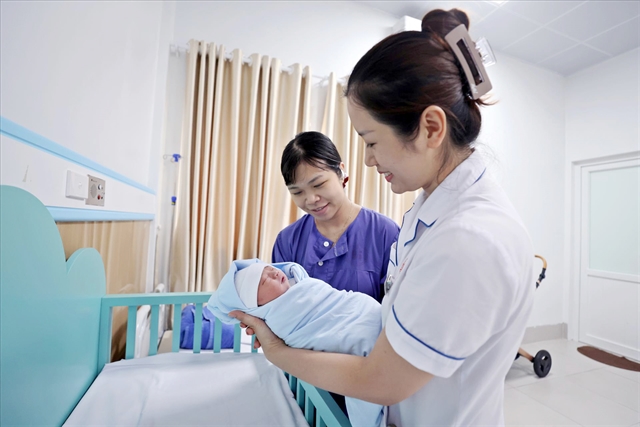 |
| Medical staffers take care of a newborn baby in Quảng Ninh Province. — VNA/VNS Photo Công Đạt |
Visitors arriving at Quảng Ninh Obstetrics and Paediatrics Hospital no longer feel the usual stifling anxious atmosphere. Instead, they are welcomed into a clean, modern and warm space.
The highlight here is the facility's breast milk bank, a unique innovation launched six years ago that has been applauded by the Ministry of Health and replicated in hospitals nationwide.
Over the years, the milk bank's small but completely sterile area has become a repository of love from mothers across the province.
To date, it has received more than 6,000 litres of milk from over 200 volunteer donors. After rigorous screening and pasteurisation, more than 5,600 litres of gold-standard milk have been provided to nourish over 22,000 newborns with medical conditions across the province.
Bùi Minh Cường, director of the Quảng Ninh Obstetrics and Paediatrics Hospital, said: “The implementation of Politburo Resolution 72 on breakthrough solutions to strengthen the protection, care and improvement of people’s health, combined with Resolution 57 on breakthroughs in science, technology, innovation and national digital transformation, has been and continues to be our guiding light.
"The province has invested in us, with some of the most modern medical equipment in the country, equivalent to that of central-level hospitals.”
In the first six months this year alone, the hospital successfully performed several complex major surgeries: the interventional closure of the ductus arteriosus in two children with congenital heart disease, and open-heart surgery to close a ventricular septal defect in a child just 22 months old.
Most notably, the hospital successfully treated an extremely premature newborn, born at only 24 weeks and five days and weighing a mere 600 grams – a feat that previously only the most advanced central hospitals dared to attempt.
The Politburo’s Resolution 72 is not just a set of directives written on a stack of paper. The resolution is alive in every heartbeat of a premature infant, in the miraculous recovery steps of patients, in the smiles of doctors dispelling fatigue and in the tears of joy of new mothers. — VNS
Society
 Society
 Society
 Society
 Society
 Society
 Society
 Society
 Society
 Society
 Society
 Society
 Society
 Society
 Society