 Society

AITO Looks Ahead to Europe, Building a Thriving Automotive Ecosystem
1.
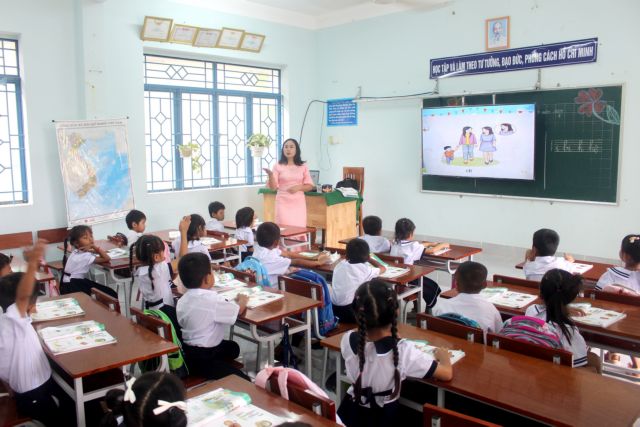 |
| A Vietnamese class for ethnic minority students in Lâm Đồng Province. — VNA/VNS Photo |
HÀ NỘI — More than 32,000 education managers could be reassigned as teachers under the ongoing nationwide public school restructuring, helping address the teacher shortage, according to the Ministry of Education and Training.
Meanwhile, more than 11,000 surplus administrative staff will need to be further redeployed by local authorities.
The number of educational institutions across the country is expected to fall by around 46.73 per cent, or approximately 17,353 institutions, compared with July 1, 2025.
Of these, 10 localities are expected to reduce the number of schools by more than 50 per cent, while 13 will see reductions of between 45 per cent and 50 per cent, and another 10 will cut the number by between 35 per cent and less than 45 per cent.
Thái Văn Tài, director of the Department of General Education, said the reduction in the number of institutions should not be used as the sole measure of success. Many localities have begun developing plans tailored to their population, geographical conditions and educational needs, including multi-level schools and models in which main campuses are linked with satellite campuses and school sites.
Reports from 28 of the 34 provinces and cities show that about 2,254 multi-level general education schools are expected to be established following the restructuring.
“Localities have gradually shifted from the mindset of merging schools to reorganising the school network and school governance models,” Tài told the Government portal.
The ultimate goals of the restructuring are to reduce the number of management units while improving resource efficiency, according to Tài.
It also aims to reduce teachers’ administrative workload while giving them more time to focus on students and most importantly, improve education quality while ensuring equal access to educational opportunities.
Under the restructuring plan, the main school, satellite campus and school-site model could allow teachers to be deployed more flexibly among facilities, particularly for subjects where it remains difficult to ensure adequate staffing, such as English, Informatics, Arts and Physical Education. Computer rooms, laboratories, libraries, sports grounds and other facilities could also be shared and used more efficiently.
Under the Government’s requirements, the restructuring of public educational institutions must be completed by August 30. In the remaining period, the Ministry of Education and Training will continue to monitor progress in each locality, address staffing-related issues and ensure that schools operate smoothly after the restructuring.
However, according to Tài, August 30 should not be regarded as the end of the process.
Once the restructuring decisions have been completed, their effectiveness must continue to be assessed based on substantive indicators, including education quality, students’ travel distances to school, staff deployment, infrastructure, school governance capacity and students’ development.
The key issue is not how many schools are cut, but whether the restructuring enables students to receive a better education, gives teachers better conditions to do their jobs and makes the education system more effective and efficient. — VNS
Society
 Society
 Society
 Society
 Society
 Society
 Society
 Society
 Society
 Society
 Society
 Society
 Society
 Society
 Society