 Economy

Lighting up Việt Nam's folk art
1.
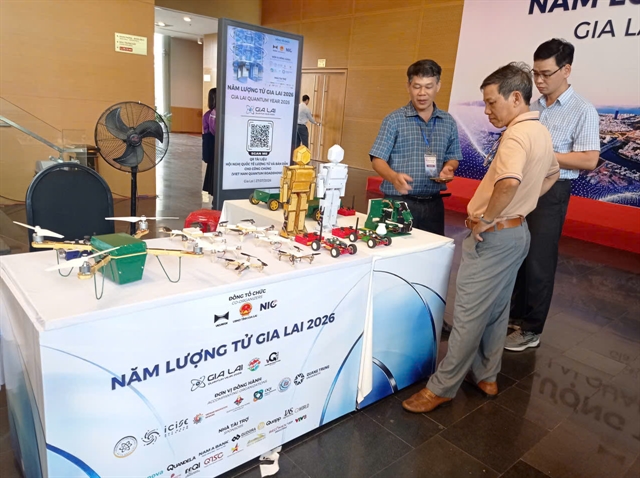 |
| Visitors view a display of handmade robots at the Exhibition on Quantum, Semiconductor, and Superconductor Technologies, held on the sidelines of the forum entitled ‘Creative Economy Powered by Quantum Technology' on Tuesday. Photos Thanh Tuệ |
GIA LAI - Amid intensifying global technological competition, international tech corporations are no longer merely seeking low-cost locations or attractive investment incentives. What they truly seek is a complete innovation ecosystem, a place where all elements converge to enable technology to be researched, developed, tested, commercialised, and scaled up.
In his remarks at the forum entitled Creative Economy Powered by Quantum Technology held in central Gia Lai Province on Tuesday afternoon, Dr Võ Xuân Hoài, deputy director of the National Innovation Center under the Ministry of Finance, noted that Việt Nam has witnessed this trend firsthand.
“Numerous major investors from the United States, Europe, the Republic of Korea, Japan, and Taiwan (China) have come to invest in and develop new technologies, developing large-scale industrial sectors. Their primary expectation is a comprehensive and integrated innovation ecosystem characterised by close collaboration among central and local government agencies, research institutes, universities, and support organisations,” said Hoài.
In Việt Nam, the Party and State adopted numerous key policies to promote the development of strategic technologies and products. Notably, quantum technology has been designated a strategic sector prioritised for investment and development.
However, for these guidelines and policies to be realised, the decisive factor is the capacity of local authorities to implement them. Based on international experience, Hoài said, for a locality to become a destination for strategic technology industries, it must meet several fundamental conditions.
First, there must be an open and favourable institutional environment for innovation. Beyond incentive policies, businesses seek transparent procedures, the flexibility to pilot new business models throught regulatory sandboxes, and a government that acts as a partner throughout the investment, research, and development process.
Second, modern innovation infrastructure is needed. This goes beyond traditional transport or industrial zones. It encompasses research centres, shared-use laboratories, digital infrastructure, high-performance computing (HPC) capabilities, data centres, and platforms specifically designed for researching, testing, and commercialising new technologies.
Third, there should be a high-quality workforce that meets both quantitative and qualitative requirements in fields such as semiconductors, AI, quantum technology, new energy, and advanced materials.
“Human capital is the "key factor" in the journey to promote innovation and develop these strategic industries. This necessitates a close 'Triple Helix' partnership between the State, academia, and enterprises, specifically requiring a proactive leadership role from local authorities,” the NIC deputy director said.
Finally, a dynamic local innovation ecosystem is essential. This is a space where tech companies, startups, investors, support organisations, experts, and scientists can effectively collaborate, synergise, and grow together.
He further noted, "to develop a truly comprehensive innovation ecosystem and advance strategic industries such as quantum, semiconductors, and AI, it is vital to enhance the innovation capacity of the local business community, particularly small- and medium-sized enterprises (SMEs)."
"In most localities, including Gia Lai, SMEs account for the vast majority of businesses. Furthermore, since local universities have not yet developed to a significant scale, fostering a startup culture remains a challenge. Therefore, prioritising the enhancement of innovation capacity for SMEs is critical. This will serve as a powerful driver, enabling local businesses to integrate into the global value chains of major international tech corporations," said Hoài.
Gia Lai could gradually develop specialised training, incubation, and acceleration programmes in fields such as quantum technology, semiconductors, AI, and digital technology. At the same time, the province should help businesses access experts, laboratories, open innovation programmes, and both domestic and international partner networks.
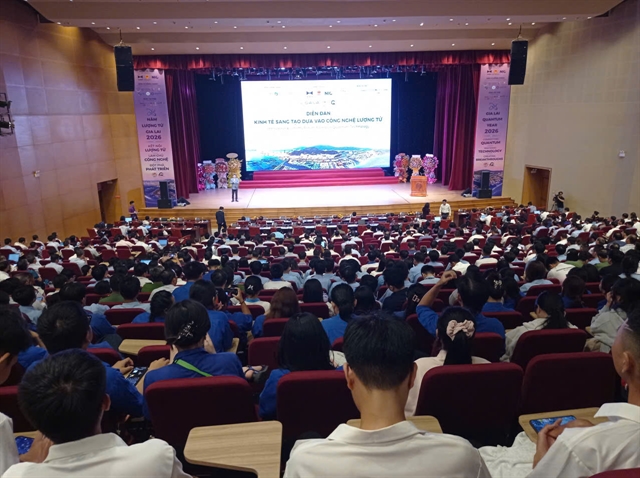 |
| The Creative Economy Powered by Quantum Technology forum attracts a large number of participants. |
A game of skill and intellect
For a long time, there has been a common perception that mastering high technology requires building multi-billion-dollar chip factories, a dream that remains far beyond the reach of any single locality.
However, Chairperson of Vietnam Quantum Technology Network (VNQuantum), Nguyễn Hoàng Hồng Nhung, said “the quantum science and technology I have witnessed in European laboratories tell a completely different story.”
According to Nhung, a quantum computer system is assembled from numerous components, ranging from photon sources to photonic chips, detectors, and a full post-processing system. A significant portion of that process involves integration, packaging, and testing—stages that are labour-intensive rather than capital-intensive investment.
This is not a game of money. It is a game of skill and intellect, said Nhung. “This is precisely where Việt Nam can find its footing.”
“And to turn this plan into reality, Việt Nam must be prepared to tackle the hard tasks.”
“First, Việt Nam needs a proper roadmap. While we have the ambition to develop this industry, we cannot dream of building a complete quantum computer factory as early as next year. Instead, we should think in stages: starting with integration, testing, and assembly, and gradually moving toward the localisation of components.
“The second task is substantive technology transfer. I want to emphasise this: a production facility is only meaningful if it is accompanied by training and transfer of knowledge that allows us to master the technology, rather than merely acting as contract assemblers.”
“Third, the entire system, including the government, investors, and businesses, must have patience. This is a journey of many years, not a few quarters. Anyone expecting immediate profits will likely give up before reaching the finish line.”
She then raised the question: “Is this plan feasible?”
It is feasible, but not easy. Precisely because it is difficult, it is worth pursuing.
“If something is easy, anyone can do it, and it offers no first-mover advantage. Because it is a challenge, if we—and specifically if Gia Lai—can succeed, it will become the first quantum integration and production hub in Việt Nam and, hopefully, in all of Southeast Asia,” said the VNQuantum chairperson.
Sharing experience from the perspective of a renowned quantum expert, Director of the Switzerland-based Open Quantum Institute (OQI) Tim Smith highlighted international collaboration in the co-creation of quantum technology.
“We are working towards regional awareness-raising and education programmes on quantum computing to ensure that this next technology wave is more inclusive than previous ones and that everyone can participate in the development and governance of a technology that will impact us all,” said Tim.
“New technologies such as quantum computing will be deployed globally, so multilateral frameworks are needed to align the national strategies so that their impact can truly transcend borders. Strength comes from coherence and collective action. So let's connect the local actors so that we can build a quantum ecosystem that forms a global mosaic of strong and robust local pieces.” VNS
Economy
 Economy
 Economy
 Economy
 Economy
 Economy
 Economy
 Economy
 Economy
 Economy
 Economy
 Economy
 Economy
 Economy
 Economy