 Economy


NA President calls for high-quality legislation to drive national development
1.

|
| Nguyễn Hồng Thái, Secretary of the Bắc Ninh Party Committee, and Watanabe Takakazu, Minister-Counsellor at the Embassy of Japan in Việt Nam, present the decision to establish the Japan Investment Promotion and Support Taskforce. |
BẮC NINH — The northern province of Bắc Ninh has set a 2030 target for all State-owned enterprises (SOEs) to adopt modern corporate governance on digital platforms, alongside a comprehensive restructuring drive and tighter performance oversight to boost the efficiency of the State sector.
Nguyễn Thị Hương, Standing Deputy Secretary of the Bắc Ninh Provincial Party Committee, said the province will restructure SOEs by sector and mandate, streamline organisational structures and concentrate State ownership in public utilities, infrastructure and other essential services where private investment remains limited or ineffective.
The province will also manage and use land and natural resources economically and transparently, and develop synchronised, modern strategic infrastructure – transport, irrigation, digital, and urban – in line with first-tier city standards as it pursues the goal of becoming a centrally governed city.

|
| Bắc Ninh People’s Committee and Samsung Electronics Vietnam sign an MoU for the 2026–2030 enterprise support programme. |
Bắc Ninh plans to strengthen State-owned credit institutions so they lead in technology and governance, continue the socialisation of public services, and streamline public service units.
It will study capital contributions to establish enterprises in science, technology and digital transformation, and roll out company-specific restructuring roadmaps with clear timelines and outcomes.
Long-standing weaknesses at SOEs will be addressed, with loss-making firms reviewed urgently. The province will clarify organisational and individual accountability and create conditions for enterprises to either proceed with bankruptcy or continue restructuring to restore efficiency, avoiding prolonged losses and waste of State assets and capital.
Human resource quality will be improved, particularly among leaders, managers and specialists in State economic bodies, with market-competitive pay. Public–private partnerships will be promoted in artificial intelligence and advanced digital technologies.
For enterprises where the State does not need to retain controlling stakes, Bắc Ninh will transfer ownership, under a defined roadmap, to central or local State capital investment entities for comprehensive review, classification and appropriate capital restructuring.
Financial supervision of SOEs will be tightened, with enhanced inspections, audits and risk warnings and stronger measures against corruption, waste and other violations in the management and use of State capital and assets.
The province is also studying the conversion of suitable public service units into single-member limited liability companies wholly owned by the State, and selective investment in capable public units in basic research and strategic technologies.
|
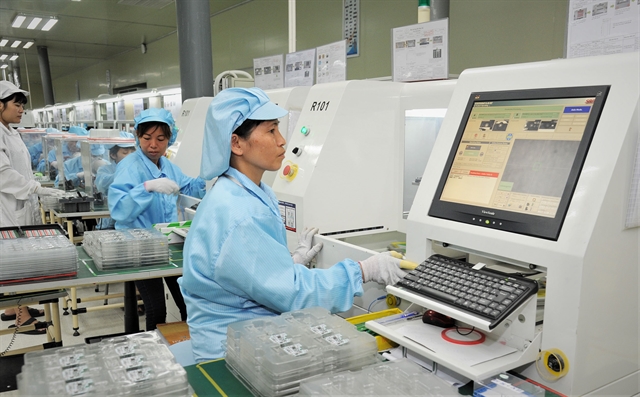
| Electronic component production at Vietonic Co., Ltd. in Đình Trám Industrial Park, Bắc Ninh Province. |
Vice Chairman of the provincial People’s Committee Ngô Tân Phượng said Bắc Ninh will continue to improve the business climate through 2030 and aims to maintain its PCI ranking among the country’s leaders.
Authorities will walk alongside businesses by raising agency heads’ accountability to promptly and effectively resolve investors’ petitions and bottlenecks, ensure fair treatment across all economic sectors, and support local firms to expand in domestic and overseas markets.
From 2021 to 2025, the province recorded 28,590 newly established enterprises with registered capital of more than VNĐ367 trillion (US$13.9 billion) with an average of VNĐ23.7 billion per firm.
In the first half of 2026, there were 4,478 new enterprises with total registered capital of about VNĐ80.2 trillion, along with 177 new branches or representative offices and 1,717 new business locations. — VNS
Economy
 Economy
 Economy
 Economy
 Economy
 Economy
 Economy
 Economy
 Economy
 Economy
 Economy
 Economy
 Economy
 Economy
 Economy