 Sci-Tech

More than 1,000 fallen Vietnamese soldiers' remains recovered from Laos, Cambodia
1.
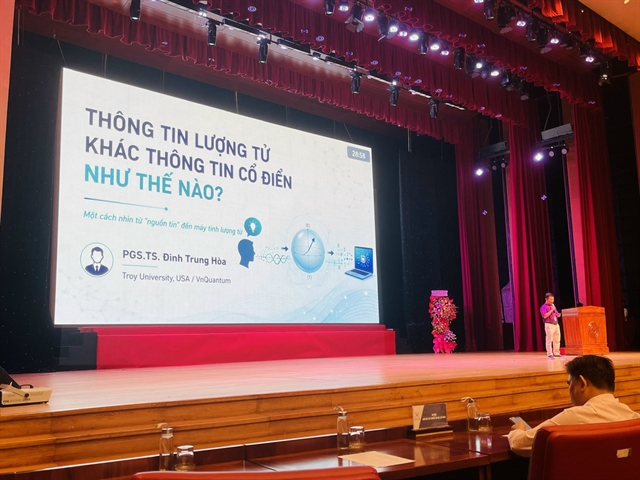 |
| Associate Professor Dr Đinh Trung Hòa from Troy University in the US, highlights that while classical information relies on distinct states that can be easily read or duplicated, quantum information is fundamentally different. |
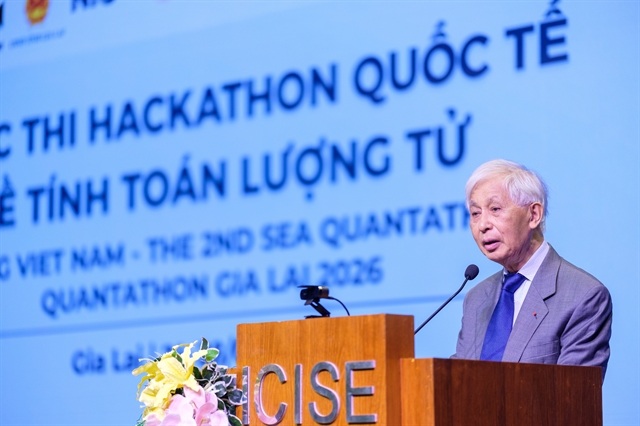
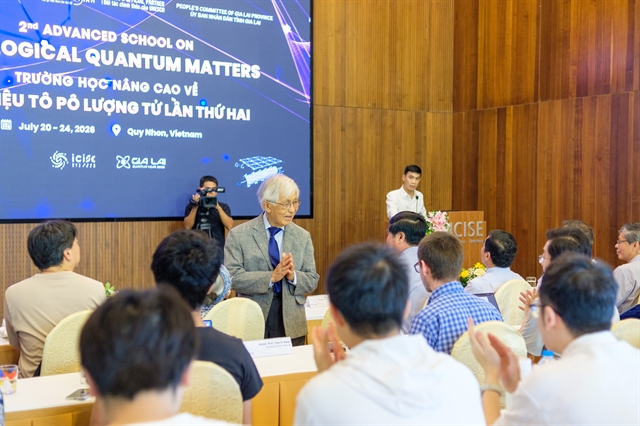
GIA LAI — The Symposium on Fundamentals of Quantum Computing & Semiconducting Technologies gets underway in Gia Lai Province on Monday.
The event kicks off a series of the Vietnam Quantum Roadshow held by the Vietnam’s National Quantum Technology Network (VNQuantum) under the auspices of Gia Lai Provincial People’s Committee and the National Innovation Center (NIC).
The symposium aims to popularise quantum computing knowledge among students in natural sciences and technology, including mathematics, physics, chemistry, engineering, and Information Technology, and is being held rotationally across various regions nationwide.
The programme leverages the collective expertise of prestigious academic partners, namely the Vietnam Institute for Advanced Study in Mathematics (VIASM) for the mathematical foundation; the Quantum Technology Institute (Vietnam National University, Hanoi) for the quantum physics foundation; and the Institute of Astronomy and Space Quantum Communications (IAS QUANTUM) for quantum technology applications, alongside student networks from local universities.
The event brings together experts and researchers from various domestic and international institutions, featuring presentations that range from theoretical foundations to the practical applications of quantum technology.
During his talk on the distinctions between quantum and classical information, Associate. Professor Dr Đinh Trung Hòa, coordinator of the Vietnam Quantum Roadshow from Troy University in the US, highlighted that while classical information relies on distinct states that can be easily read or duplicated, quantum information is fundamentally different.
“It is driven by quantum states where phenomena like superposition, interference, and entanglement take centre stage, unlocking potential far beyond the reach of classical systems,” said Hòa.
Dr Hòa covered essential building blocks such as qubits and the no-cloning theorem, explaining how these unique properties pave the way for breakthroughs in quantum cryptography, communication, and computing.
By providing a clear, intuitive look at these two models, the presentation shed light on why quantum technology is set to define the next era of innovation.
In his presentation, Quantum Key Distribution (QKD): Principles, Protocols, and Experimental Demonstrations, Dr Vũ Quang Minh from the Hà Nội-based Posts and Telecommunications Institute of Technology identified QKD as the core technology of quantum communications.
QKD allows two entities to establish a secret key with a security level guaranteed by the laws of quantum mechanics. Unlike traditional cryptographic systems, which rely on assumptions regarding an attacker’s computational power, QKD exploits quantum properties to detect eavesdropping and ensure the absolute security of the distributed key.
Addressing security in the digital age, Dr Minh highlighted the sensitive information exchanged daily, including e-banking transactions, medical records, e-government services, critical infrastructure, and corporate data. Every encryption system requires a secret key; therefore, securing these keys is vital for overall information security.
According to Dr Minh, with current classical computing technology, breaking these keys would take millions of years. However, Professor Shor’s algorithm has demonstrated the immense theoretical potential of quantum computers to crack encryption in just hours or days. This advancement in qubit-based computing has led to two primary security solutions: Post-Quantum Cryptography (PQC) and Quantum Key Distribution (QKD).
Following Dr Minh’s presentation, Dr Vũ Tuấn Hải from the University of Information Technology, Vietnam National University, Hồ Chí Minh City delivered a talk titled Classical, Probabilistic and Quantum Computing.
Dr Hải provided a computer science perspective on quantum computing, utilising simple systems to explain concepts such as the classical-to-quantum Turing machine and complexity classes. He concluded by introducing the concept of the quantum walk algorithm to help students grasp the fundamental mechanics of how quantum algorithms operate.
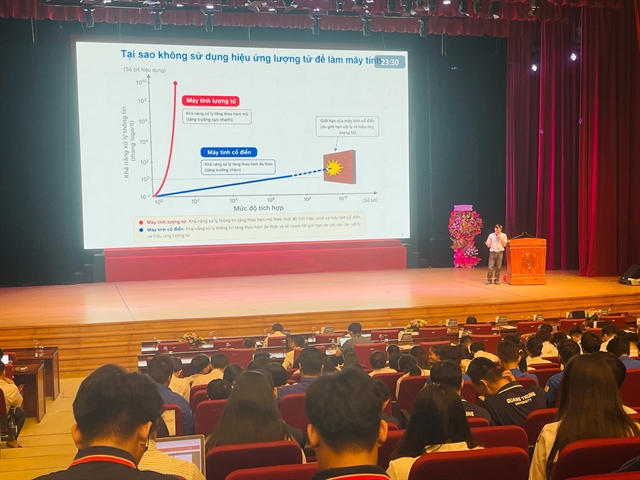
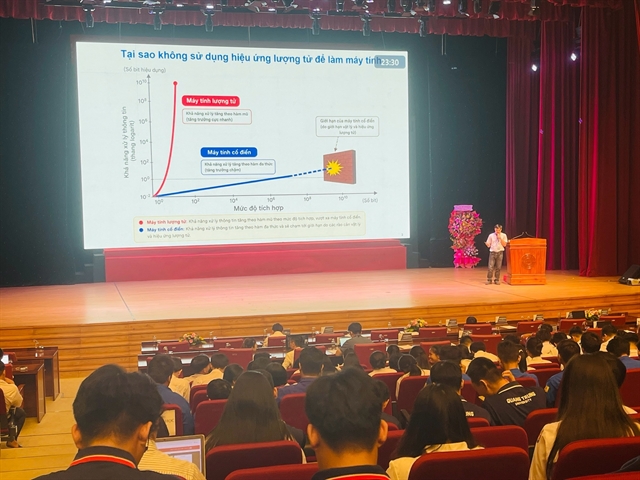 |
| Dr. Hàn Huy Dũng of the Hanoi University of Science and Technology presents at the Symposium on Fundamentals of Quantum Computing & Semiconducting Technologies on Monday morning. VNS photos Khánh Chi |
Meanwhile, Dr Hàn Huy Dũng from the Hanoi University of Science and Technology spoke about The STEM Journey of Building a Quantum Computer: From Interdisciplinary Knowledge to Skills and Innovative Thinking.
According to Dr Dũng, building a quantum computer is an interdisciplinary journey that requires a combination of physics, chemistry, materials science, electronics, and programming. This process begins with understanding qubits, superposition, quantum entanglement, and measurement, before progressing to quantum circuit simulation, algorithm development, and hardware control system design.
“To build a quantum computing system step-by-step, practitioners need to equip themselves with knowledge in quantum mechanics, quantum materials, signal processing, digital circuits, microcontrollers, FPGA and programming techniques,” he said.
“Every stage of building a quantum computer demands the ability to design, test, analyse errors, mitigate noise, and continuously improve the system.”
The one-day event also features presentations by Associate Professor Dr Trần Thị Thu Hạnh from Hồ Chí Minh City University of Technology on Atomic and Molecular Structures; Professor Dr Lại Ngọc Điệp, ENS Paris-Saclay, on Fundamental Particles of Light: From Basic Physics Experiments to Quantum Applications; and Associate Professor Dr Nguyễn Thị Xuân Huynh, Quy Nhơn University, on Quantum Mechanics: From Fundamental Theory to Applications in Materials Research, among others. VNS
Sci-Tech
 Sci-Tech
 Sci-Tech
 Sci-Tech
 Sci-Tech
 Sci-Tech
 Sci-Tech
 Sci-Tech
 Sci-Tech
 Sci-Tech
 Sci-Tech
 Sci-Tech
 Sci-Tech
 Sci-Tech
 Sci-Tech