 Economy

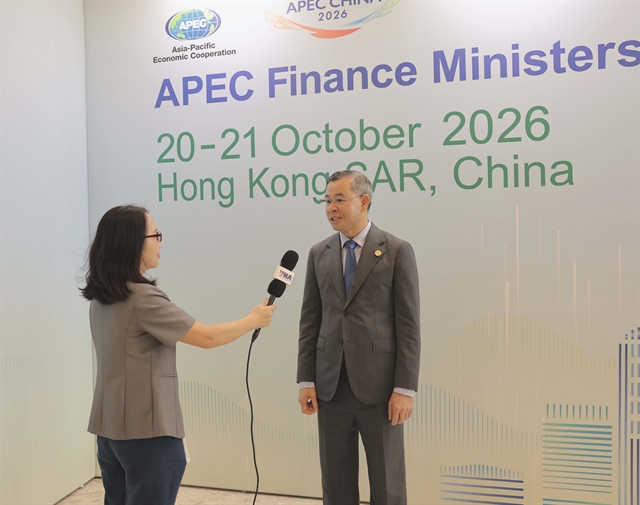
Việt Nam sets four priorities for APEC Finance Ministers’ Meeting in 2027
1.

|
| General Secretary and President Tô Lâm and French President Emmanuel Macron meet with leaders of leading corporations and businesses from the two countries on Thursday. — VNA/VNS Photo |
PARIS — French sporting goods retailer and manufacturer Decathlon expects General Secretary of the Communist Party of Vietnam (CPV) Central Committee and President Tô Lâm’s official visit to France to open new investment opportunities in Việt Nam, with a focus on strengthening production capacity and expanding its distribution network.
Speaking to Vietnam News Agency correspondents in Paris on the occasion of the visit, Frédéric Merlevede, Decathlon’s Global Production Director, highlighted the Vietnamese leader's official visit and the new momentum in Việt Nam-France relations for his group's development prospects in Việt Nam.
With more than 30 years of operations in Việt Nam, Decathlon plans to continue investing in the country’s industrial ecosystem, working with local suppliers to increase product value while promoting innovation, technical expertise and sustainable development.
Việt Nam is now one of the key pillars of Decathlon’s global production chain. The group plans to increase the value and technological content of products designed and manufactured in Việt Nam so that they meet demanding international standards, particularly those of the European market.
Alongside strengthening production capacity, Decathlon aims to bring more products made in Việt Nam to Vietnamese consumers.
Merlevede said rising incomes and growing interest in exercise and sports were creating strong potential for the domestic market. Against this backdrop, Decathlon plans to accelerate the expansion of its store network and e-commerce operations nationwide, giving consumers easier access to quality sporting goods made in Việt Nam.
The group is also seeking to combine advanced technologies with high-quality human resources in its development strategy in Việt Nam. The group eyes to develop projects related to Industry 5.0 and the wider application of artificial intelligence (AI) and advanced manufacturing technologies.
According to Decathlon, Industry 5.0 combines technological capabilities, human intelligence and sustainability. AI and data analytics are helping the group optimise production chains, improve quality control and use resources more efficiently.
Merlevede, however, stressed that technology can deliver its full potential only when supported by skilled workers capable of mastering it. He spoke highly of Vietnamese engineers, describing local personnel not merely as production workers but as “technology partners” capable of mastering and further developing complex manufacturing processes.
The combination of AI, smart manufacturing and Vietnamese engineering expertise will help increase product value and strengthen Việt Nam’s position as a hub for the design and manufacture of high-tech sporting equipment meeting demanding international standards, he said.
After more than three decades in Việt Nam, Decathlon has a positive assessment of the country’s business environment and the potential of its market of more than 100 million people.
Merlevede said Việt Nam has two major advantages: its competitiveness as a global manufacturing base and its rapidly growing domestic consumer market.
Political and economic stability, the EU-Vietnam Free Trade Agreement (EVFTA), and the quality of its workforce, particularly engineers, have helped make Việt Nam a competitive production location in terms of productivity and technical capabilities. Meanwhile, its young and dynamic population, urbanisation and growing interest in sports offer significant potential for domestic consumption.
To facilitate new projects and encourage long-term, high-value investment, Decathlon proposed four priority areas: accelerating the energy transition, including through effective implementation of the direct power purchase agreement (DPPA) mechanism and support for rooftop solar power at factories; modernising logistics infrastructure and multimodal transport; and further digitalising administrative and customs procedures.
The group also proposed tax incentives for investment in research and development, AI and the circular economy to encourage technological advancement and stronger business cooperation.
In addition, it called for greater investment in sports infrastructure and the promotion of sports in schools, which it said would encourage physical activity while creating further room for growth in Việt Nam’s sporting goods market. — VNA/VNS
Economy
 Economy
 Economy
 Economy
 Economy
 Economy
 Economy
.jpg) Economy
Economy
 Economy
 Economy
 Economy
 Economy
 Economy
 Economy
 Economy