 Society

Vietnamese community in China urged to stay united, contribute to homeland
1.
|
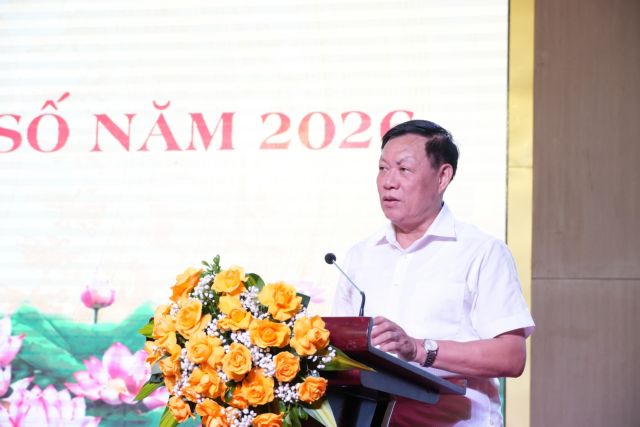
| Deputy Minister of Health Đỗ Xuân Tuyên speaks at the workshop. — VNA/VNS Photo Nguyễn Thảo |
PHÚ THỌ — Many population indicators showed positive results in the first half of this year, the Ministry of Health (MoH) said on Wednesday during a thematic workshop with provinces and municipalities in the northern region on population work.
Speaking at the workshop, Deputy Minister of Health Đỗ Xuân Tuyên said 2026 is a pivotal year for implementing population programmes and projects for the 2026–2030 period.
In the first six months of 2026, the population sector met both targets set out in Resolution No. 01/NQ-CP on key tasks and solutions to implement the socio-economic development plan as well as the state budget estimate for this year, and is estimated to have met or exceeded five of seven specialised indicators.
Lê Thanh Dũng, director of the Việt Nam Population Authority (VNPA) under the MoH, reported that five localities exceeded the target for maintaining replacement-level fertility; more than 4.74 million people used modern contraceptive methods; a total of 683 communes and wards implemented integrated communication campaigns on reproductive health and family planning.
Localities stepped up screening, diagnosis and treatment of certain prenatal and newborn conditions; strengthened training to improve counselling capacity and the provision of screening services.
Many localities introduced policies to address sex ratio imbalance at birth, to care for older people’s health and to modernise communication through digital technology and social media.
However, population work in some localities still faces many difficulties due to organisational restructuring and the implementation of a two-tier local government model.
The workforce for grassroots population work remains insufficient and has not been consolidated, while investment resources are inadequate.
Professional capacity in some areas – such as prenatal and newborn screening, older people’s health care, digital transformation and population data management – remains limited.
Updating and linking data across localities is not yet synchronised.
The integration of population objectives into socio-economic development plans in some areas remains ineffective.
At the workshop, the ministry instructed localities to implement the National Programme to Ensure Replacement-Level Fertility by 2030, the Older Persons’ Health Care Programme for 2026–2030, and the population-related contents of the National Target Programme on Health Care, Population and Development for 2026–2035.
Regarding the Programme to Ensure Replacement-Level Fertility by 2030, Nguyễn Thị Thu, deputy head of the Population Size and Family Planning Division under the VNPA, said Việt Nam’s population last year reached approximately 102.3 million people.
But fertility is falling below replacement level, increasing the risk of labour shortages, population decline and an accelerated ageing process.
To respond to this situation, the 2025 Population Law stipulates various policies encouraging couples to have two children and to maintain replacement-level fertility.
The Programme to Ensure Replacement-Level Fertility by 2030 shifts the emphasis from adjustment to increasing and maintaining fertility, prioritising localities with low fertility.
It aims to raise the national total fertility rate by an average of two per cent by 2030, ensure over 95 per cent of people of reproductive age receive counselling on marriage and childbearing, and have all of provinces and cities implement policies to support childbirth and child-rearing.
Currently, eight out of 34 provinces and municipalities have adopted resolutions on population policy. Among them, five localities provide direct financial support to encourage two-child families, ranging from VNĐ1–5 million (US$37-190) per eligible case.
The Older Persons’ Health Care Programme to 2030 sets 14 targets and six groups of tasks and solutions.
The programme aims that from this year, older people will receive a health check or screening at least once a year and have health management records.
By 2030, 90 per cent of communes, wards and special administrative zones will have clubs and volunteer teams caring for older people, 20 per cent of localities will develop day-care models, and all of provinces and cities will have elderly care facilities through socialisation and hospitals or geriatric departments/specialties.
Delegates also exchanged experiences and proposed numerous solutions to effectively implement the Population Law and population programmes for 2026–2030, contributing to maintaining replacement-level fertility, improving population quality and proactively adapting to population ageing. — VNS
Society
 Society
 Society
 Society
 Society
 Society
 Society
 Society
 Society
 Society
 Society
 Society
 Society
 Society
 Society