 Society

Việt Nam, Switzerland seek to deepen parliamentary cooperation
1.
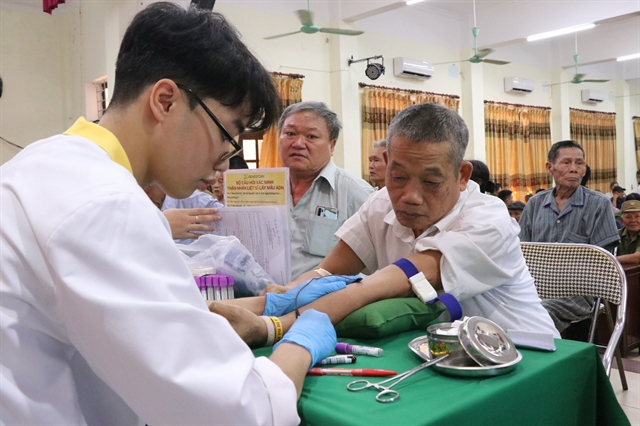 |
| A relative of a fallen soldier gives a blood sample for DNA testing at a police station in the central province of Nghệ An. — VNA/VNS Photo |
NGHỆ AN — Before dawn broke over her hometown in the central province of Nghệ An, 74-year-old Trần Thị Ngụ was already waiting outside the local police station.
The errand that brought her there was one she'd waited for nearly six decades to complete: rolling up her sleeve for a blood draw that might finally tell her family where her eldest brother is buried.
Her brother, Trần Đình Kiên, was 18 when he was killed in action in 1966. Of the four siblings in the family, three brothers went off to fight; two came home wounded, but Kiên never came home at all.
Over the years his surviving brothers, despite their own war injuries, made repeated trips to Cambodia, where Kiên had been fighting, hoping to find some trace of his grave. They never did.
"I've tried so many times to imagine what my brother would look like today. In my memory, he's still 18, with that gentle smile," Ngụ said, waiting her turn in line.
Ngụ is among hundreds of thousands of Vietnamese still searching for relatives killed in the wars.
By the Ministry of National Defence's count, an estimated 175,000 fallen soldiers remain unaccounted for, and another 300,000 sets of remains have never been matched to a name. For families like Ngụ's, many of them now elderly, the search has become a race against time.
That race is now getting help from a new generation of DNA science. Researchers say a gene-sequencing technique developed over the past few years is succeeding where older methods failed – reading genetic material out of bone fragments so degraded that scientists once considered them a dead end.
"These are more than scientific achievements," said Phí Quyết Tiến, director of the Institute of Biology at the Vietnam Academy of Science and Technology.
"They're a real chance to fulfil something families have been hoping for for years."
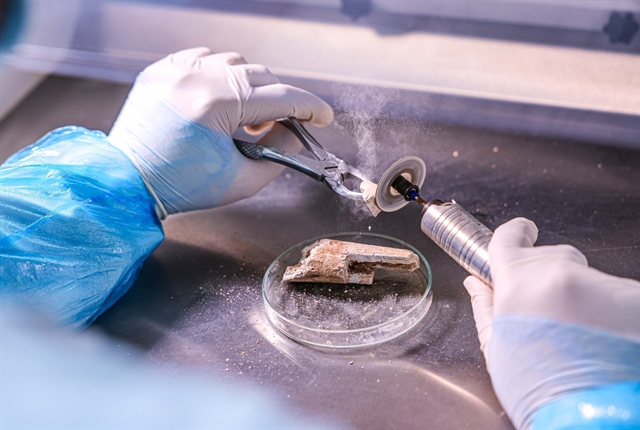 |
| A bone fragment from an unidentified fallen soldier is cleaned, cut and sterilised before being ground into a fine powder for DNA extraction. — VNA/VNS Photo |
For decades, identification efforts leaned on mitochondrial DNA testing, which worked reasonably well in cases involving a manageable number of graves and traceable relatives.
But the method has real limits, particularly in Việt Nam, where bones have often decayed far more than remains found in cooler climates – leaving too little usable genetic material to test.
Researchers at the academy set out to adapt more advanced sequencing technology from abroad to Việt Nam's conditions.
The result is a technique known as NGS-SNP – shorthand for Next Generation Sequencing combined with analysis of single nucleotide polymorphisms, tiny variations at specific points in a person's genetic code.
Rather than needing an intact stretch of DNA, as older tests did, the new approach can piece together an identity from thousands of these small markers at once, even in badly fragmented samples.
That matters for two reasons, Tiến said. First, it works on far weaker samples than earlier techniques could handle. Second, it can match remains to relatives several generations removed – great-nephews and grandnieces, not just parents or siblings – at a moment when many families no longer have anyone alive from the fallen soldier's own generation to provide a direct comparison.
He said the long-term goal is a single national DNA database where every new sample, whether from a grave or a living relative, is automatically checked against everything already on file.
The scale of the effort is considerable. In the first half of 2026 alone, 24 recovery teams working in Laos, Cambodia and within Việt Nam brought home 1,255 sets of remains for reburial, according to the defence ministry.
Feeding the identification pipeline requires an equally large sampling operation. The ministry has organised 297 sampling teams with more than 3,600 personnel, who have now collected DNA material from over 15,400 individual graves.
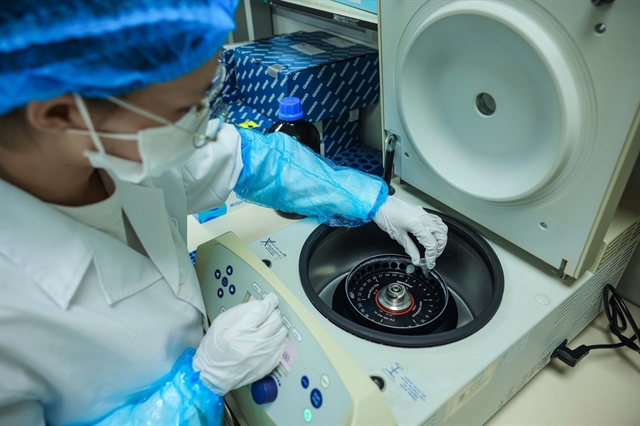 |
| Ground bone powder is placed into a centrifuge, then spun to concentrate the sample and settle out the DNA. — VNA/VNS Photo |
For the family's part, authorities have gathered and stored more than 93,000 biological samples from relatives, of which over 53,000 have been analysed and loaded into the national database.
New storage facilities have been built or renovated to hold the growing archive of samples, and the Military Institute of Forensic Medicine – the lab handling much of the analysis – has received new equipment and additional staff training.
So far, DNA units nationwide have logged more than 8,100 remains samples for testing. The forensic institute has completed analysis on 92 of them; 20 yielded a full genetic profile.
At the same sampling site in Nghệ An, 62-year-old Nguyễn Thị Thanh gave her own sample that morning, clutching a yellowed folder of documents – a death notice, a handful of details, decades of memory – that made up nearly everything her family knew about her brother.
Nguyễn Thanh Bình volunteered for the army in 1970, at 17. The family heard from him only sporadically through letters until 1976, when a fellow soldier returned home with the news: Bình had been killed on February 28, 1974, fighting in Cambodian territory.
The news arrived two years late.
"In 2001, before our father died, he held our hands and made us promise to find Bình and bring him home, whatever it took," Thanh said.
"That promise is something the whole family has carried ever since."
One by one, though, the people who made that promise have passed away – her siblings, and in 2021, her mother, who died without ever seeing her son come home.
Thanh is the only one left to keep looking. Since 2011, she has travelled to Cambodia five times, working with a Vietnamese military unit that specialises in recovering soldiers' remains abroad, following a hand-drawn burial map kept by one of Bình's old comrades.
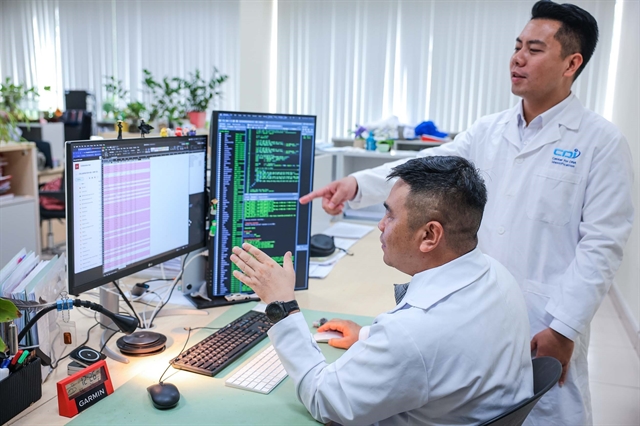 |
| Technicians review NGS-SNP results on a display. — VNA/VNS Photo |
But half a century has reshaped the landscape, and the traces they're chasing have mostly vanished.
"I'm too old and too weak to make that trip again. Now everything rests on the DNA bank. If the testing can just bring my brother home, I'll finally have peace," Thanh said.
Stories like Ngụ's and Thanh's are playing out by the thousands. In Nghệ An Province alone, police say a seven-day sample collection drive at seven fixed sites brought in more than 17,830 samples from relatives – data that officials say could eventually help identify more than 22,000 fallen soldiers connected to the province.
"The number came in below our target, but it still met what we needed for this phase of the campaign," said Lieutenant Colonel Chu Chí Quốc, a senior police officer in the provincial Police Department of Nghệ An, noting that a single relative's sample can sometimes help identify two or three fallen soldiers from the same family line.
Quốc said some cases couldn't be completed at all, either because no eligible relatives were left, or because relatives lived far away or were too elderly or unwell to travel to a collection site. Authorities are now planning follow-up drives to reach them.
Under the current protocol, samples are collected in a set order down the maternal line, starting with mothers and maternal grandmothers, then siblings, aunts, uncles and their children to keep comparisons as accurate as possible. — VNS
Society
 Society
 Society
 Society
 Society
 Society
 Society
 Society
 Society
 Society
 Society
 Society
 Society
 Society
 Society