 Society
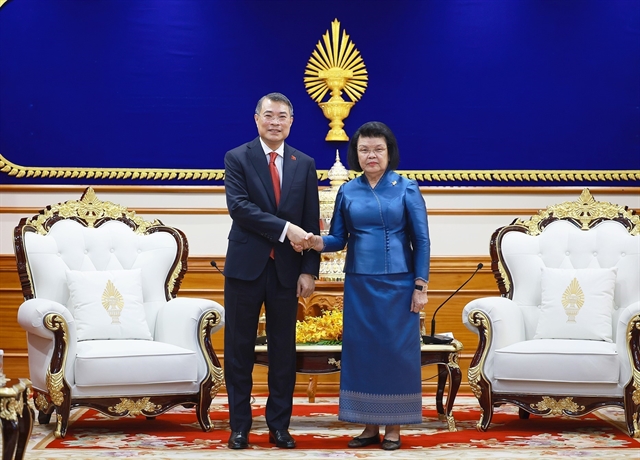
Vietnamese Prime Minister meets Cambodian National Assembly President
1.
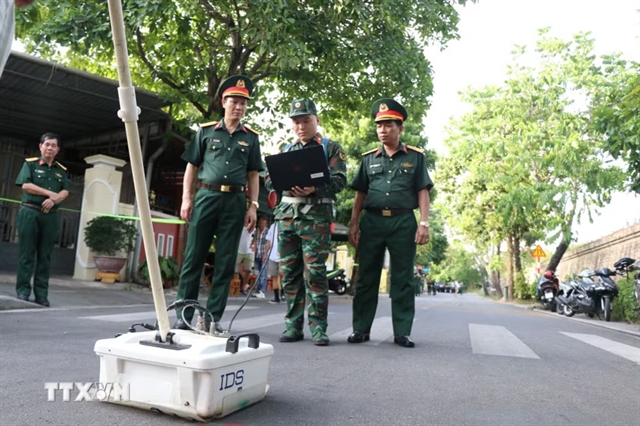 |
| The search for fallen soldiers’ remains that may be buried under the city's streets. — VNA/VNS Photos Mai Trang |
HUẾ — Armed with ground-penetrating radar and data analysis, Huế City is turning technology into a frontline tool to locate martyrs’ graves long hidden beneath the city’s streets and citadel walls.
As the spearhead of the 500‑day‑and‑night campaign to search for, recover and identify the fallen, Steering Committee 515 deployed a GPR team from the Ministry of National Defence’s Institute of Design.
Within hours of their June 25 arrival in Huế City, specialists were scanning two priority sites of Xuân 68 Street and the area around Chánh Tây Gate.
GPR works by sending electromagnetic waves into the subsurface and recording reflections from contrasting materials, disturbed soil layers, buried pits or foreign objects.
In Huế City’s dense urban fabric, stacked roadbed materials can limit penetration depths, but early readings are promising.
On Xuân 68 Street, technicians found two long disturbed areas about 1.2m deep, 2.5m wide, and 10–12m long. Near Chánh Tây Gate, they recorded another disturbance about one metre below the surface and 7–9m wide. Below 3.5m, the radar gets noisy, so the data must be analysed in the lab before any conclusions are made.
Lieutenant Colonel Phạm Thị Thanh Vân, Deputy Director of the Institute’s Central Branch, said the signals were only the beginning and that her team would process the entire dataset to characterise subsurface structures and pinpoint anomalies that could indicate burial pits, adding that only then would they recommend the next steps.
What the radar can’t provide on its own, Huế is sourcing from the people who were there. The city’s military command is pairing each scan line with testimony from residents and veterans – memories that, after nearly six decades and sweeping urban change, have become priceless coordinates on a fading map.
One of those guides is 67-year-old Lê Văn Lượt of Phú Xuân Ward.
In early June, he came forward with childhood memories of the aftermath of the 1968 Tết Offensive: a bomb crater near Chánh Tây Gate where he believes 10 to 15 revolutionary soldiers were interred. His recollections, consistent with Regiment 6 combat logs from the Trị Thiên Military Region, triggered multiple on-site verifications and a leafleting campaign urging others to share what they remember.
“I’ve kept this in my mind since I followed my father to the scene,” Lượt said while watching technicians push the radar unit along the base of the citadel wall.
In recent days he has helped the military cordon the site and offered two additional suspected locations within the Imperial Citadel.
“I hope this helps bring the martyrs back to their families, and encourages more people to speak up.”
Longtime residents recall burials and the backfilling of bomb craters.
Two officials who took over the area after 1975 confirmed a large crater once abutted the wall.
From the veteran ranks, former Regiment 6 soldier Phạm Ngọc Tuấn has urged a careful, expanded survey around the memorial stele on Tôn Thất Thiệp Street near Hữu Gate, an area he remembers as a first-aid and surgical station during Tết 1968.
Previous searches there have found nothing but the new approach blends patience with precision.
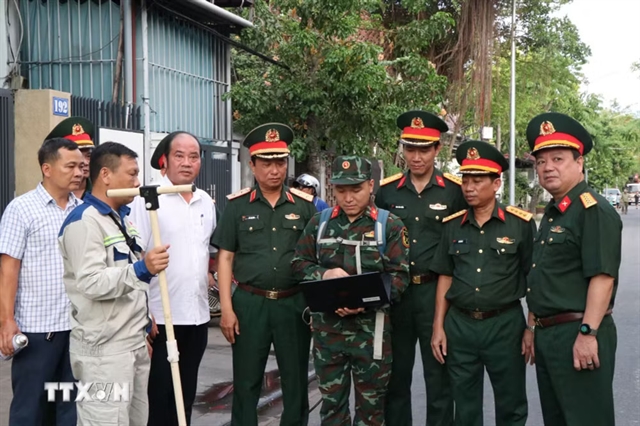 |
| Leaders from Military Region 4, Huế City, and the Military Command observe a GPR survey. |
At the sites, Lieutenant General Hà Thọ Bình, Commander of Military Region 4, has called for a tightly integrated method with scientific, line-by-line surveys, rigorous data analysis and constant cross-checking with eyewitness accounts and historical records. The goal is not speed for its own sake but certainty.
That certainty can hinge on a single, fragile detail. A faint recollection of a trench line, the knowledge that a crater sat just here against an old wall – all can tip the balance from vague suspicion to targeted excavation.
The martyr remains recovery team 192 rates some of the new leads as highly credible, aligned with wartime diaries and unit logs.
If GPR is the campaign’s new set of eyes, memory is its compass. Together, they’re giving Huế the clearest map it has had in decades. Each dataset is checked, stored, and slated for lab processing before any shovel hits the ground. Each tip is logged, assessed and overlaid with history.
Early radar returns cannot confirm the presence of graves. However, they can prioritise where to look first. And that is already changing the tempo of the work, tightening search corridors, focusing scarce resources, and, in practical terms, bringing families closer to the answers they have sought for generations.
The campaign’s highest aim remains unchanged, which is to return the heroes to their motherland and their loved ones, and to close a waiting that has stretched across time. — VNS
Society
 Society
 Society
 Society
 Society
 Society
 Society
 Society
 Society
 Society
 Society
 Society
 Society
 Society
.jpg) Society
Society