 Society

Top Vietnamese leader highlights new horizon for Việt Nam–Denmark cooperation
1.
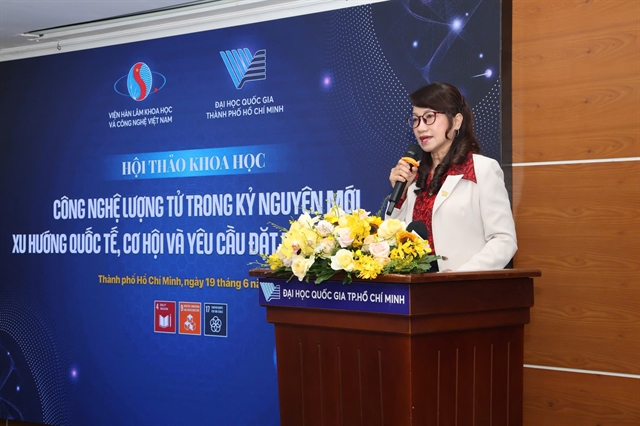 |
| Professor Nguyễn Thị Thanh Mai, chancellor of VNU-HCM, speaks at the national scientific conference on quantum technology in HCM City on June 19. — Photos courtesy of VNU-HCM |
HCM CITY — Việt Nam must urgently build an autonomous national quantum capability to protect its digital sovereignty against future decryption threats, experts said at a major national scientific conference in HCM City on June 19.
The conference called "Quantum technology in the new era: International trends, opportunities, and requirements for Việt Nam", was co-hosted by Vietnam National University-HCM City (VNU-HCM) and the Vietnam Academy of Science and Technology (VAST).
It brought together top policymakers, scientists, and representatives from the ministries of public security and national defence to chart a strategic roadmap for the country.
Speaking at the conference, Professor Nguyễn Thị Thanh Mai, chancellor of VNU-HCM, said quantum technology has rapidly evolved from academic theory into a critical national security asset.
"The question is no longer whether quantum technology should be a priority, but how Việt Nam can develop the speed, foundation, and autonomy to master this field, reduce external dependencies, and integrate deeply into the global value chain," she said.
Delegates warned of a pressing non-traditional security risk known as the "harvest now, decrypt later" strategy, where malicious actors intercept and store encrypted data today to decrypt it once quantum computers become sufficiently powerful.
Because of this, experts urged that developing post-quantum cryptography and protecting national digital infrastructure must begin immediately.
To eliminate fragmented investments and maximise resources, the conference introduced a proposed "Hub-and-Nodes" strategic network architecture for the 2026-45 period.
Under this framework, a single national centre will act as the coordinating ‘hub’ to manage and distribute resources to five specialised ‘nodes’: the Ministry of Public Security, the Ministry of National Defence, VNU-Hà Nội, VNU-HCM, and VAST.
This model is expected to bridge the gap between laboratory research and commercial industries, helping technologies cross the innovation “valley of death".
Prof. Mai outlined three core pillars to achieve these strategic goals:
Interdisciplinary Human Resources: Focusing on training young scientists and attracting leading overseas Vietnamese experts from advanced global tech hubs, including the US, Japan, Europe, and Singapore.
Targeted Applications: Prioritising immediate national security needs, such as post-quantum cryptography, alongside practical applications in material sciences (semiconductors and batteries), pharmaceuticals, logistics, and smart city infrastructure.
Tripartite Ecosystems: Establishing sustainable partnerships between research institutes, universities, and businesses. Tech enterprises are encouraged to engage early by commissioning software solutions, funding scholarships, or co-developing application laboratories.
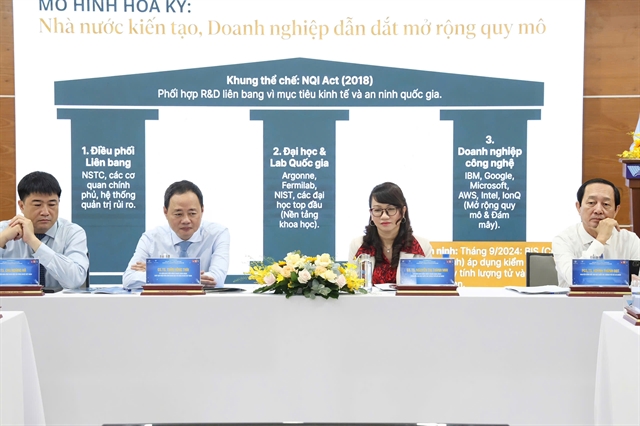 |
| Experts discuss strategic roadmaps for Việt Nam’s quantum ecosystem during the national scientific conference in HCM City on June 19. — Photos courtesy of VNU-HCM |
Professor Trần Hồng Thái, president of VAST, said the global quantum race involves an expansive ecosystem including secure communications, high-precision sensing, photonics, and advanced materials.
“To ensure Việt Nam can realistically compete, delegates recommended significant institutional reforms.”
These include establishing policy “sandboxes" to test emerging technologies and adopting a "stage-gate" risk-management model to evaluate state-funded projects periodically.
Furthermore, the Government should shift its funding focus from purchasing standalone equipment (CapEx) to financing the long-term operation and maintenance of shared research infrastructure (OpEx), according to scientists.
The conference’s findings will serve as a foundation for completing Việt Nam’s upcoming national strategy, aiming to turn quantum technology into a driving force for socio-economic growth and national defence. — VNS
Society
 Society
 Society
 Society
 Society
 Society
.jpg) Society
Society
 Society
 Society
 Society
 Society
 Society
 Society
 Society
 Society