 Society
Việt Nam, Singapore promote cooperation through Party-to-Party channel
1.
|
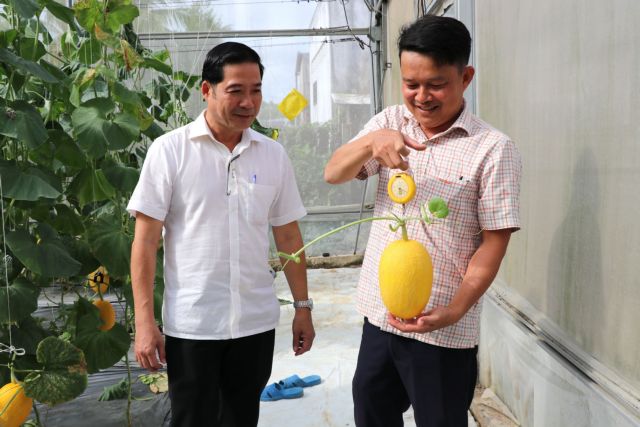
| Farmer Trần Minh Thiện (right) at his 1,000-square-metre greenhouse melon farm in Vĩnh Long Province’s Song Lộc Commune, which generates annual profits of more than VNĐ150 million (US$5,700). — VNA/VNS Photo |
VĨNH LONG — From greenhouse grown melons cultivated by small farmers to hydroponic vegetable farms operated by young entrepreneurs, high-tech agriculture is steadily reshaping production across Vĩnh Long Province.
The shift is helping farmers improve productivity, increase incomes and adapt to the growing challenges posed by climate change, while meeting increasingly stringent market requirements for quality and food safety.
One of the province's notable examples is a greenhouse melon farm operated by farmer Trần Minh Thiện in Song Lộc Commune.
In 2019, Thiện converted 1,000sq.m of low yielding rice land into a greenhouse equipped with drip irrigation and a closed cultivation system.
The technology allows precise control of temperature, humidity, water supply and nutrient levels, creating favourable conditions for stable plant growth and consistent fruit quality.
The farm produces around two tonnes of melons per crop. With selling prices ranging from VNĐ40,000–60,000 (US$1.5–2.3) per kilogramme, the model generates average profits exceeding VNĐ40 million ($1,520) per harvest.
Each crop lasts about 75 days, allowing up to four production cycles annually.
According to Thiện, greenhouse cultivation is becoming an increasingly suitable option as farmers seek higher returns from limited land resources and face more unpredictable weather conditions.
However, he noted that the initial investment remains substantial, requiring around VNĐ450 million ($17,100) for a 1,000 square metre greenhouse.
Access to financing, technology transfer and market linkages will therefore be critical for expanding the model.
Ngô Hồng Thanh, chairman of the People's Committee of Song Lộc Commune, said the locality currently has nearly one hectare of high-tech melon production.
Recognising its economic advantages, the commune plans to convert around 20 hectares of agricultural land this year to coconut cultivation, fruit trees and other high-value crops, including greenhouse melons.
Local authorities are also coordinating training programmes and technical support to help farmers adopt advanced production methods.
While greenhouse melon cultivation highlights innovation among farmers, hydroponic vegetable production demonstrates the growing role of young enterprises in agricultural modernisation.
Trần Thái Bảo began experimenting with small scale hydroponic cultivation in 2018 with the goal of producing safe vegetables for his family.
Seeing strong consumer demand, he expanded operations and established Green Farm Co., Ltd. in 2019.
What started as a 1,000 square metre greenhouse in Châu Thành Commune has since expanded to an additional facility in Nguyệt Hóa Ward, bringing the company's total production area to about 2,000 square metres.
Green Farm received VNĐ200 million ($7,600) in support through agricultural restructuring programmes to invest in greenhouse infrastructure and obtain VietGAP certification.
The assistance helped reduce initial costs and enabled the company to strengthen product quality and competitiveness.
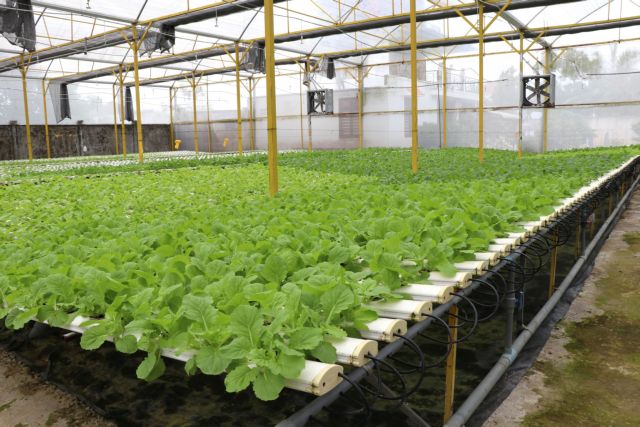
Bảo, the company's director, said all products are cultivated using recirculating hydroponic technology within controlled greenhouse environments.
The closed system continuously recycles water and nutrients, allowing precise management of crop growth while reducing pest risks, minimising pesticide use and lowering labour costs.
The company currently produces seven varieties of leafy vegetables with an output of approximately 6.5 tonnes per month.
Products are supplied to 12 supermarkets across the Mekong Delta region and sold at prices ranging from VNĐ30,000–35,000 ($1.1–1.3) per kilogramme.
Five products, including pak choi, spinach and mustard greens, have been recognised under the national One Commune One Product programme with three-star OCOP certification.
Beyond providing safe food, Green Farm also creates stable employment for six local workers and contributes to rural economic development.
|
| A hydroponic vegetable farm operated by Green Farm Co., Ltd. in Vĩnh Long Province.—VNA/VNS Photo |
Accelerating the transition
From greenhouse farming and hydroponics to automated irrigation systems and digital nutrient management, advanced technologies are becoming increasingly common throughout Vĩnh Long's agricultural sector.
According to the provincial Department of Agriculture and Environment, Vĩnh Long is accelerating efforts to restructure agriculture towards higher value-added production and sustainable development.
Priority areas include concentrated raw material zones, value chain-based production, organic agriculture, high-tech farming and market-oriented cultivation.
To support the transition, the province has introduced various policies encouraging farmers, cooperatives and businesses to invest in modern production systems.
Financial assistance is available for greenhouse and net house construction, safe production practices and quality certification.
Support levels reach up to VNĐ50 million ($1,900) for net houses and VNĐ100 million ($3,800) for greenhouses covering 1,000 square metres.
Science and technology have also played a key role in agricultural modernisation. During the past five years, the three localities that were merged into the new Vĩnh Long Province implemented more than 50 research and technology application projects.
Every year, technical agencies provide training to nearly 15,000 participants and offer direct consultations to around 20,000 farming households.
Numerous climate resilient crop varieties and livestock breeds have been introduced, while more than 200 smart farming models featuring water saving irrigation, organic production, circular agriculture and Good Agricultural Practices standards have been developed and replicated.
Mechanisation has also expanded through support programmes that help farmers upgrade machinery and equipment, improving labour productivity and operational efficiency.
The province now has more than 85,600 hectares under organic production or high-tech agricultural systems, accounting for roughly 11 per cent of total agricultural land.
Digital technologies are increasingly being integrated into production through planting area codes, traceability systems and electronic farming records.
More than 80 vegetable production facilities operating under protected cultivation are equipped with automated temperature and humidity control systems.
Trần Trường Giang, deputy director of the provincial Department of Agriculture and Environment, said Vĩnh Long is shifting from a traditional focus on agricultural production to a broader agricultural economy approach centred on efficiency, value creation and market demand.
The province aims to develop a greener, more ecological and circular agricultural sector supported by high technology, digital transformation, branding and traceability systems.
Authorities are continuing to improve policies related to finance, credit, taxation and land access, while promoting public private partnerships, innovation and agricultural start-ups to attract greater investment into rural areas.
As climate change intensifies and market standards continue to rise, high-tech agriculture is expected to become a major growth driver for Vĩnh Long.
More importantly, the transition reflects a broader change in mindset among farmers and businesses, moving from experience-based cultivation to production guided by science, technology and market signals, laying the foundation for a modern and sustainable agricultural sector. — VNS
Society
 Society
 Society
 Society
 Society
 Society
 Society
 Society
 Society
 Society
 Society
 Society
 Society
 Society
.jpeg) Society
Society