 Society

Bà Đen Mountain’s cloud cap offers a spectacle worth seeing in person
1.
|
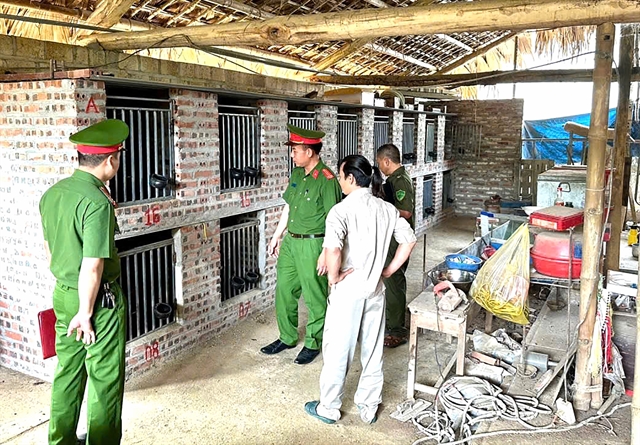
| Lý Ngọc Hà stands with police officers beside his fighting cock farm, built with support from preferential loans. Photo: baochinhphu.vn |
HÀ NỘI — Before dawn breaks over Yên Thành Village in the mountainous commune of Văn Bàn in northern Lào Cai Province, Lý Ngọc Hà is already in his garden, bucket of grain in hand, calling out as he walks. The fighting cocks, now familiar with his voice, flap noisily in response, breaking the early morning stillness.
Few would guess that the man tending his chickens today was once sent to compulsory drug rehabilitation twice.
Two painful falls
Born in 1987, Hà spent years trapped in drug addiction.
“At that time, I was still young and impulsive,” he said. “Friends tempted me into trying drugs. After that, things spiralled out of control. I did not even realise when I became addicted. I lost too much: myself, my family, everything.”
Those two stints in compulsory rehabilitation were not merely entries in an official record. They marked moments when his family came close to breaking point.
Back then, the family’s small house in Yên Thành was clouded in gloom. Laughter became rare, replaced by the judgemental glances of neighbours.
His mother, Mộc Thị Mùi, still remembers those difficult days vividly.
“Our family suffered terribly. People gossiped about us,” she said. “My husband and I did not even want to leave the house or speak with others. But ever since he returned from rehabilitation and quit drugs, the whole family has become happier. Our lives have improved a lot.”
Her simple words carry the weight of years filled with tears, hope and quiet perseverance.
After his second rehabilitation programme, Hà returned home not as a defeated man but as someone determined to rebuild his life. He started with the smallest things: raising fighting cocks and farming fish in the backyard of his family home.
Hà was among the first people in Văn Bàn Commune to be considered for financial support under local assistance programmes. Access to preferential loans allowed him to expand his poultry farm, increase his flock and invest in better facilities.
Today, his fighting cock breeding model has begun generating a stable income. He also earns extra money by caring for chickens on behalf of other enthusiasts.
The work may be modest, but it allows him to support himself, care for his family and, most importantly, stay away from temptation.
Nguyễn Công Bằng, head of Yên Thành Village, said Hà had changed dramatically over the past three years.
“He no longer hangs around aimlessly. He focuses on making an honest living now,” Bằng said. “We hope he will continue striving to improve his life.”
According to local authorities, Hà has completed his post-rehabilitation monitoring period, has not relapsed and complies fully with local regulations.
Numbers that tell a story
Hà’s story is not unique but reflects a broader transformation taking place in Văn Bàn Commune.
In December 2025, the locality became one of 32 communes in Lào Cai Province officially recognised as drug-free communes.
According to commune police data, the area currently reports no drug-related crimes, no illegal drug-use hotspots and no wanted fugitives connected to narcotics offences. The achievement follows years of coordinated prevention and enforcement efforts.
Challenges, however, remain considerable.
Văn Bàn is a mountainous commune covering more than 156 square kilometres and home to nearly 28,000 residents. Formed through the merger of five former administrative units, it also has more than 5,000 migrant workers employed far from home. This group is considered vulnerable to social problems if left unmanaged.
Lieutenant Colonel Trịnh Xuân Hiệp, chief of Văn Bàn Commune Police, said authorities remain determined to prevent drugs from resurfacing.
“We have identified this as a fight that must be pursued relentlessly,” he said. “At present, commune police are monitoring 73 drug-related cases, including 42 people who have completed rehabilitation programmes. Every case is documented, assigned to responsible officers and monitored regularly.”
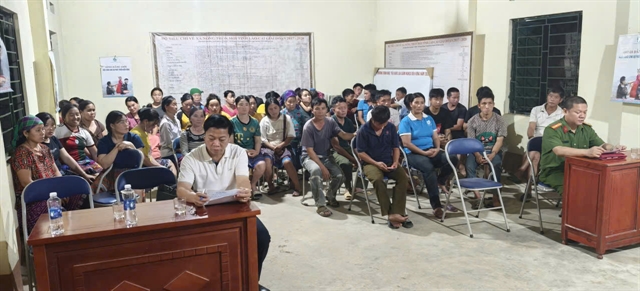
Over the past year, police and local agencies have organised 120 awareness campaigns, reaching more than 10,000 people.
Yet, management alone is not enough. Helping former addicts secure stable livelihoods is considered key to preventing relapse.
“We have reviewed nearly 50 cases seeking loans to develop livelihoods,” Hiệp said. “We are coordinating with the Social Policy Bank to provide timely assessments and support. Our principle is to leave no one behind.”
|
| Police officers in Văn Bàn Commune conduct anti-drug awareness campaigns for residents. Photo: baochinhphu.vn |
Under Government Decision No. 08/2026/QĐ-TTg, which took effect on May 1, former drug users are eligible for preferential loans to support production, business activities and job creation through simplified procedures and low interest rates. Individuals can borrow up to VNĐ200 million (US$7,700).
Alongside support measures, anti-drug enforcement continues under what local authorities describe as a zero-tolerance approach.
Văn Bàn Commune Police have recently launched a large-scale drug testing campaign using more than 3,000 testing kits, targeting high-risk groups such as drivers, factory workers and freelance labourers.
Police have also expanded outreach efforts to every village and household, with all local families signing commitments to comply with the law and reject drugs.
For Hà, the journey back into society has been possible because his family never abandoned him, local authorities never gave up on him and he himself refused to surrender.
His daily routine may seem ordinary but for him it stands as the clearest proof that his life has taken a different path.
“As long as someone is truly determined to quit drugs, society will not turn its back on them,” Lieutenant Colonel Hiệp said. — VNS
Society
 Society
 Society
 Society
 Society
 Society
 Society
.jfif) Society
Society
.jfif) Society
Society
 Society
 Society
 Society
 Society
 Society
 Society