 Society
Sơn La holds second coffee festival, targeting stronger businesses in future
1.
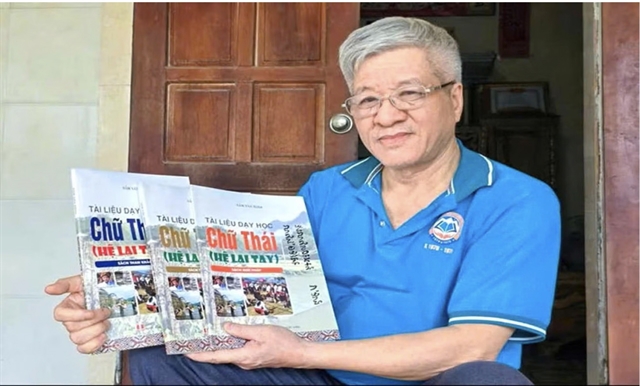 |
| Sầm Văn Bình introduces his works on the Thái script. — Photo baophapluat.vn |
NGHỆ AN — From fragmented documents and faded manuscripts, dedicated people have patiently compared, transcribed and memorised each ancient character with the hope of preserving the script of the Thái ethnic group in central province of Nghệ An.
Writing is inseparable from the customs, traditions and spiritual life of the community. When writing disappears, many rituals and folk knowledge will gradually fade away.
Thái ethnic people accounting for more than 50 per cent of ethnic groups in central Nghệ An Province posses a huge cultural treasure with folk literature and traditional rituals, of which the script of Thái ethnic group in Nghệ An is recognised as the national intangible cultural heritage.
The Thai script is commonly used in two systems of Thái Lai Tay and Thái Lai Pao, and is applied in the culture, education, and traditional festivals of the mountainous communes of Nghện An Province.
Efforts from the community
For a long time, the Thái script gradually faded from daily life, existing only in the memories of the elders in the mountain villages.
Young people grow up with the general education curriculum, familiar with the Latin alphabet, smartphone screens and the increasingly fast-paced modern lifestyle.
Traditional ethnic scripts, no longer used frequently, face the risk of disappearing. Language, like a stream, will gradually dry up over time if its source is blocked, leaving a void that is difficult to fill in the cultural life of the community.
Since 2020, Nghệ An has implemented a project of digitalisation for the Thái script database and co-ordination with the Việt Nam Language Institute to standardise the script system.
Free Thái writing classes have opened in communes, attracting hundreds of students both young and old.
The year 2025 marked an important milestone for ethnic cultural preservation when the Ministry of Culture, Sport and Tourism issued a decision on recognising the Thái language and script of Nghệ An as the National Intangible Heritage.
This event not only celebrates the unique cultural values of the Thái community in Nghệ An Province but also opens a new chapter in the journey to revive a linguistic heritage that was once in danger of disappearing.
Non-stop efforts
The preservation of the script is thanks to the efforts of countless people, especially Sầm Văn Bình in Quỳnh Hợp Commune.
From fragmented documents and faded manuscripts, Bình patiently compared, transcribed, and memorised each ancient character with the hope of preserving the script of the Thái ethnic group.
Some nights, the lights in his small house stayed on until late, illuminating the pages of manuscripts densely filled with meticulously handwritten Thái characters, like a silent race against oblivion.
After many years of hard work, Bình not only mastered reading and writing ancient Thái script but also restored a large part of the vocabulary that was in danger of disappearing.
Building on that foundation, he systematised the script into teaching materials, compiling a five-volume Thái-Tày language course organised by topic. He published the 'Thái–Vietnamese Dictionary' (14,000 entries) and 12 volumes titled 'Funeral orations of the shaman (thầy mo)'.
The works of Bình are not only linguistic achievements, but also a rich repository of living culture, helping to disseminate and preserve ethnic identity.
In particular, the 'Funeral orations of the thầy mo' volumes carry not only linguistic value, but also constitute a precious cultural archive, reflecting the spiritual life, worldview and outlook on life of the Thái people across generations.
For Bình, writing cannot be separated from customs, traditions and the spiritual life of the community. When a script disappears, many rituals and bodies of folk knowledge also gradually fade.
He believes preserving the script is not merely about safeguarding a system of characters, but about protecting the cultural foundation and retaining the core identity of a community amid the unceasing flow of time.
Passing on the value of heritage
Vi Khăm Mun, 80, in Xiềng Líp Hamlet of Yên Hoà Commune, has also spent many years researching and compiling teaching materials for the Thái language.
He has travelled across villages collecting and translating proverbs, idioms and folktales of the Thái people to support language teaching.
Between 2010 and 2020, he taught numerous classes – on average about six per year – with hundreds of learners in total.
To facilitate instruction, he painstakingly compiled textbooks for teaching the Thái script, which students found clear and accessible.
“Teaching the Thái script is not merely about reading and writing; it is also about passing on a rich treasury of traditional cultural values to younger generations,” Mun told baophapluat.vn.
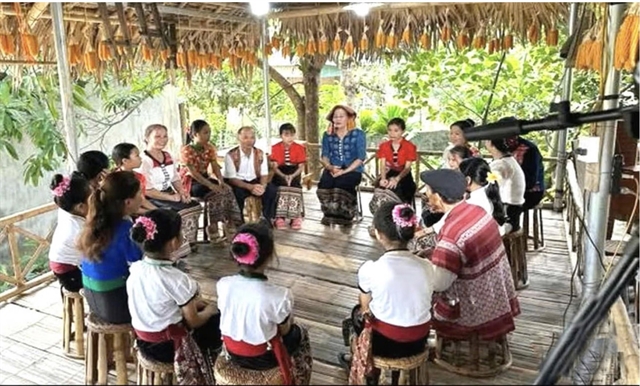 |
| A class of artisan Sầm Thị Xanh in Châu Tiến Commune. — Photo baophapluat.vn |
Sharing the same desire to preserve the customs, culture and script of the Thái people as Bình and Mun, artisan Sầm Thị Xanh in Châu Tiến Commune has chosen a different approach.
In Châu Tiến, she runs free Thái language classes. Her classes are far from quiet. They are filled with singing, the sound of gongs, and the rhythm of footsteps in traditional dances.
Children come to learn how to write the Thái script while also learning lăm and nhuôn – traditional songs – singing, lăm vông dancing and engaging in cultural practices closely tied to community life.
The learning space becomes a form of cultural activity, where the script is nurtured alongside music, dance and laughter.
From these 'classrooms without schools or lecterns', an awareness of preserving ethnic identity is quietly sown among the younger generation.
The Thái script is no longer distant or confined to books. It is gradually reappearing in everyday life, in community activities, traditional festivals, and even in emerging community-based tourism models in the mountainous areas of Nghệ An.
A significant turning point came when the Thái language and script in Nghệ An were inscribed as a National Intangible Cultural Heritage.
Yet for those who have quietly safeguarded the script for years, this is not the final destination but merely the starting point of a longer journey.
The real gateway opens when the Thái script is officially encoded in Unicode – the universal character system used worldwide.
With its inclusion in the latest Unicode version, the Thái script can now be displayed consistently across all platforms – from computers and smartphones to global applications.
After many ups and downs, the Thái script of Nghệ An is steadily experiencing a strong revival in both everyday life and the digital space.
This journey reflects not only the efforts of authorities and researchers but also the perseverance and dedication of individuals who have quietly preserved each character.
For the heritage to endure, the most crucial factor remains the continuation by younger generations—those who will carry forward their cultural story.
As long as the Thái script continues to be read, written and used in daily life, that cultural identity will persist, flowing through generations like an unending stream. — VNS
Society
 Society
 Society
 Society
 Society
 Society
 Society
 Society
 Society
 Society
 Society
 Society
 Society
 Society
 Society