 Society
Vietnamese Prime Minister meets Cambodian National Assembly President
1.
.jpg) |
| The deformed aluminium canteen with number 170071 was left on the battlefield after martyr Tuyến died. — Photo courtesy of Vietnam Wartime Accounting Initiative |
Khánh Dương
HÀ NỘI — At dawn on May 26, 1972, hundreds of Vietnamese soldiers were killed in a fierce clash at the foot of Câu Nhi Bridge in central Quảng Trị Province.
Among them was Trần Minh Tuyến, a 20-year-old medic who died while carrying out a rescue mission.
For more than five decades, his family in northern Thái Bình Province searched tirelessly for his remains, travelling across cemeteries in central Việt Nam.
Yet all efforts proved futile and hope gradually faded, especially as Tuyến had fallen alongside many other unidentified soldiers.
A breakthrough finally came in April 2025.
During a recovery mission in Câu Nhi, Team 584 for the recovery of fallen soldiers’ remains in Quảng Trị Province discovered human remains alongside a deformed aluminium canteen.
Engraved on its surface of the canteen were the name 'Tuyến' and a faint number '170071'.
However, the clue was not definitive, as two soldiers bearing the same name had died in the battle.
As the identification process reached a dead end, a crucial source of information emerged: 'wartime artefact records' returned in July 2025 by the Vietnam Center and Sam Johnson Vietnam Archive (VNCA) and the Institute for Peace and Conflict (IPAC) at Texas Tech University.
Among them was a notebook belonging to political officer Lê Thanh Hải, who had taken part in the battle more than 50 years earlier.
The notebook was more than a personal record. It was a living archive of history, containing lists of soldiers, combat maps and meeting minutes.
Within it, the name Trần Minh Tuyến appeared clearly, along with the military ID number 170071, matching the number engraved on the canteen.
Authorities then joined forces, including the liaison board of Pioneer Army Division 308, the 'Soldiers’ Heart' organisation, the Quảng Trị Provincial Department of Home Affairs and the National Archives Centre No 3 to carefully cross check and verify every detail.
Forensic experts later restored the faded number on the canteen, confirming it as “170071”.
On January 5, 2026, Division 308 officially confirmed that the remains belonged to martyr Trần Minh Tuyến from Thái Bình Province.
After more than half a century, the young soldier was finally called by his rightful name.
Trần Văn Tâm, Tuyến’s younger brother, told Việt Nam News: “It is likely that when he fell, my brother held the canteen with his name and military code pressed against his body. One side was shattered by bullets, but the name and number were preserved.
“Many other items were found with him, including gas masks, medicines and personal belongings. Some medicine vials had not decomposed and the tablets inside remained intact."
Tâm said he became convinced the remains were his brother’s upon seeing a small plastic bag among the recovered items.
“Inside was a decayed piece of paper with a drawing of a flower and the words ‘Happy New Year’. I believe it was drawn by my brother,” he said.
“Although he joined the army when I was just two years old, I remember him through my mother’s stories and the drawings he left on the mud walls at home. He loved drawing, was very talented and actively involved in youth activities.
“Before my mother passed away, she had one final wish: to find my older brother – if not his remains, then at least his name and identity.
“This brings a sense of fulfilment for my mother. Our family is overwhelmed. Many people say we are fortunate to have found him among hundreds who fell on that battlefield.”
In late March 2026, Tuyến was finally brought home by his family, comrades and local residents - a delayed but complete return, where the fallen soldier could rest in his homeland with his name and memory restored.
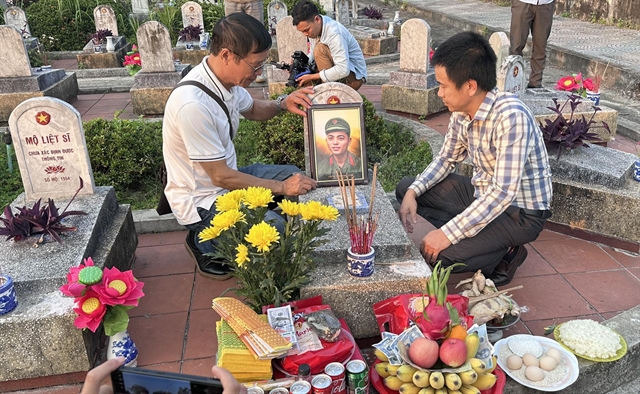 |
| Remains of martyr Trần Minh Tuyến were finally brought home. — Photo courtesy of Vietnam Wartime Accounting Initiative |
Humanitarian effort
Martyr Tuyến’s story illustrates how wartime artefacts can revive memories and help families repatriate the remains of their loved ones.
The case highlights the power of coordination among the military, archival institutions, local authorities, veterans and international partners, particularly through the Vietnam Wartime Accounting Initiative.
Tuyến’s family is among around 40 families who have received wartime artefact records over the past three years under the humanitarian initiative funded by the US Government.
The project is led by the VNCA and IPAC at Texas Tech University, which research archival materials to assist in the search for missing persons.
According to Vietnamese writer Đặng Vương Hưng, a project coordinator, during the war, US forces documented materials collected from battlefields using cameras and microfilm. These included letters, notebooks, diaries and handwritten documents belonged to Vietnamese soldiers, as well as Party records, commendation papers and photographs.
These materials were initially used for intelligence purposes during the wartime. Many were recovered from bodies shortly after battles. They often included details on when and where items were found, including coordinates, he said.
Today, with the help of modern technology, these archives are being revived, becoming a valuable source of information for Vietnamese families searching for missing relatives.
Hưng said handwritten letters, diaries and notebooks also reveal personal stories, serve as references to families and reflect the thoughts and emotions of soldiers before they fell.
“They are not only physical wartime artefacts, they bring back memory and intangible traces,” he said.
Dr Alex-Thái Đình Võ, research director of the Vietnam Wartime Accounting Initiative, told Việt Nam News: “As one of the project’s founders and also a Vietnamese, with a father who was a former Sài Gòn army officer, my strongest feeling is not simply a sense of ‘success’, but a deep happiness when a person, after many years of being forgotten in war, is finally called again by name and reunited with their family.
“Each file, each recovered artefact is not just data, but a human life.
“I believe that these persistent efforts - restoring names and reconnecting memories - are practical and necessary steps toward healing, gradually addressing the lingering consequences of war.”
Speaking about the way forward, he said what matters is not only sharing data, but jointly building a process of connection and practice: from historical research and record comparison to field verification and engagement with communities.
“Our project is only a beginning - a foundation of data and knowledge," Võ said.
"To move toward actual search and identification, broader and deeper coordination is required among relevant authorities, researchers and the Vietnamese people themselves.
“When we work together with compassion and responsibility, ‘bringing them home’ will no longer be just a hope, but will increasingly become a reality.” — VNS
Society
 Society
 Society
 Society
 Society
 Society
 Society
 Society
 Society
 Society
 Society
 Society
 Society
 Society
 Society