 Society
Sơn La holds second coffee festival, targeting stronger businesses in future
1.
|
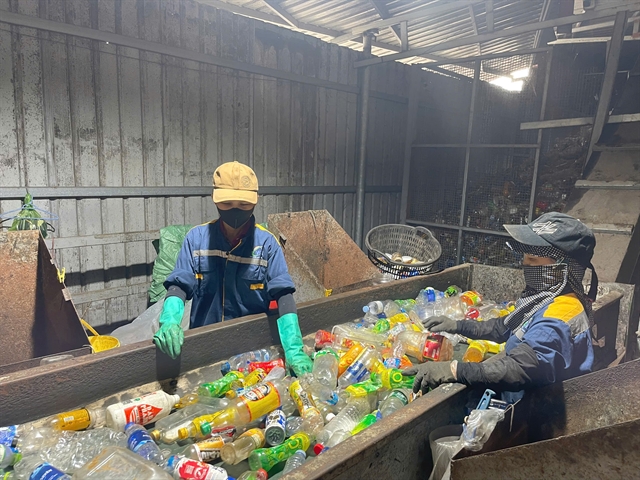
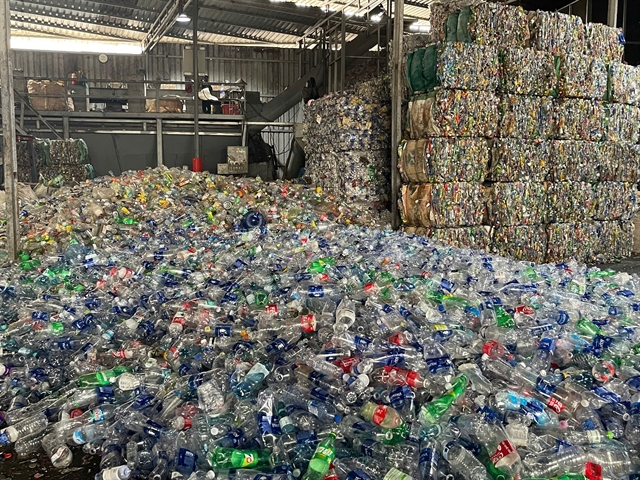
| Workers operate a plastic bottle recycle chain in Bắc Ninh Province. — VNS Photo Thu Trang |
BẮC NINH — Collaboration between the public and private sectors is driving tangible progress towards plastic circularity in Việt Nam, through improved waste management practices, behaviour change, and the scaling up of innovative solutions.
These priorities were underscored during a UNDP regional field visit.
The visit showcased on-the-ground results under the Plastics Circularity Project, funded by The Coca-Cola Foundation (TCCF), which bridges plastic waste management from policy to practice.
The project focuses on four main components: Piloting innovative waste collection and recycling models; Strengthening capacity for communities and informal waste workers; Promoting responsible consumption and production; and Generating evidence to inform national policy through the National Plastic Action Partnership (NPAP).
“Tackling plastic waste and advancing a circular economy requires strong collaboration across the entire plastic value chain, especially with the private sector partners,” UNDP Deputy Resident Representative Francesca Nardini emphasised.
“Through our support, UNDP is not only working with innovators, but also actively engaging businesses as key partners in scaling solutions. By bringing together stakeholders across the plastic value chain, we are helping turn promising ideas into sustainable, market-driven models that can deliver long-term impact in Việt Nam”.
With the support of TCCF, UNDP in Việt Nam is working with multiple local stakeholders to help advance sustainable waste management and to directly improve the livelihoods of waste workers through a unique ‘waste to shore’ project in fishing communities. This initiative provides the training, access to income opportunities, and essential support services, for a more inclusive recycling system in Việt Nam.”
Waste management in HCM City, Hải Phòng and Quảng Ninh remains a challenge, but new models offer viable solutions, and the project aims to support them.
One of the highlights of the project is the implementation of the Responsible Sourcing Initiative (RSI) in northern Việt Nam. Implemented in partnership with Vikohasan, a large PET bottle recycler in the region, the pilot will focus on a complex value chain involving dozens of large aggregators, suppliers, and approximately 12,000 informal waste workers (IWWs).
The initiative aims to improve livelihoods while strengthening the systems.
Until early next year, 5,500 IWWs in Hà Nội, Bắc Ninh, and Nghệ An are expected to benefit from training, personal protective equipment (PPE), and formalising business protocols. This initiative is expected to help collect and process an estimated 20,000 tonnes of plastic waste more responsibly.
At the same time, through NPAP chaired by the Ministry of Agriculture and Environment, the Plastics Innovation Programme is helping new ideas grow and scale.
To date, US$240,000 has been mobilised to support 11 innovative solutions, including $140,000 provided by TCCF and UNDP co-financing. Beyond funding, the programme connects investors and experts, helping build a robust ecosystem for circularity in Việt Nam.
Together, these emerging models are delivering hands-on solutions, building local capacity, and generating practical lessons to support the implementation of national regulations.
This is particularly timely as Việt Nam advances updates to the 2020 Law on Environmental Protection, providing local authorities with tested approaches to translate policy into effective action on the ground.
Plastics Circularity Project
|
| Plastic bottles are collected for recycling in Bắc Ninh Province. — VNS Photo Thu Trang |
The Management of Plastic Waste and Circular Interventions on Plastics in South, Southeast Asia and the Pacific is a three-year multi-country initiative supported by TCCF.
It aims to strengthen plastic waste management systems and make the sector more inclusive and sustainable across ten countries: Bangladesh, Bhutan, Cambodia, India, Indonesia, Maldives, Nepal, Philippines, Sri Lanka, and Việt Nam.
In Việt Nam, the project advances marine and land-based plastic waste management solutions. Under the NPAP platform, the initiative pilots a waste-return system at three fishing ports and implements waste sorting regulations, promotes and strengthens stakeholder collaboration and knowledge exchange.
The project aims to collect 7,000 metric tonnes of plastic waste, implement nation-wide awareness campaigns, and improve the livelihoods of more than 3,200 waste workers. — VNS
Society
 Society
 Society
 Society
 Society
 Society
 Society
 Society
 Society
 Society
 Society
 Society
 Society
 Society
 Society