 Society
Vietnamese Prime Minister meets Cambodian National Assembly President
1.
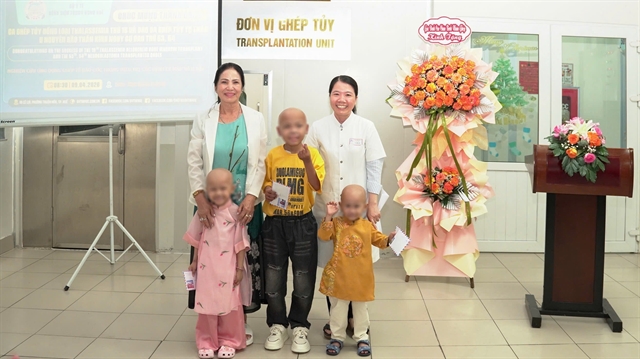 |
| The three patients are in good condition and have been released from the hospital after undergoing stem cell transplant procedures. — VNA/VNS Photo |
HUẾ CITY — Huế Central Hospital has conducted three successful bone marrow transplants for three paediatric patients.
One case involved a thalassaemia patient with bone marrow taken from his biological brother, while the other two cases involved autologous bone marrow transplants to treat neuroblastoma.
This is the hospital's 16th case of thalassaemia in a child, while the two autologous bone marrow transplants for neuroblastoma are the hospital's 54th and 55th procedures.
Nguyễn Trần Phúc V., 11, from Vĩnh Long Province, was diagnosed with Beta-Thalassaemia — a genetic anaemia in which the body does not produce as much beta globin as normal — when he was just four years old.
Since then, he had to receive blood transfusions every three to four weeks and received iron chelation therapy.
At Huế Central Hospital, he was advised to get a bone marrow transplant.
After HLA blood testing to detect leukocyte antigens, the child was found to be a match with his biological brother. The hospital held a consultation and developed a stem cell transplant plan for the child.
Meanwhile, the other two paediatric patients underwent autologous stem cell transplants to treat high-risk neuroblastoma.
One of the patients, four-year-old Nguyen Minh H. from HCM City, was diagnosed with high-risk neuroblastoma in 2025 after being hospitalised with fever and leg pain, rendering him unable to walk.
He was recommended for autologous stem cell transplantation after undergoing chemotherapy. However, stem cell collection was not satisfactory, so he was transferred to Huế Central Hospital.
The hospital held a consultation, adjusted his stem cell collection plan, obtained the necessary quantity of cells and successfully performed the transplant.
Another patient, three-year-old Đinh Hoàng Bảo A. from Lâm Đồng Province, was hospitalised with a large tumour in his belly and diagnosed with high-risk neuroblastoma.
After treatment in several hospitals, she was transferred to Huế Central Hospital for an autologous stem cell transplant and has now recovered well and is in stable health.
Hospital director and professor Dr Phạm Như Hiệp said that haematopoietic stem cell transplantation is a radical treatment for children with blood transfusion-dependent thalassaemia. It also contributes to prolonging the lives of children with solid tumours, such as in high-risk neuroblastoma.
Since 2019, the hospital has carried out stem cell transplants in children with solid tumours from high-risk neuroblastoma, metastatic retinoblastoma and recurrent lymphoma, followed by allogeneic stem cell transplantation for thalassaemia, Hiệp said.
For this group of patients, the hospital performed its first incompatible blood group transplantation using a desensitisation technique that is new to Việt Nam.
The hospital has performed stem cell transplants for thalassaemia treatment since September 2024, becoming the first hospital in the central and Central Highlands regions and the second hospital in the country to master the technique.
Thus far, the hospital has carried out 71 stem cell transplants in children, of which 16 cases were allogeneic transplants for paediatric thalassaemia patients conducted within just one and a half years – the highest number achieved nationwide in a single year.
Due to an increasing demand for bone marrow transplants, the hospital has put two new transplant rooms into operation, allowing for the simultaneous execution of multiple transplant cases for paediatric patients.
In the near future, the hospital will routinely perform semi-matched transplants for children with thalassaemia who do not have complete HLA compatibility with their siblings and parents, the director said.
Thalassaemia is a common inherited haematological disease. In Việt Nam, about 2,000-2,500 children are diagnosed with the severe form each year.
Patients require long-term treatment with blood transfusions and iron chelation therapy, and face numerous complications affecting the heart, liver, kidneys, endocrine system, bones and overall development.
Access to haematopoietic stem cell transplantation opens up opportunities to escape dependence on blood transfusions and lead a normal life for patients. — VNS
Society
 Society
 Society
 Society
 Society
 Society
 Society
 Society
 Society
 Society
 Society
 Society
 Society
 Society
 Society