 Society

Kellogg-HKUST EMBA Ranked No. 1 in the World in the Financial Times Executive MBA Ranking 2026
1.
|
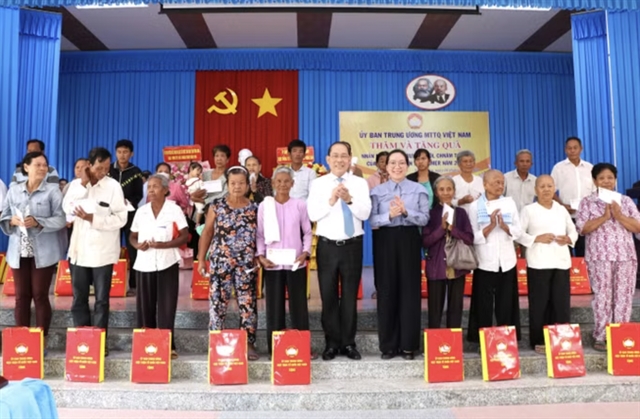
| Families receiving government assistance and disadvantaged Khmer households in Vĩnh Long Province receive gifts on the occasion of their traditional New Year. — VNA/VNS Photo |
VĨNH LONG — As the 2026 Chol Chnam Thmay festival approaches, Khmer communities in the Mekong Delta province of Vĩnh Long are welcoming their traditional New Year with growing prosperity and renewed optimism, thanks to improved livelihoods and sustained support from local authorities.
Across Khmer hamlets, the festive season is marked by a sense of abundance and cultural vibrancy. Effective production models, access to preferential credit, and practical support policies have helped raise incomes and living standards, making this year’s celebrations warmer and more fulfilling.
In recent years, alongside socio-economic development, Vĩnh Long has consistently implemented policies to support ethnic minorities, particularly the Khmer community. Programmes promoting production, vocational training, and concessional loans have been carried out concertedly, enabling many households to expand livelihoods, reduce poverty, and stabilise their lives.
A notable example is the family of Thạch Vi La in Song Lộc Commune, one of the Khmer ethnic households with stable livelihoods in the locality. Starting 15 years ago with just 8,000sq.m of farmland, the family faced initial hardship due to small-scale production. With access to preferential loans from the Vietnam Bank for Social Policies, they invested in expanding farming activities, applying technical advances to cultivation, and developing livestock farming, thus gradually increasing incomes and improving their living conditions.
Today, the family cultivates 3ha of rice, earning over VNĐ300 million (nearly US$11,400) annually. Their herd of nearly 30 breeding cattle generates an additional VNĐ200 million per year while coconut cultivation, including makapuno coconut, brings in about VNĐ50 million.
Vi La has also trained as a veterinary service provider, earning extra daily income. Besides, by-products such as organic fertiliser further supplement his household revenue.
“This year’s harvest is good, so we can celebrate the new year more fully,” he said, expressing hopes for favourable weather and continued progress in the year ahead.
Thanks to the effective implementation of national target programmes, particularly the one on new-style rural area development and sustainable poverty reduction, along with policies supporting production, preferential credit, and the transfer of sci-tech advances, Song Lộc Commune has seen significant improvements in living standards. By the end of 2025, average per capita income reached over VNĐ78.6 million per year while the household poverty rate fell sharply to just 0.56 per cent.
Tô Thị Thu Hương, Secretary of the commune's Party Committee and Chairwoman of the Song Lộc People's Council, said local authorities have tailored support to specific household groups while encouraging residents to adopt new farming methods, restructure crops and livestock, and apply scientific advances to improve productivity and value.
At the same time, the commune has facilitated effective economic models such as organic coconut cultivation, makapuno coconut farming, and breeding cattle. VietGAP-standard production models linked to market-oriented value chains have also been expanded, contributing to higher agricultural value and better incomes for local residents.
Chol Chnam Thmay will take place from April 14 to 16 this year. It is a time for communities to honour ancestors, express gratitude, and pray for favourable weather and abundant harvests.
To ensure joyful and inclusive celebrations, local authorities have organised a range of activities. A gathering of around 800 Khmer representatives, including officials, religious dignitaries, and community figures, has been held. Delegations have been dispatched to extend greetings and present gifts to local religious establishments, organisations, and outstanding individuals.
Vĩnh Long has allocated support for 156 Khmer Theravada Buddhist pagodas and 180 exemplary Khmer households and policy beneficiaries. Educational and cultural institutions serving Khmer people have also received assistance. In addition, nearly 5,000 gift packages funded through the “Fund for the Poor” and private sources have been distributed to disadvantaged households.
Beyond material support, authorities have supported cultural, sports, and community activities that reflect Khmer traditions while organising free medical examinations and treatment for locals.
Secretary of the provincial Party Committee Trần Văn Lâu said Vĩnh Long, home to a population of nearly 3.4 million of which over 10 per cent are Khmer people, will continue prioritising policies that have proved effective to improve the material and spiritual life of Khmer communities, especially in remote areas, and preserve their cultural identity. — VNA/VNS
Society
 Society
 Society
 Society
 Society
 Society
 Society
 Society
 Society
 Society
 Society
 Society
 Society
 Society
 Society