 Society
Việt Nam-Cambodia trade gathers pace towards $20 billion target
1.
|
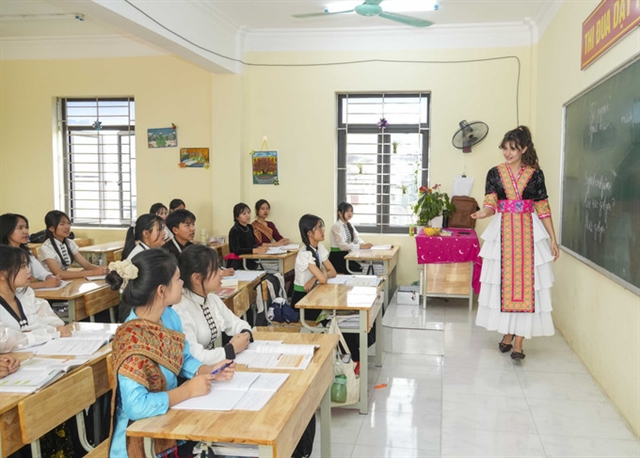
| Teacher Natalia Lisochenko during her Russian language class in Điện Biên Province. — VNA/VNS Photos |
ĐIỆN BIÊN — The mountainous northern province of Điện Biên is implementing a Russian language teaching programme for ethnic students, enabling them to access modern learning environments and integrate into the global community.
As international integration deepens, diversifying foreign languages in schools is a key requirement that opens up development opportunities for younger generations.
The education sector in Điện Biên Province has recently enhanced international cooperation, seeking suitable training models to enhance the quality of foreign language teaching and learning.
Cooperation with Herzen State Pedagogical University of Russia to implement a Russian language programme is a concrete step demonstrating the province’s determination to integrate its education.
Along with language instruction, the programme also aims to help students gain deeper insights into culture, people and international learning environments.
The Điện Biên Boarding High School for Ethnic Students has been selected as a pioneer in implementing the programme.
With two classes comprising 50 grade 10 students, learners are taught directly by native-speaking lecturers, a relatively new experience for students in mountain areas.
Classes are held three times a week. Each session consists of three periods, ensuring continuity and allowing students time to gain familiarity, practise and gradually develop language reflexes.
This is crucial to improving learning outcomes, especially for a language as distinct as Russian.
School vice principal Phạm Thị Thanh Huyền said introducing Russian into the curriculum is a practical step to implement the education sector’s policy on developing a second foreign language in schools. It also concretises cooperation between Điện Biên Province and the city of Saint Petersburg.
She said students have the opportunity to learn a new language in a structured environment, broaden their knowledge, improve communication skills and gradually form an international mindset, laying a foundation for future study and exchange opportunities.
From classroom to integration opportunities
Initial results of the programme are starting to emerge through classroom activities.
From the very first lessons, classes have been lively and open. Modern teaching methods focusing on interaction and combining theory with practice help students easily approach the new language.
From learning the alphabet and pronunciation to basic communication patterns, lessons are delivered flexibly in an engaging manner, creating strong interest among learners.
Lương Đăng Thế Khôi, a student in Class 10A9, said learning directly with native teachers has given him new experiences. The distinctive sounds and pronunciation of Russian have sparked his curiosity and motivation to explore the language further.
“Learning an additional foreign language not only broadens knowledge, but also motivates me to strive for greater opportunities in the future,” he said.
Lò Khánh Chi from Class 10A2 said Russian is useful for study and also helps her better understand the culture, customs and people of Russia.
“Through language learning, I can access a new culture, broaden my perspective and shape my career orientation," she said, expressing her desire to pursue Russian-related fields if given the opportunity.
Lecturers from Herzen State Pedagogical University have guided students throughout the programme.
Through teaching and exchanges, they have spoken highly of the students’ learning spirit as well as the school’s educational environment.
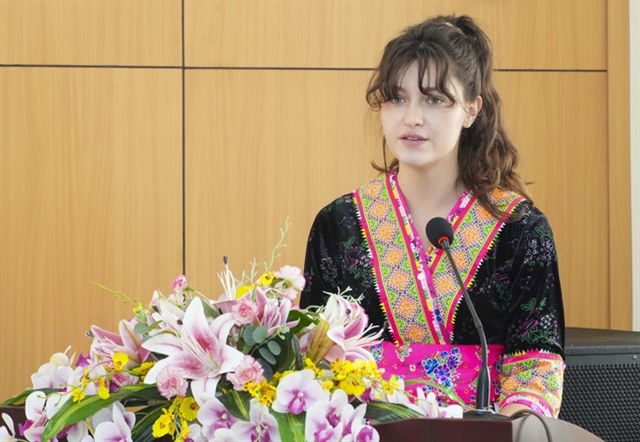
Teacher Natalia Lisochenko said the students impressed her with their friendliness, politeness and serious learning attitude.
They are diligent, proactive and closely connected with one another, creating a positive and motivating learning environment that contributes to better teaching outcomes and stronger teacher-student bonds, she said.
|
| Teacher Natalia Lisochenko. |
Teacher Elizaveta Lapto said what impressed her most was the strong sense of unity within the school.
Despite having taught there for only a short time, she quickly integrated and felt the friendliness and openness of both students and teachers, providing a solid foundation for effective international cooperation.
Cù Huy Hoàn, deputy director of the provincial Department of Education and Training, said organising Russian language classes is not merely a language teaching activity, but also a concrete step toward promoting international integration in education.
Through the programme, students gain access to a modern learning environment, improve language proficiency and develop essential skills to adapt to globalisation.
Following a cooperation agreement between Điện Biên authorities and Saint Petersburg, the department has successfully organised its first Russian language course combined with a summer exchange camp in Russia.
Building on these results, a second course has been launched to further enhance foreign language training quality, he said. — VNS
Society
 Society
 Society
 Society
 Society
 Society
 Society
 Society
 Society
 Society
 Society
 Society
 Society
.jpg) Society
Society
.jpg) Society
Society