 Society
Industry and trade sector puts technology into practice
1.
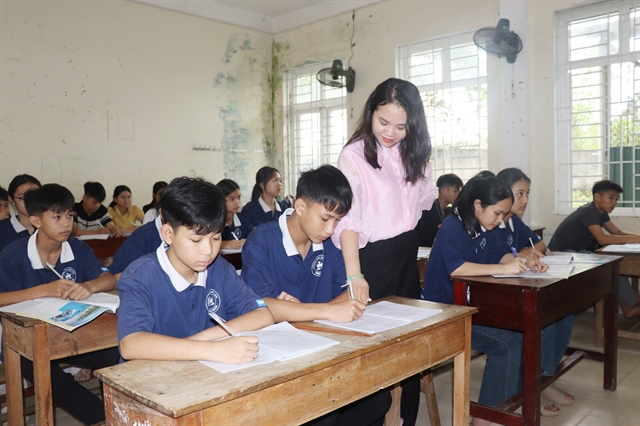 |
| Having completed her secondment period, Nguyễn Thị Cẩm Vân hopes to return to teach closer to home to take better care of her family. — VNA/VNS Photo Hoàng Ngà |
HÀ TĨNH — Nearly 70 teachers in the central province of Hà Tĩnh are unable to return to their former schools after completing their secondment terms, raising concerns among educators and delaying the rotation of teachers to disadvantaged areas.
Located near the Việt Nam–Laos border, the area formerly known as Hương Khê District features complex, rugged terrain and is home to many disadvantaged communities.
To address staffing imbalances in local schools and ensure fairness in education, local authorities introduced regulations on teacher transfers, dividing schools into three zones based on socio-economic conditions.
Under the most recent regulations of the Ministry of Education and Training, teachers from favourable areas (Zone 1) seconded to difficult areas (Zone 3) are required to work there for three to five years for women and five to six years for men. Upon completing this period, they are to be given priority for transfer back to their original institutions.
In practice, however, a significant gap has emerged between policy and implementation.
Originally from Chu Văn An Secondary School in a Zone 1 area, Nguyễn Thị Cẩm Vân has been teaching at Hà Linh Secondary School in Zone 3 since the 2022-23 academic year. She has now completed her secondment period but has still not been reinstated.
Vân travels more than 40km each day to work, she said. During the rainy season, landslides and poor road conditions make commuting extremely challenging. She said she is willing to dedicate herself to disadvantaged areas, but having fulfilled her duties under the regulations, she hopes to return closer to home, settle down and take better care of her family.
In a similar situation, art teacher Trần Thế Vinh was transferred from Phúc Đồng Secondary School to strengthen staffing at Hà Linh Secondary School in 2019.
Though regarded as innovative and credited with revitalising the school’s art education, Vinh said he could not hide his exhaustion after years away from his family. He hoped that authorities would assign him to a more suitable post so he could continue contributing with peace of mind over the long term.
Notably, the teachers still awaiting reassignment are considered core staff who have made significant contributions to education quality in disadvantaged areas.
Nguyễn Đình Anh, vice principal of Hà Linh Secondary School, said the school has four teachers who have already completed their official secondment periods. Although they are waiting to return closer to home, they remain highly active, enthusiastic and responsible in their work. They fulfil their teaching duties, actively participate in school activities and serve as reliable support for students in need, he said.
Awaiting solution
According to local statistics, 68 teachers from Zone 1 have completed their service in Zone 3 but have not yet been able to return to their home institutions.
Phan Quốc Thanh, vice chairman of Phúc Trạch Commune People’s Committee and former head of the Hương Khê District Department of Education and Training, acknowledged the challenges. The department had previously sent multiple written recommendations and proposed plans to reassign teachers from more favourable areas to replace those who had completed their duties, he said.
However, Hà Tĩnh is still undergoing administrative reorganisation and transitioning to a two-tier local government model. Changes in the management structure have delayed administrative procedures related to personnel and staffing as officers await new guidelines.
In response to concerns from the grassroots level, the Hà Tĩnh Province Department of Education and Training has begun reviewing the situation, emphasising that the matter must be handled cautiously and according to a clear roadmap to avoid major disruption to teaching and learning.
Nguyễn Hồng Cường, deputy director of the Hà Tĩnh Department of Education and Training, said teacher reallocation must be carefully considered and implemented on an appropriate schedule to balance the need to maintain sufficient teaching staff in disadvantaged areas and the legitimate wishes of teachers who have completed their obligations.
For the time being, the department has asked local authorities to encourage these teachers to remain at their current schools until the end of the 2025-26 academic year to avoid disruptions to teaching activities. Immediate transfers mid-year, he said, would create multiple complications, particularly imbalances in the number of teaching staff in favourable and disadvantaged areas.
Under the plan, after completing its review and gathering information, the Hà Tĩnh Department of Education and Training is expected to work with schools and local authorities where the 68 teachers currently work to verify data and assess actual staffing needs. Based on this assessment, the department will advise the provincial People’s Committee on an appropriate solution that ensures normal teaching activities and the legitimate rights of teachers. — VNS
Society
 Society
 Society
 Society
 Society
 Society
 Society
 Society
 Society
 Society
 Society
 Society
 Society
 Society
 Society