 Society
Viettel’s Unitel in Laos a symbol of Việt Nam-Laos friendship: Prime Minister
1.
|
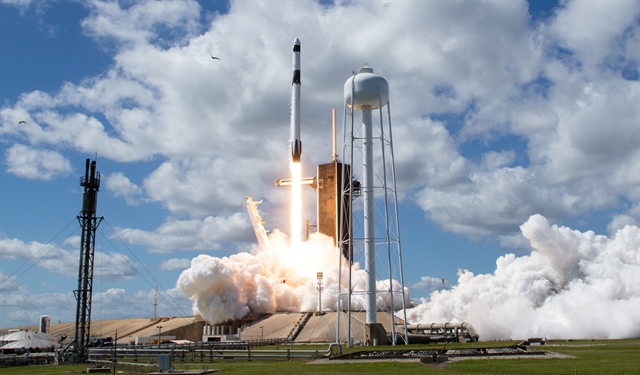
| SpaceX's Falcon 9 rocket lifts off from the Kennedy Space Center in Florida, USA. — XINHUA/VNA Photo |
HÀ NỘI — SpaceX’s Starlink Services Vietnam has received a licence from the Việt Nam Telecommunications Authority (VNTA) to deploy a pilot low-Earth-orbit (LEO) satellite telecommunications service in the country, marking Việt Nam's first trial of large-scale satellite Internet connectivity.
Speaking at the Ministry of Science and Technology’s regular press briefing on Wednesday, VNTA Deputy Director Nguyễn Anh Cường said the pilot period will last for five years and must conclude before 2031. The trial reflects a cautious regulatory approach aimed at evaluating the impact of emerging satellite technology on Việt Nam's national telecommunications infrastructure.
To safeguard market stability, the Government has capped the service at a maximum of 600,000 subscribers. The ceiling is based on both the technical capacity of the satellite system and regulatory management considerations.
As part of its deployment plan, Starlink will build four gateway stations in Phú Thọ, Đà Nẵng, and HCM City, to ensure stable connectivity while complying with Việt Nam's cybersecurity requirements.
Pricing has emerged as a key public concern. The satellite Internet service is expected to cost individual users $435 in the first month, including US$350 for equipment and an $85 subscription fee. From the second month onward, the monthly charge will remain at approximately $85.
Total first-year expenses are estimated at around $1,370, equivalent to roughly VNĐ34–35 million. Annual costs from the second year are projected at about $1,020, making the service five to ten times more expensive than fibre-optic Internet packages, which typically range from VNĐ200,000–400,000 per month, and significantly higher than mobile 4G/5G services.
Cường emphasised that Starlink was licensed under a strictly controlled pilot framework in terms of both scope and scale. It must comply fully with Việt Nam's regulations on pricing and fair competition, similar to other telecommunications providers.
Authorities will closely monitor operations to make appropriate policy adjustments, maintain market balance, and prevent disruptions to the existing telecom ecosystem, he added.
Despite higher costs compared to conventional services, satellite Internet offers distinct advantages, notably its independence from terrestrial fibre-optic infrastructure. Users only need receiving equipment to access the service, making it particularly suitable for mountainous areas, sparsely populated regions, and remote offshore islands where fibre deployment is challenging or costly.
The service could also function as a backup connectivity solution for businesses, especially in cases of disruptions to international undersea fibre-optic cables that occasionally affect Internet speeds in Việt Nam.
According to Cường, given Việt Nam's already well-developed fixed broadband infrastructure, Starlink is unlikely to compete directly with existing providers. Instead, it is expected to complement current networks by expanding coverage to underserved areas and strengthening overall connectivity resilience.
If equipment importation and installation proceed smoothly, Vietnamese users may begin accessing Starlink satellite Internet services from mid-2026. — VNA/VNS
Society
 Society
 Society
 Society
 Society
 Society
 Society
 Society
 Society
 Society
 Society
 Society
 Society
 Society
 Society