 Society

Businesses struggle to retain talent in the age of AI
1.

|
| An elderly resident receives a health check-up at home at Hiệp Bình Ward, HCM City. — VNA/VNS Photo Đinh Hằng |
HÀ NỘI — As urban life accelerates, caring for elderly family members with multiple chronic conditions is becoming an increasing burden for many households. Medically standardised home care services are rapidly expanding to fill this gap, meeting urgent needs while opening a billion-dollar segment within Việt Nam’s growing silver economy.
For Nguyễn Thu Trang, who lives in HCM City’s Bàn Cờ Ward, daily life once felt overwhelming. Her 82-year-old father suffered a stroke and lost the ability to care for himself. From eating and personal hygiene to basic movements, everything required assistance, turning the family’s routine upside down.
“Sending him to a nursing home felt too harsh, but hiring an untrained caregiver was risky. At one point, he developed bedsores because we didn’t know how to care for him properly. I felt helpless,” she said.
Trang said caring for an elderly parent is not just physically demanding but also psychologically exhausting. Balancing work with the role of an accidental nurse, without medical knowledge, placed immense pressure on her.
Her situation began to improve after she was introduced to a professional home care service. Trained caregivers started visiting daily, assisting with hygiene, tube feeding and rehabilitation exercises.
“Since receiving professional support, my father has gradually regained some movement. Most importantly, he can stay at home with the family,” she said.
Rising demand in an ageing society
Trang’s story is increasingly common in urban Việt Nam, where elderly parents require care while their children juggle demanding jobs. Most older people still rely heavily on family members for daily activities and strongly prefer ageing in place rather than moving to institutional care facilities.
However, rapid urbanisation and changing lifestyles are weakening traditional multi-generational family structures, reducing the availability of in-home caregivers. At the same time, work pressures leave families with less time to provide adequate care.
According to the United Nations Population Fund, Việt Nam officially entered the ageing phase in 2011. While France took 115 years and Sweden 85 years to transition into an aged society, Việt Nam is expected to complete this shift in just 25 years, reaching that milestone by 2036.
This rapid demographic transition is driving the emergence of the silver economy, which extends beyond traditional healthcare services to encompass a broad ecosystem of elderly-focused solutions, with specialised geriatric care at its core.
The market potential is significant. A joint report by the Vietnam Chamber of Commerce and Industry (VCCI) in HCM City and UNFPA projects that by 2035, Việt Nam will have around 20 million potential customers for elderly care services. This shift is expected to attract substantial investment and reshape the health care services landscape.
Businesses move to capture the opportunity
In the past, families in need of caregivers often relied on informal intermediaries at hospitals. While convenient, this approach carried risks, including untrained caregivers, inconsistent service quality and potential safety concerns for patients.
Meanwhile, nursing homes, though better equipped, remain costly and are often viewed as a last resort due to cultural and emotional considerations. The gap between these two models has created fertile ground for home-based care services.
According to the Vietnam Elderly Care Market Report 2023, the country’s elderly care market was valued at approximately US$2.21 billion in 2023 and is projected to reach nearly $4.8 billion by 2031, growing at an average annual rate of 7.7 per cent.
Recognising this trend, healthcare technology companies are emerging as key players, bringing hospital-level care standards into private homes.
|
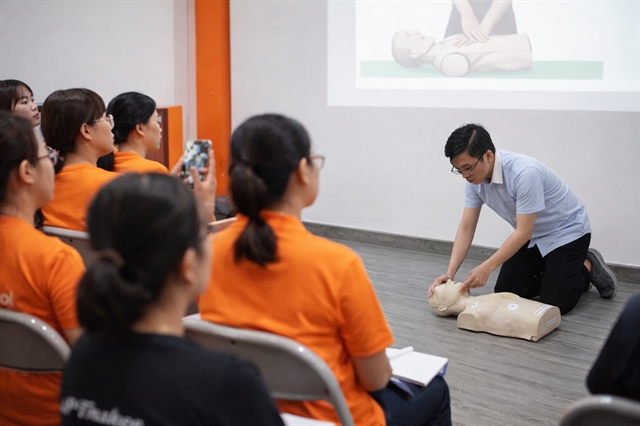
| A training course for medically standardised home elderly care staff at bTaskee Co, Ltd. Photo courtesy of bTaskee |
One example is bTaskee, which recently partnered with the Centre for Training Healthcare Human Resources on Demand under the University of Medicine and Pharmacy in HCM City to develop professional home care services under its bCare brand.
Đỗ Đắc Nhân Tâm, CEO of bTaskee, said the nature of home healthcare requires not only solid medical knowledge but also responsibility and compassion.
“Our partnership aims to standardise services so families can feel confident entrusting their loved ones. At the same time, all trainees who complete the programme are guaranteed job opportunities with stable incomes,” he said.
Other companies are also adapting. WeCare 247 currently manages a workforce of around 1,800 to 1,900 caregivers. It has integrated its services into the operations of more than 34 major hospitals nationwide, including Chợ Rẫy Hospital and Nhân Dân 115 Hospital. This allows for a continuous care model that extends from hospital to home.
International-standard models are also gaining traction. Bluecare applies sterilisation and care protocols based on Dutch standards, while eDoctor has partnered with Việt Nam-Australia Family Health Services to implement a closed-loop one doctor–one nurse care model.
Large corporations are entering the space as well. NovaGroup has partnered with the University of Medicine and Pharmacy Hospital in HCM City to develop a network of high-quality general clinics, completing the health care component of its all-in-one ecosystem.
What these models share is a focus on standardisation from recruitment and training to care protocols and professional accountability. This shift is gradually transforming a job once seen as informal domestic work into a semi-medical profession with recognised skills, certification and clearer social standing. — VNS
Society
 Society
 Society
 Society
 Society
 Society
 Society
 Society
 Society
 Society
 Society
 Society
 Society
 Society
 Society