 Society
University of Economics HCM City hosts international student research conference
1.
|
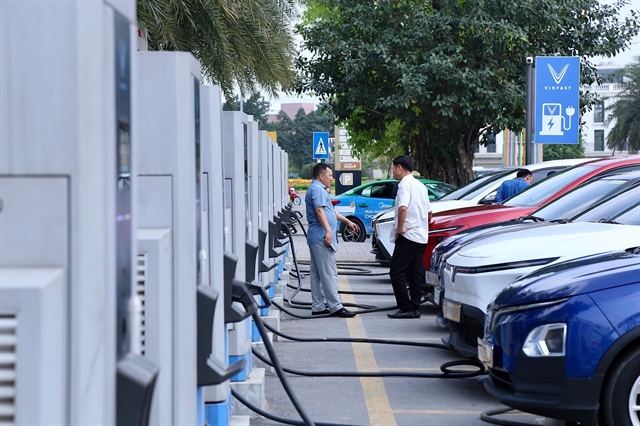
| A charging station in western Hà Nội, March 31. — VNA/VNS Photo |
HÀ NỘI — Prime Minister Phạm Minh Chính has directed ministries and local authorities to develop national standards for electric vehicle (EV) charging stations in apartment buildings, as Việt Nam steps up efforts to expand green transport.
The move, outlined in Official Dispatch 27, comes as officials acknowledge that infrastructure in major cities is struggling to keep up.
In many apartment complexes, charging stations, parking arrangements and battery-swapping facilities remain limited or poorly coordinated, placing strain on internal power systems and raising concerns about fire safety.
To close those gaps, the Ministry of Construction has been tasked with updating urban planning rules to better integrate EV infrastructure, including charging networks and battery-swapping systems.
The revised framework is set to be finalised by the second quarter of 2026.
The construction ministry will also review and amend national technical standards for apartment buildings to provide clearer guidance the design and installation of charging stations.
That work is due to be completed by the end of March, alongside efforts to ease procedures for building and upgrading charging infrastructure to existing buildings – an issue that has slowed rollout in older developments.
Meanwhile, the Ministry of Industry and Trade will take the lead in setting safety and energy efficiency standards for charging equipment, charging stations and related power supply systems, with a target deadline in the third quarter of 2026.
The ministry is also urged to step up public outreach to encourage a shift to electric and other clean-fuel vehicles, while promoting the use of public transport.
The directive is meant to address growing concerns that EV adoption could outpace the systems needed to support it. Gaps in planning, particularly around parking, have contributed to uneven deployment of charging stations and added pressure on building infrastructure.
The State utility group Vietnam Electricity (EVN) has been asked to adjust its demand management programmes to accommodate new charging stations in residential areas.
EVN will also work to simplify grid connection procedures and support the installation of separate electricity meters for charging stations, aimed at making usage and billing more transparent.
Local authorities have been instructed to review urban plans and ensure space is set aside for EV infrastructure in new developments.
At the same time, developers and building management boards are expected to work with service providers to install charging stations safely and guide residents on how to use them.
The government also called for close oversight as the rollout gathers pace, warning against loopholes that could lead to corruption, waste or vested interests.
The directive builds on earlier efforts to promote cleaner transport and cut emissions in the sector. Officials are expected to review progress under existing programmes and propose targeted changes to help speed up the transition. — VNS
Society
 Society
 Society
 Society
 Society
 Society
 Society
 Society
 Society
 Society
 Society
 Society
 Society
 Society
 Society