 Society
University of Economics HCM City hosts international student research conference
1.
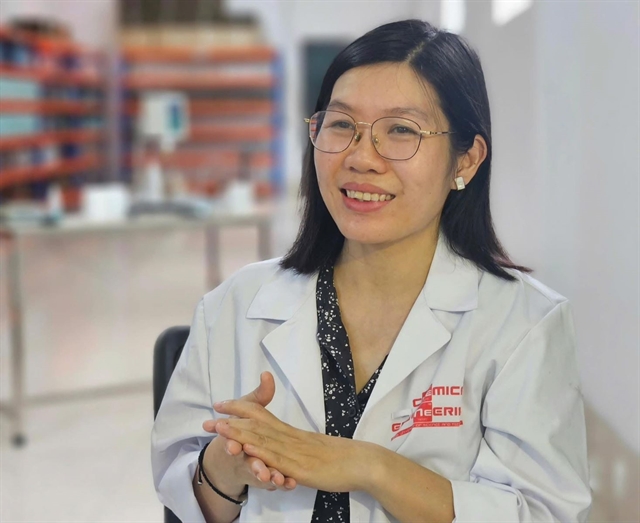 |
| Vũ Thị Tần, lecturer at Hanoi University of Science and Technology’s Chemical Engineering Faculty, has been honoured at the Asia Innovation Award 2025. — VNA/VNS Photo |
HÀ NỘI — For Vũ Thị Tần, a researcher at Hanoi University of Science and Technology, scientific work must go beyond academic publications to deliver practical solutions for everyday life.
Guided by that principle, the 40-year-old scientist has persistently pursued the transformation of knowledge into real-world products. Her dishwasher tablet, born from a common household need, is one such outcome, requiring rigorous standards in materials science, safety and adaptability to local conditions.
With this innovation, Tần, a lecturer at the university’s Chemical Engineering Faculty, was named among two honourees from her institution at the Asia Innovation Award 2025, recognising research and technological solutions with strong applicability and contributions to sustainable development.
Science rooted in everyday needs
The idea for a Vietnamese-made dishwasher tablet stemmed from a simple personal experience. While using a dishwasher at home, Tần noticed that all accompanying products had to be imported at relatively high cost, with few comparable domestic alternatives.
A question emerged: why does such an everyday product still depend on foreign markets?
For her, this was not just a technical challenge but also a matter of technological self-reliance in areas closely tied to daily life. Developing a dishwasher tablet requires balancing multiple factors, from dissolution rate and compound stability to cleaning performance under real usage conditions.
After numerous trials, her product, T-Clean Eco, was finalised with around 70 per cent natural ingredients, including coconut, corn and palm derivatives. It incorporates biological enzymes and nano-silver to enhance antibacterial and deodorising properties, making it suitable for Việt Nam’s hot and humid climate.
The product also aims to reduce harmful chemicals, limit plastic waste, and optimise costs for domestic consumers.
“For me, research doesn’t have to start with grand problems. It can begin with very specific needs,” she said.
“The value of science lies not in where it is published, but in how far it can go in real life.”
Choosing to return and contribute
Having spent years studying and conducting research in Russia and Spain, Tần was trained in highly competitive scientific environments where innovation and applicability are paramount.
She graduated with distinction from Tula State University and later earned her PhD in Spain. Her academic journey shaped a clear direction: research must address tangible, real-world challenges.
“The more I studied and experimented, the more I was drawn to one question: can I create a new material to solve a specific problem?” she said.
After completing her doctorate, she joined ArcelorMittal, beating thousands of candidates to secure a position and later becoming a research team leader. There, she worked on materials and surface treatment technologies, contributing to 17 patents.
In 2017, Tần decided to return to Việt Nam.
This was not a change in direction, but a deliberate choice to apply her knowledge where it could have more direct impact.
“I wanted what I create to solve problems closer to everyday life at home,” she said.
Back at Hanoi University of Science and Technology, she continues to focus on applied materials research, tackling issues such as waste oil treatment and water purification. These challenges are closely linked to the environment and daily living.
According to Tần, one of the biggest challenges has been balancing research with family responsibilities. Taking on multiple roles, especially while raising young children, makes maintaining a consistent research pace difficult.
To adapt, she adopts a disciplined approach to work, setting clear priorities at each stage and building a strong value system to guide her decisions.
In a context where science is increasingly intertwined with interdisciplinary issues such as the environment, consumption and sustainable development, diverse perspectives are becoming ever more essential, including the experiences and approaches of women.
However, for women to advance further in science and take on leadership roles, coordinated improvements are needed across education, policy and workplace environments.
According to Dr Vũ Thị Tần, the decisive factor ultimately lies with each individual: the courage to make a choice and the perseverance to pursue it.
She also believes women possess unique strengths in science, including meticulousness, attention to detail and strong collaborative skills. These qualities are particularly important in precision-driven fields like materials science.
Ultimately, she said, the deciding factor remains individual determination – the courage to choose a path and the perseverance to follow it through. — VNS
Society
 Society
 Society
 Society
 Society
 Society
 Society
 Society
 Society
 Society
 Society
 Society
 Society
 Society
 Society