 Society

Top leader’s visit to open new chapter in Việt Nam–Denmark relations
1.
|
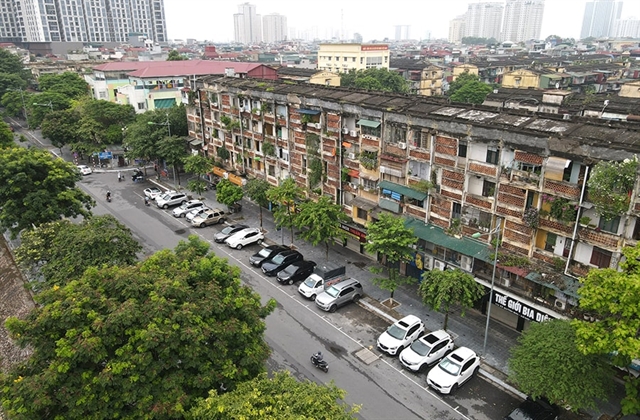
| The Quỳnh Mai residential complex in Hà Nội's Bạch Mai Ward is in serious disrepair and will be renovated this year. Photo hanoimoi.vn |
HÀ NỘI — Due to slow progress in renovating Hà Nội's many old apartment buildings, city authorities have issued a plan to inspect and evaluate the buildings for either rehabilitation or demolition.
Municipal data shows that Hà Nội has more than 2,100 old apartment buildings in need of reassessment and renovation. The buildings are mainly located in the former inner-city districts of Hai Bà Trưng, Đống Đa, Ba Đình and Thanh Xuân.
In the Kim Liên area of the city's former Đống Đa District, 222 old buildings need renovating. But as of earlier this year, just 19 renovation projects — or 1.2 per cent — have been carried out, showing that there remains a lot of work to do.
At the beginning of this year, the Hà Nội People's Committee issued Plan 354/KH-UBND on the inspection and assessment of old apartment buildings in the city to determine the level of danger and classify buildings into those requiring demolition or those not requiring demolition, according to the 2023 Housing Law and current technical standards and regulations.
The plan applies to 48 communes and wards that are home to old apartment buildings. The Department of Construction has been assigned to lead relevant departments and agencies in implementing the plan, including defining boundaries and ownership rights as well as outlining plans for renovation projects.
According to the Department of Construction, the comprehensive assessment of old buildings is crucial.
Assessment results serve not only as a legal basis for determining the level of danger of the structure but also as a foundation for developing renovation plans, ensuring the safety of residents and preventing risks and natural disasters.
This is a mandatory step to accelerate the renovation process in the future.
Alongside the inspection process, the Department of Construction and the Department of Planning and Architecture are jointly compiling a list of areas requiring renovation, which will be submitted to the city's People's Council for consideration and public announcement to attract investors.
The roadmap clearly states that this year, the legal framework will be finalised, the list of projects will be developed and announced, and investors will be selected for some projects. Focus will be placed on implementation of the projects from 2027 to 2030.
The city aims to complete the renovation of dangerous grade-D apartment buildings by 2030. Grade D involves extensive structural damage, risk of collapse, and the immediate relocation of all residents.
Under the plan, by 2035, renovation of all old apartment buildings in the city will be essentially completed.
Hà Nội authorities have decided not to continue fragmented renovations, but to link them to comprehensive urban reconstruction.
Nguyễn Bá Nguyên, deputy director of the Hà Nội Department of Planning and Architecture, told hanoimoi.vn that the city aims to combine the renovation of old apartment buildings with the upgrading and reconstruction of old urban areas, creating new residential areas with integrated technical and social infrastructure and helping improve the quality of life for residents.
Architect Trần Huy Ánh, a member of the Hà Nội Architects’ Association, said that conducting a comprehensive reassessment of old apartment buildings in the city is an ongoing and essential task to ensure a safe living environment for residents.
“For many years, some projects have been delayed due to a lack of a unified assessment of the level of danger and unclear identification of buildings subject to mandatory demolition,” Ánh said.
“Transparent and objective assessment results will create social consensus and provide the government with a solid legal basis to implement the next steps,” the architect added.
New mechanisms
One reason progress in renovating old apartment buildings has not met expectations over the years is bottlenecks in the planning and investment processes.
A representative from the Department of Construction acknowledged that previously, detailed planning was usually carried out by State agencies, but many plans were impractical and lacked the means to attract investors, leading to prolonged implementation processes.
The promulgation of Resolution 258/2025/QH15 by the National Assembly on piloting a number of specific mechanisms and policies for implementing large and important projects in the capital city is considered a major turning point.
According to the Department of Construction, these mechanisms will contribute to lifting hurdles that have existed for many years, creating motivation to accelerate the renovation of old apartment buildings in the coming months.
Vice Chairman of the Hà Nội Real Estate Club Nguyễn Thế Điệp said that allowing reasonable adjustments to planning indicators is a practical solution.
“To attract businesses in renovating old apartment buildings, a feasible financial calculation must be created,” Điệp said.
“When land use coefficients and building heights are adjusted to appropriate levels and linked to the need for additional infrastructure, businesses will have more room to balance their interests, while residents will enjoy a better living space,” he added.
However, he also noted that planning adjustment needs to be tightly supervised, making sure not to increase the infrastructure overload in the inner-city areas.
"Renovating old apartment buildings is not just about building new houses but also an opportunity for urban redevelopment, rearranging spaces, adding schools, parking lots, green spaces and public facilities. If done well, this will be a major boost to the capital's modernisation process," he said.
With a new legal framework and decisive leadership from the city, 2026 could be a pivotal year for transitioning from preparation to actual implementation.
Completing project evaluations, publishing a project list and selecting investors for several key projects will likely create a ripple effect, strengthening the confidence of citizens and businesses. VNS
Society
 Society
 Society
 Society
 Society
 Society
 Society
 Society
 Society
 Society
 Society
 Society
 Society
 Society
 Society